

A transformer installed in a remote area can be difficult to supervise. There may be no security personnel nearby, and routine inspections only provide a snapshot of the equipment’s condition.
A transformer anti-theft monitoring system addresses this gap by monitoring selected physical and electrical conditions around the transformer and reporting abnormal events to a remote operator.
Depending on the system design, this may include vibration, tilt, cable interruption, power loss, enclosure opening, or other signs of physical interference.
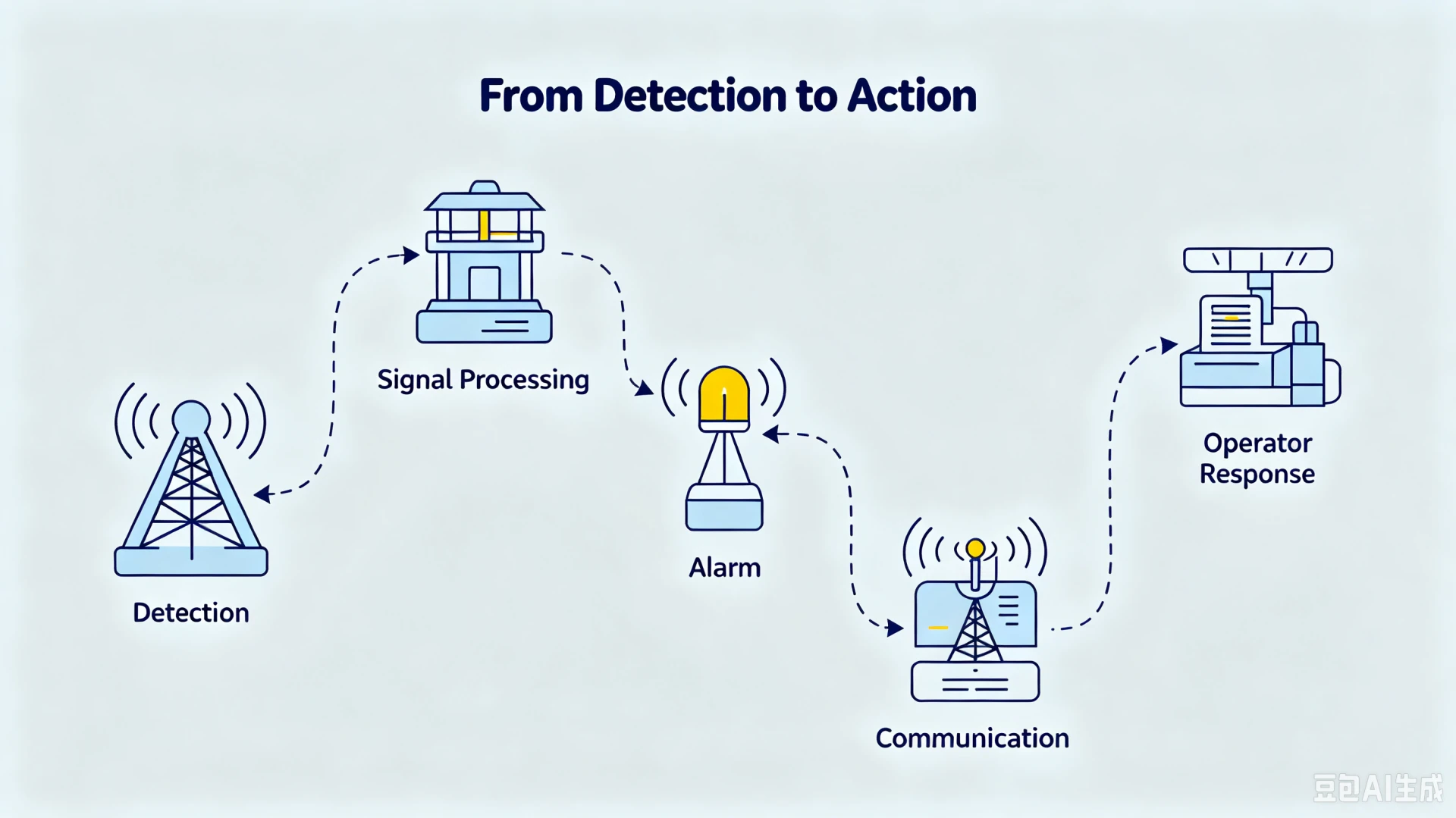
The basic process is:
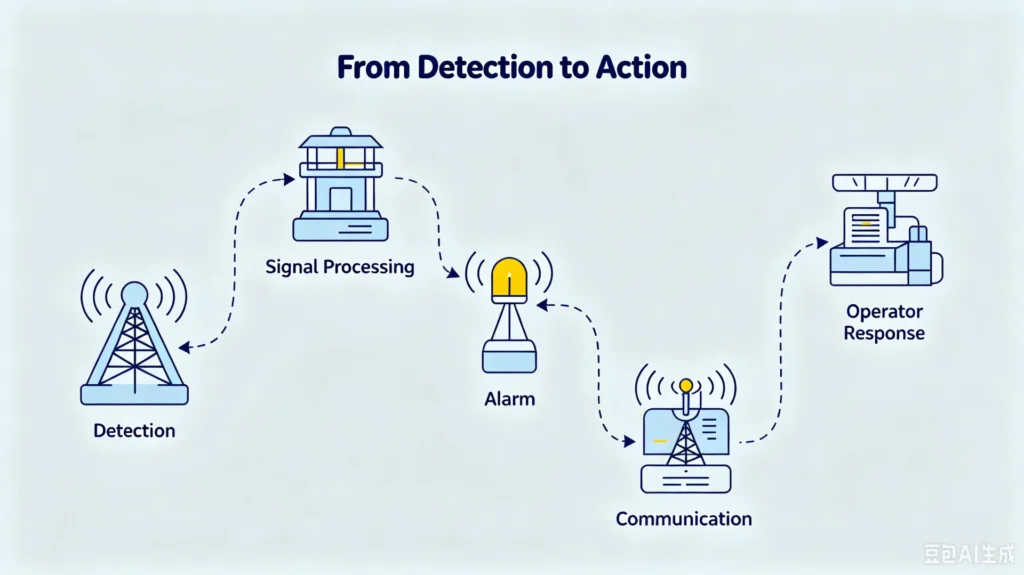
The purpose is not to identify a thief directly. Instead, the system looks for conditions that are unusual enough to require attention.
This distinction matters in real installations. A vibration alarm, for example, could be caused by nearby construction or a vehicle rather than an attempted theft. The monitoring system provides the information; the operator or field team determines what actually happened.
For utilities, EPC contractors, and electrical engineers, understanding this distinction is important when selecting sensors, configuring alarm thresholds, and designing a monitoring system for remote distribution transformers.
What Is a Transformer Anti-Theft Monitoring System?
A transformer anti-theft monitoring system combines sensors, a monitoring controller, communication equipment, and alarm functions to supervise a transformer installation.
The exact configuration varies from project to project. A simple system may monitor only movement and power status, while a more comprehensive installation may include vibration, tilt, cable monitoring, tamper detection, GPS, battery monitoring, and remote communication.
What Does a Transformer Anti-Theft Monitoring System Do?
Depending on its configuration, the system can:
- Detect unusual vibration or mechanical impact
- Identify changes in transformer position or tilt
- Monitor selected cable circuits for interruption
- Detect unexpected power loss or phase loss
- Detect opening of protected enclosures
- Activate a local siren or warning light
- Send alarm information to remote personnel
- Record events for later investigation
These functions are particularly useful where transformers are unattended for long periods.
Where Are Transformer Anti-Theft Monitoring Systems Used?
Typical applications include:
- Rural distribution transformers
- Agricultural and irrigation transformers
- Pole-mounted transformers
- Remote substations
- Mining and oilfield installations
- Construction sites
- Industrial distribution systems
- Solar and renewable energy facilities
The common factor is not the type of transformer itself. It is the difficulty of providing continuous supervision at the site.
How Does a Transformer Anti-Theft Monitoring System Work?
The monitoring process is relatively straightforward, but the quality of the result depends heavily on sensor selection and alarm configuration.
A typical installation can be viewed as:
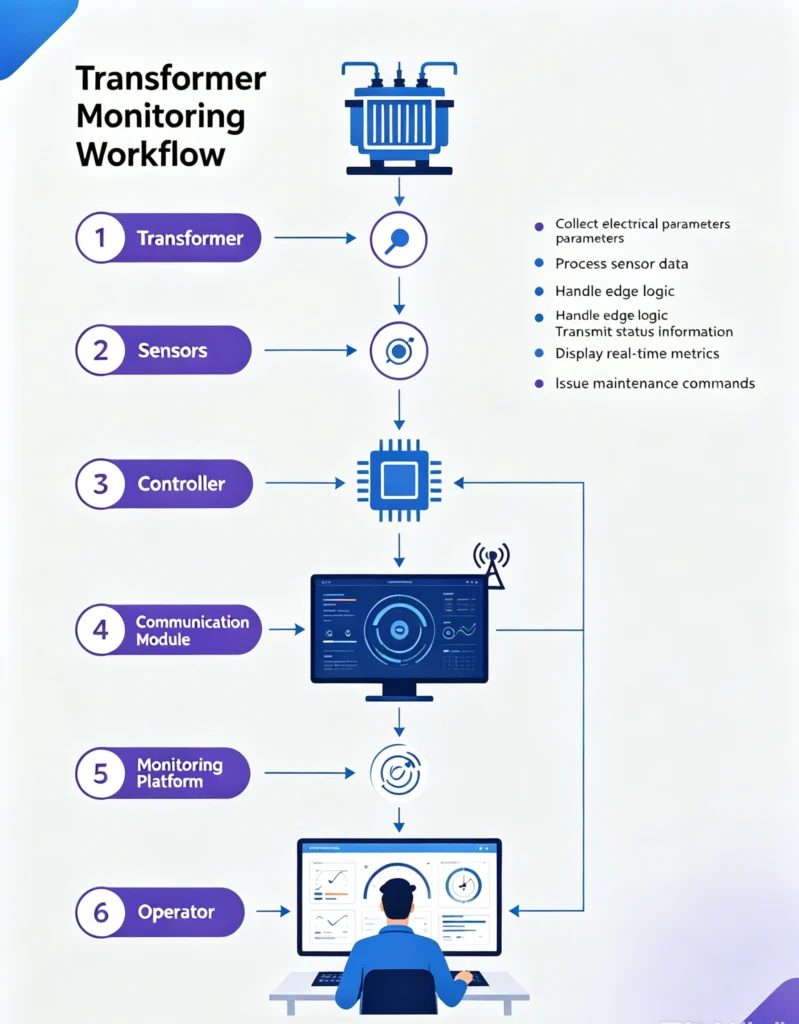
Each part has a different job.
Step 1 — Sensors Monitor the Transformer
Sensors are installed according to the risks identified at the site.
A vibration sensor may be used where physical impact or forced access is a concern. A tilt sensor can monitor movement of the transformer or supporting structure. Cable monitoring can identify an interruption in a monitored circuit, while tamper switches can protect doors and access panels.
Electrical monitoring may also be added to identify unexpected power loss or phase loss.
The sensors do not all need to operate in the same way. Some provide a simple switch signal, while others continuously measure a physical parameter.
Step 2 — The Controller Evaluates the Signals
The monitoring controller receives the signals from the connected sensors.
Its job is more than simply forwarding every sensor change to the operator. The controller can apply configured thresholds, delays, alarm conditions, and, on some systems, combinations of events.
For example, a short vibration may not be treated in the same way as continuous vibration accompanied by a change in transformer position.
This type of logic is useful because remote transformer sites often have environmental disturbances that cannot be completely avoided.
Step 3 — An Alarm Is Generated
When a configured alarm condition is reached, the controller can activate one or more outputs.
Depending on the installation, these may include:
- Audible siren
- Warning light
- Relay output
- SMS notification
- Cloud platform alarm
- SCADA or other monitoring-system event
A local alarm can draw attention to the transformer, but its value depends on whether anyone is nearby.
For a transformer several kilometers from the nearest maintenance team, remote notification is usually much more important than the siren itself.
Step 4 — The Alarm Is Transmitted Remotely
The communication module connects the transformer site with the remote monitoring system.
Depending on local infrastructure, this may use GSM, 4G, NB-IoT, or another available communication method.
A typical communication path is:
Transformer Site → Cellular Network → Monitoring Platform / SMS → Operator
The amount of information transmitted depends on the monitoring device. Some systems send a basic alarm message, while others can transmit event details, device status, battery information, signal strength, and location.
Step 5 — The Operator Checks the Event
Once an alarm arrives, the operator can review the event and decide what to do next.
For example, the operator may check:
- Which transformer generated the alarm
- What type of event occurred
- When it occurred
- Whether maintenance was scheduled
- Whether the feeder is experiencing an outage
- Whether other sensors reported abnormal conditions
If the event cannot be explained by normal operation or scheduled work, a field inspection can be arranged.
This final verification step is important. A monitoring system should support the operator’s decision-making rather than assume that every sensor trigger represents a confirmed theft.
What Does a Transformer Anti-Theft Monitoring System Detect?
The detection functions depend on the sensors installed at the site.
Transformer Vibration
Vibration sensors can identify unusual mechanical activity around the transformer or its supporting structure.
Impact, drilling, cutting, or forced access may produce vibration that differs from the normal background condition.
However, vibration is not unique to theft. Heavy vehicles, construction equipment, strong wind, and other nearby activities can also produce mechanical disturbances.
For this reason, transformer vibration monitoring works best when the sensor sensitivity is adjusted to the actual installation environment.
Transformer Tilt and Movement
A tilt sensor monitors changes in physical orientation.
If a transformer is being lifted, dragged, or displaced, the angle may change beyond the normal range.
This makes transformer tilt detection particularly useful for exposed installations where physical removal is a realistic risk.
Tilt detection is also useful as a second source of information. A change in tilt combined with power loss or vibration can provide more useful information than a tilt event considered on its own.
Cable Cutting Detection
Cable monitoring can be used to supervise the continuity of selected incoming or outgoing circuits.
If the monitored circuit is interrupted, the controller can generate an alarm.
This approach is useful where cable cutting or deliberate disconnection is a known security concern.
The monitoring method should be matched to the actual cable arrangement. A continuity circuit does not automatically identify every possible type of cable damage.
Power Loss and Phase Loss
Electrical monitoring can identify unexpected changes in supply conditions.
A sudden loss of voltage may be caused by deliberate disconnection, but it can also result from:
- Feeder faults
- Fuse operation
- Planned maintenance
- Upstream switching
- Utility outages
For that reason, power loss should generally be treated as an event that needs interpretation rather than proof of theft.
For example:
Power loss alone → possible electrical fault
Power loss + vibration → physical disturbance should be investigated
Power loss + vibration + tilt → higher-priority security event
The actual alarm logic depends on the equipment and project requirements.
Tamper and Enclosure Detection
Tamper sensors protect physical access points.
Magnetic contacts, micro-switches, or similar devices can be installed on:
- Control cabinets
- Transformer enclosures
- Security cages
- Access doors
- Inspection panels
When the protected point changes state, the monitoring controller can generate an alarm.
This is a relatively simple detection method, but it can be useful when unauthorized access to a protected enclosure is one of the main risks.
Main Components of a Transformer Anti-Theft Monitoring System
A complete installation normally contains several different components.
| Component | Main Function |
|---|---|
| Vibration sensor | Detect unusual mechanical activity |
| Tilt sensor | Detect movement or change in orientation |
| Cable monitoring module | Detect interruption of a monitored cable circuit |
| Power monitoring module | Monitor voltage, phase status, or power loss |
| Tamper sensor | Detect opening of protected access points |
| Monitoring controller | Collect and evaluate sensor signals |
| Local alarm | Provide audible or visual warning |
| Communication module | Send events to remote personnel |
| Monitoring platform | Display status and alarm information |
| Backup battery | Keep selected monitoring functions operating during power loss |
Not every project requires every component.
A rural transformer with a high theft risk may require several detection methods, while a transformer inside a secured substation may need much less.
How Does Remote Transformer Theft Monitoring Work?
Remote communication is particularly important for unattended transformers.
A local siren can be useful, but if there is nobody within hearing distance, it does not solve the main problem: the utility still does not know that something has happened.
GSM-Based Transformer Monitoring
GSM can be used for relatively simple remote alarm applications where suitable network service is available.
For systems that mainly need SMS notifications and limited data transmission, a basic cellular connection may be sufficient.
4G Transformer Monitoring
4G Cat.1 is useful where the monitoring system requires IP connectivity or communication with a cloud platform.
It also provides more room for transmitting status information and event data than a simple SMS-only arrangement.
NB-IoT Transformer Monitoring
NB-IoT is designed for low-power IoT applications with relatively small data volumes.
It can be considered for battery-powered transformer monitoring where suitable NB-IoT coverage is available.
However, the choice should not be based on communication technology alone. Battery life also depends on reporting frequency, signal quality, temperature, sensor consumption, and alarm activity.
| Communication | Typical Strength | Considerations |
|---|---|---|
| GSM | Simple alarm communication | Depends on local network availability |
| 4G Cat.1 | IP connectivity and higher data capacity | Useful for cloud-connected systems |
| NB-IoT | Low-power communication | Coverage and operator support must be checked |
For a project deployment, communication performance should be tested at the actual transformer location.
What Happens When a Transformer Theft Attempt Is Detected?
The response depends on which sensor has been triggered.
Example 1 — Transformer Movement
A transformer begins to move from its normal position.
The tilt sensor detects a change beyond its configured limit and sends the signal to the controller. If the alarm condition is met, the controller activates the configured alarm output and sends the event remotely.
The operator can then check whether maintenance work or another known activity is taking place.
Example 2 — Cable Interruption
A monitored cable circuit is interrupted.
The cable monitoring module changes state, and the controller records the event. A local alarm may be activated and a remote notification sent.
If the transformer also reports power loss, the operator has another piece of information to consider when assessing the incident.
Example 3 — Unexpected Power Loss
The transformer suddenly loses its supply.
The monitoring device detects the electrical event. If backup power is available, the monitoring equipment can continue operating and report the event.
The operator then checks whether the loss is caused by a wider grid fault or whether other security-related events occurred at the same time.
This type of event correlation is one of the more useful features of a modern monitoring system.
Transformer Anti-Theft Monitoring System vs. Traditional Security
Physical security and electronic monitoring are not competing solutions.
They address different parts of the problem.
| Method | Detects Events | Remote Notification | Main Role |
|---|---|---|---|
| Fence | No | No | Restrict access |
| Lock | No | No | Restrict access |
| Anti-theft hardware | No | No | Delay unauthorized removal |
| Local siren | Limited | No | Draw local attention |
| CCTV | Yes | Possible | Visual verification |
| Anti-theft monitoring system | Yes | Yes | Detect and report abnormal events |
A security cage may make a transformer harder to access. A monitoring system can indicate that somebody is attempting to interfere with it.
For higher-risk locations, using both approaches is often more practical than relying on either one by itself.
Why Use a Transformer Anti-Theft Monitoring System for Remote Transformers?
The Transformer May Be Unattended
The biggest advantage is simple: the system can monitor the site when nobody is there.
This is particularly relevant for rural distribution networks, agricultural sites, and remote substations.
Inspections Cannot Cover Every Event
Regular inspections remain necessary for maintenance, but they cannot show what happened between two visits.
Remote alarms provide another source of information between inspection cycles.
Operators Can Prioritize Field Visits
Instead of treating every transformer as equally urgent, maintenance teams can use alarm information to identify sites that need attention.
This can be especially useful when a utility manages a large number of distributed transformers.
Electrical and Physical Events Can Be Viewed Together
A power outage by itself may not say much about the cause.
A power outage accompanied by transformer movement or cable interruption provides more information.
This is one reason multi-sensor monitoring can be more useful than a single alarm input.
Transformer Anti-Theft Monitoring for Different Applications
Rural Distribution Networks
Rural transformers may be spread over a large area and have limited supervision.
A combination of movement detection, power monitoring, and remote alarm transmission can provide useful coverage.
Agricultural and Irrigation Transformers
Transformers serving irrigation systems are often installed in open areas.
Tamper detection and power monitoring can be useful, especially where the site remains unattended outside the irrigation season.
Pole-Mounted Transformers
Pole-mounted equipment may be physically accessible from the ground or through climbing.
Tilt and vibration detection can be considered where unauthorized access or removal is a concern.
Mining and Oilfield Sites
These environments can combine remote locations with dust, temperature extremes, vibration, and other harsh conditions.
Equipment selection should therefore consider environmental protection as well as theft detection.
Construction Sites
Temporary transformer installations may be exposed to unauthorized access and equipment movement.
Monitoring requirements may change as the construction site develops, so installation and relocation should be considered during project planning.
Remote Substations
An unattended substation may contain several transformers and other valuable electrical equipment.
Centralized monitoring can make it easier for operators to manage alarms from multiple assets.
Solar and Renewable Energy Facilities
Large solar installations may contain transformers distributed across a wide area.
Remote monitoring can provide a way to supervise multiple transformer locations without requiring personnel to remain at each site.
How to Choose a Transformer Anti-Theft Monitoring System
The right system is determined by the site rather than by the number of sensors listed in a product brochure.
Start With the Theft Risk
Identify the most realistic threats.
For example:
- Cable cutting
- Transformer movement
- Enclosure tampering
- Unauthorized access
- Deliberate power disconnection
This gives the project team a starting point for sensor selection.
Check the Transformer Installation
The mounting arrangement matters.
A pole-mounted transformer, ground-mounted transformer, and transformer inside a secured substation do not present the same detection requirements.
Check Communication Coverage
Verify the available cellular network at the actual installation point.
Do not assume that regional coverage automatically means reliable communication at the transformer.
Consider Backup Power
If the monitoring system needs to continue operating after transformer power is lost, an appropriate backup power source is required.
Battery requirements should be calculated from the actual device’s consumption and expected operating conditions.
Review Alarm Configuration
Ask how the system handles:
- Thresholds
- Time delays
- Multiple sensor inputs
- Alarm priorities
- False alarms
- Remote acknowledgement
Good alarm logic can be more important than simply adding more sensors.
Check Environmental Protection
Outdoor equipment may be exposed to:
- Rain
- Dust
- Humidity
- UV radiation
- Temperature changes
- Corrosion
- Mechanical impact
The enclosure and sensor specifications should be checked against the conditions at the actual site.
Consider Integration
For larger projects, determine whether the system can exchange information with existing SCADA, distribution management, or other monitoring platforms.
The goal is to fit the security monitoring system into the utility’s existing operating process rather than create another isolated alarm source.
Transformer Anti-Theft Monitoring System Installation
Installation should be planned around the transformer and its vulnerable points.
Sensor Installation
Mount each sensor where it can provide a useful indication of the condition being monitored.
Vibration sensors need stable mechanical coupling. Tilt sensors need to be installed in a position where the transformer’s movement can be represented accurately.
Cable monitoring and tamper switches should be installed according to the physical arrangement of the equipment.
Controller Installation
The controller should be placed in a protected location with suitable environmental protection.
Sensor wiring, power connections, and communication connections should be checked before commissioning.
Communication Configuration
For cellular systems, configure the SIM card, APN, network parameters, and alarm recipients as required.
Check the actual signal level and communication stability at the transformer site.
Alarm Configuration
Configure vibration, tilt, power, cable, and tamper conditions according to the installation.
Avoid copying identical thresholds to every site if the surrounding environments are significantly different.
Functional Testing
Each alarm input should be tested separately.
For example:
- Test the vibration input
- Test the tilt input
- Test cable interruption detection
- Test power-loss detection
- Open the protected enclosure
- Test the local alarm
- Test remote SMS or platform notification
The purpose is to verify the complete chain from sensor to operator.
Commissioning
Record the final sensor locations, alarm settings, communication parameters, and response procedure.
This documentation makes later troubleshooting and maintenance much easier.
Installation and commissioning should follow the equipment manufacturer’s instructions and the electrical safety requirements applicable to the site.
Transformer Anti-Theft Monitoring System Maintenance
Remote monitoring equipment still requires periodic checks.
Check the Sensors
Confirm that the sensors remain securely installed and are responding correctly.
Check Communication
Verify that the monitoring device remains connected and that alarms are reaching the intended destination.
Check the Backup Battery
For battery-powered equipment, monitor battery condition and follow the manufacturer’s replacement recommendations.
Test the Alarms
Local and remote alarms should be tested periodically rather than waiting for an actual theft event.
Review Alarm History
Repeated alarms from the same transformer may indicate an unsuitable threshold, environmental interference, or another issue that needs attention.
Inspect the Enclosure
Look for:
- Water ingress
- Corrosion
- Loose connections
- Damaged cables
- Physical damage
- Deteriorated seals
Maintenance intervals should be determined by the equipment, environment, and utility’s maintenance procedures.
Transformer Anti-Theft Monitoring System Checklist
Before putting a system into service, confirm:
- Theft risks have been assessed
- Transformer installation has been reviewed
- Required sensors have been selected
- Vibration detection has been configured where required
- Tilt detection has been configured where required
- Cable monitoring has been checked
- Power-loss monitoring has been configured
- Tamper points have been identified
- Communication coverage has been tested
- Backup power requirements have been assessed
- Local alarms have been tested
- Remote alarms have been tested
- Alarm thresholds have been documented
- False-alarm conditions have been considered
- Maintenance procedures have been defined
- Operator response procedures have been established
Frequently Asked Questions
What is a transformer anti-theft monitoring system?
It is a combination of sensors, a controller, communication equipment, and alarm functions used to monitor transformers for abnormal physical or electrical conditions that may be associated with tampering or theft.
How does a transformer anti-theft monitoring system work?
Sensors monitor selected conditions such as vibration, tilt, cable continuity, power status, or enclosure access. The controller evaluates these signals and generates an alarm when the configured conditions are met.
The event can then be sent to operators through SMS, a cloud platform, or another communication system.
What can a transformer anti-theft monitoring system detect?
Depending on the configuration, it can detect:
- Vibration or mechanical impact
- Transformer movement or tilt
- Cable interruption
- Power loss or phase loss
- Enclosure opening
- Other configured tamper conditions
What sensors are used for transformer theft detection?
Common options include vibration sensors, tilt sensors, cable monitoring circuits, power monitoring modules, and tamper switches.
The final combination should be based on the transformer installation and expected theft method.
Can a transformer anti-theft monitoring system detect cable cutting?
It can detect interruption of a monitored cable circuit when the system is designed for that purpose.
The actual detection capability depends on the monitoring circuit and cable arrangement.
Can transformer theft be monitored remotely?
Yes.
A cellular or other communication link can transmit alarm information from the transformer site to a remote operator or monitoring platform.
Can the system work after transformer power is lost?
A system equipped with suitable backup power can continue selected monitoring functions after an external power loss.
The required battery capacity depends on the monitoring device, communication method, reporting frequency, and expected outage conditions.
Is GSM, 4G, or NB-IoT better for transformer monitoring?
It depends on the project.
GSM may be adequate for basic alarm communication. 4G Cat.1 is useful for IP-connected and cloud-based systems, while NB-IoT can be considered for low-power applications where suitable coverage is available.
Network availability at the actual installation site should be checked before making the final selection.
Can the system integrate with SCADA?
Some systems support integration with SCADA or other monitoring platforms.
The available interface and protocol depend on the equipment, so this should be confirmed during project specification.
Can these systems be installed on existing transformers?
In many cases, yes.
Retrofit installation is possible when suitable mounting locations, power connections, and monitored circuits are available.
The installation method should be checked for each transformer type.
How long does a transformer anti-theft monitoring system operate on battery?
There is no universal battery-life figure.
Operating time depends on battery capacity, sensor consumption, communication frequency, signal quality, temperature, and alarm activity.
If a project requires several years of unattended operation, battery performance should be evaluated using the actual operating conditions rather than relying on a generic figure.
Conclusion
A transformer anti-theft monitoring system is essentially a way of adding remote visibility to a transformer that cannot be watched continuously.
Sensors provide information about physical and electrical changes. The controller evaluates those signals and applies the configured alarm logic. Local outputs can warn people near the site, while GSM, 4G, NB-IoT, or other communication methods can send the event to personnel elsewhere.
The complete process can be summarized as:
Sensors → Controller → Alarm Logic → Local Alarm → Communication → Remote Monitoring → Field Verification
The system does not replace physical security, routine maintenance, or operator judgement.
A security cage can make unauthorized access more difficult. A monitoring system can indicate when something unusual is happening. A remote platform can make that information available to the people responsible for the transformer.
For remote and unattended distribution transformers, combining these functions can significantly improve visibility between physical inspections.
The most suitable configuration depends on the actual transformer installation, theft risk, communication coverage, available power, environmental conditions, and response procedure.
For utilities, EPC contractors, and transformer operators looking to add remote security monitoring to existing or new installations, the next step is to define the detection points first and then select the sensors, communication method, and alarm architecture around those requirements.
For an integrated solution, see our Transformer Anti-Theft Monitoring Device product page.
[…] How Does Transformer Anti-Theft Monitoring Work in Rural Networks? […]