

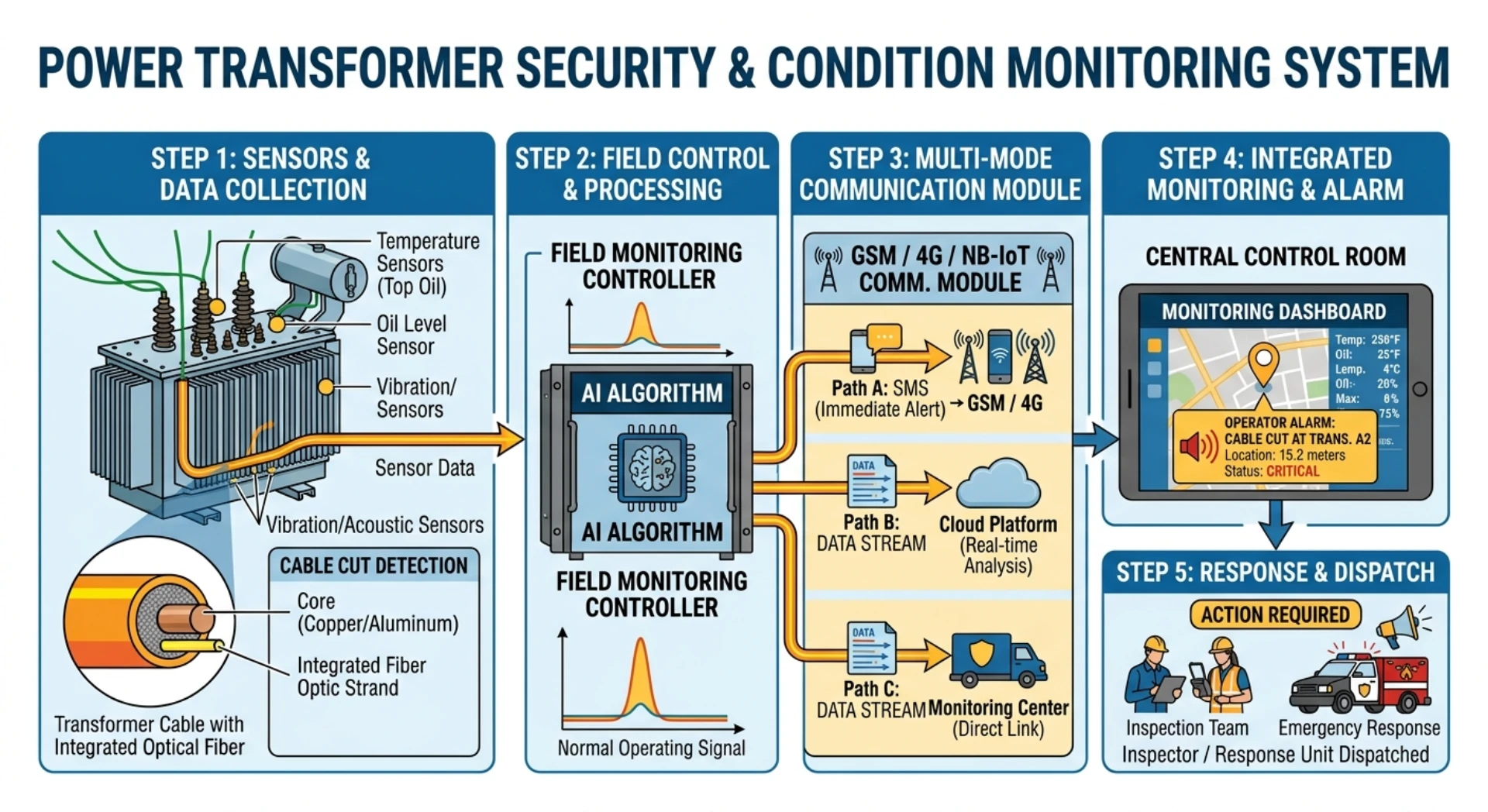
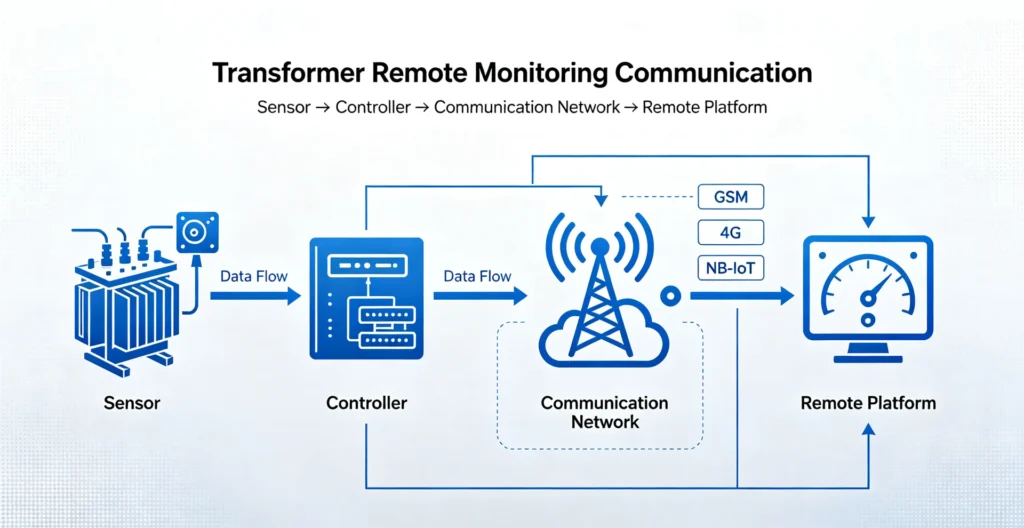
Transformer remote monitoring communication is the telemetry layer that carries an event from a sensor on the unit to a person who can act on it, and it consists of three separate choices that are usually confused with one another: the radio technology, the protocol the messages speak, and the path the messages take.
Key Takeaways
- The link is the only part of an anti-theft installation that can be removed without visiting the site. A jammer placed a few hundred metres away, or an antenna unplugged at the connector, produces the same reading at the control room as a perfectly quiet night.
- Because of that, the heartbeat is not a health check. It is the control that turns “no message” from an ambiguous silence into a dated fact, and its interval is a risk parameter rather than a maintenance preference.
- A theft alarm is small, in the order of a hundred to two hundred bytes. Bandwidth almost never decides the choice. The recurring cost is set by how often the device speaks when nothing is happening.
- GSM is not a slower version of 4G. It is a different network generation with a published retirement horizon in a growing number of markets, and a specification that names GSM without naming a migration path is a specification with an expiry date.
- Three layers get called “the protocol”: the bus between sensor and controller, the uplink to a server, and the northbound feed into a control centre. A device that speaks one and not the other two becomes an integration project after delivery.
What Is Transformer Remote Monitoring Communication?
Transformer remote monitoring communication is the set of components and rules that move a measurement off a remote transformer and into a system where a human or an automated process can decide what to do about it, covering the radio, the message format and the delivery path as one discipline. It is the engineering that turns a local sensor reading into a remote decision.
The reason it deserves its own page rather than a paragraph inside a detection article is that it fails differently from every other part of the system. A sensor fails by going quiet at the source, and a controller fails by not acting. A link fails by removing the ability of anyone to know whether the other two are working at all. That property makes the communication layer the only component whose failure mode is indistinguishable from normal operation, and it is why the rest of this page treats silence as a first-class event rather than as the default state.
Three questions get answered by the same purchase order, and they are worth separating before anything else. Which radio carries the message? What format does the message use on the way up, and what format does the receiving system expect? What happens when the radio is unavailable? The third question is the one most often left out of a specification, and it is the one that decides whether a monitored site is genuinely monitored or merely instrumented.
Where a site has more than one sensing channel, the link is also what allows those channels to be correlated, which is the difference between an alarm an operator trusts and an alarm an operator silences. The transformer anti-theft monitoring system page sets out how the channels combine on one controller; this page covers the part that carries the result away.
How a Sensor Event Becomes an Alarm Over a Wireless Link
A theft alarm travels five segments between the sensor on the unit and the operator’s phone, and each of those segments carries its own worst-case delay: sampling and persistence, decision logic inside the controller, radio transmission, platform processing, and the final notification hand-off to a person. Adding them up gives the honest figure, which is usually thirty seconds to two minutes rather than the instantaneous picture a sales sheet implies.
| Segment | What happens | Typical worst case |
|---|---|---|
| Sensing and sampling | The sensor samples its channel at 1–10 Hz and the event must persist long enough to be declared | 1–10 s, set by the persistence rule |
| Decision logic | The controller tests the event against its confirmation rules and any correlation requirement | 0–30 s, longer when two channels must agree |
| Transmission | The module wakes, attaches to the network and sends one message | 2–10 s on 4G, 3–8 s on GSM, 5–20 s on NB-IoT |
| Platform processing | The server decodes, stores and routes the event | Under 5 s |
| Notification | SMS, push notification and email hand-off | 5–60 s, and longer on a congested SMS route |
| Total | The full transformer remote monitoring communication path, from first sample to ringing phone | About 30 s to 2 min end to end |
Two of those segments are engineering choices and three are not. Sampling and decision logic are configured, and they are where most of the controllable delay sits. Transmission time is a property of the radio and the local network condition, platform processing is fast enough to ignore, and notification time belongs to whichever carrier terminates the message. A programme that wants a thirty-second end-to-end figure has to buy it in the first two rows, because the other three will not move.
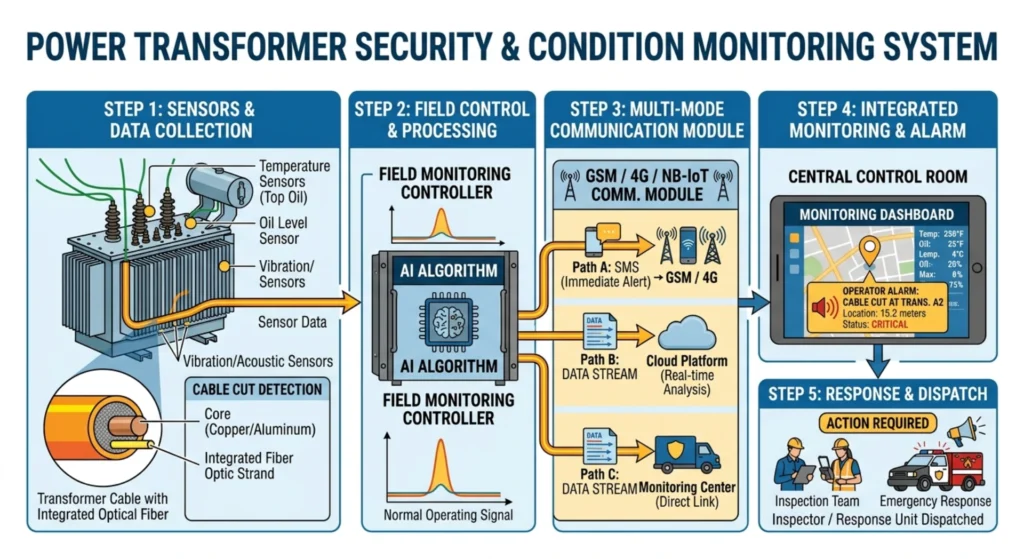
The full sensor set that feeds this path, and the way the four specialist channels divide the work among themselves, is set out on the transformer theft detection page.
Retransmission is the segment that most transformer remote monitoring communication specifications forget. A cellular message that does not complete is normally retried by the module, and on a weak link the retry can add ten to thirty seconds. The practical consequence is that a single-alarm test conducted in daylight beside an open cabinet proves less than it appears to: the link that runs at full strength during commissioning is not the link that has to work at three in the morning with the door closed and a storm overhead.
GSM, 4G and NB-IoT Compared for Transformer Monitoring
GSM transformer monitoring, 4G transformer monitoring and NB-IoT transformer monitoring are not three speeds of the same thing, because the deciding differences sit in cost per message, handover behaviour, roaming support, and how long the operator intends to keep the network running. The table below sets out the properties that decide a real project, and every row in it is a question worth putting to the local operator before a band is written into a specification.
| Property | GSM (2G) | 4G (LTE) | NB-IoT |
|---|---|---|---|
| Network generation | Second generation, circuit and packet switched | Fourth generation, packet only | 3GPP Release 13 low-power wide area, licensed spectrum |
| Usable uplink for telemetry | 2–10 kbit/s | Tens of kbit/s and above | 20–250 kbit/s peak, a few kbit/s in practice |
| Latency per message | Low | Lowest of the three | Higher, seconds rather than fractions of a second |
| Roaming between operators | Mature and predictable | Well supported | Uneven, and it varies by country |
| Handover between cells | Supported | Supported | Limited or absent on many deployed networks |
| Native SMS | Well supported | Supported | Not available, data only |
| Power per transmission | Higher | High without a low-power profile | Lowest of the three |
| Battery life on a duty-cycled node | Weeks to months | Weeks to months | Years, on a correctly sized pack |
| Deep indoor and below-ground reach | Poor | Poor to moderate | Roughly seven times the coverage area of a conventional cell |
| Module cost | Low, but rising as volumes fall | Moderate | Low |
| Network horizon | Retirement announced or completed in a growing number of markets | The current mainstay | Current, with a long planning horizon |
| Best fit | Sites whose only escalation path is SMS | Sites needing remote configuration, firmware updates or image transfer | Battery-powered sites with low data volume and tolerant latency |
The first row is the one that gets a specification returned for revision. GSM transformer monitoring has the longest field history of the three and the shortest guaranteed future, because a device built around a 2G module works well on the day it is installed and its service life is then set by a decision made in a network planning office rather than by anything on the transformer. Asking the local operator for the stated retirement date of the network being considered is a two-email question that prevents a fleet of modules becoming scrap while the controllers beside them still work.
The reach row matters more in this application than in most. NB-IoT and LTE-M were standardised for exactly this class of device: low cost, low data rate, long battery life, and operation in locations that are awkward for a conventional cell. The GSMA summary of the licensed-spectrum Mobile IoT family records that upgrading an existing cellular network to carry them can deliver as much as a sevenfold increase in coverage area and can penetrate below ground, which is the property that decides whether a device in a concrete chamber can be reached at all (GSMA Mobile IoT, retrieved 4 October 2026).
4G transformer monitoring remains the default where mains power is available, because the extra session speed is what pays for over-the-air configuration, threshold changes and firmware updates, and those are the features that keep a district from sending a van to every settings edit. NB-IoT transformer monitoring is the natural fit where the power budget is the binding constraint, since the module can sleep for long intervals and still be reachable on the next wake. A site that has mains power, adequate 4G service and no ambition to send images has no reason to look past 4G.
[UNIQUE INSIGHT] The comparison that decides most real projects is not in the table above. It is the one between a link that fails by going silent and a link that fails by reporting something wrong. All three radios here can go silent. Only a network that supports handover will keep reporting while a moving asset passes between cells, and only a network with predictable roaming will keep reporting when a border-area site attaches to a foreign operator. For fixed transformers neither matters much; for a monitoring programme that later extends to mobile plant it decides the shortlist.
Which Communication Method Fits Which Site
Which communication method fits a site is decided by four conditions measured at the site rather than by a preference for one standard: the received signal level at the installed position, the power available between visits, the volume of data the site must send, and whether the operator needs to reach the device to change its settings. Those four are cheap to establish and expensive to assume, and the transformer remote monitoring communication matrix below is the shortest form of the decision.
| Site type | Constraint that decides | First choice | Fallback |
|---|---|---|---|
| Unattended substation with mains power | Coverage and remote access | 4G with a second SIM on another operator | GSM SMS where 4G is absent |
| Pole-mounted unit on battery only | Power budget | NB-IoT | 4G with aggressive duty cycling |
| Site needing remote settings changes | Session latency and session length | 4G | Plan a visit instead |
| Site with no terrestrial coverage at all | Physics | Satellite messaging | Satellite only |
| Site behind an operator with a published sunset date | Network horizon | 4G or NB-IoT | Replace the module, not the controller |
| Mine, quarry or oilfield with a private network | Ownership of the link | Private LTE or a site gateway | 4G as the secondary path |
The fourth condition is the one buyers forget, and it is the one that generates support calls. A device that can only send data, and cannot be reconfigured over the air, converts every threshold change and every escalation-list edit into a site visit. That is an acceptable cost on a single pole beside a road and an unacceptable one across thirty sites in a district, so the requirement should be written down as a session requirement rather than discovered later.
Sites that exist mainly to be reached without a visit follow a different logic, and the two pattern pages in this cluster treat that logic as their subject: the transformer theft monitoring page for unattended substations, and the rural transformer theft prevention page for wide-area distribution networks. Neither repeats the comparison above, because the radio choice belongs here.
Transformer Monitoring Communication Protocol: Sensor, Controller, Platform
Transformer monitoring communication protocol is a phrase that covers three different layers at once, and most integration problems trace back to a buyer and a supplier using the same words for different layers: the bus between sensors and controller, the uplink to the internet, and the northbound feed into a control centre. Getting the layers in the right order costs nothing, and getting them wrong produces a gateway that nobody budgeted for.
| Layer | Question it answers | Common choices | What goes wrong when it does not match |
|---|---|---|---|
| Sensor bus | How does the controller read its sensors? | RS-485 with Modbus RTU, 4–20 mA loops, dry contacts, pulse inputs | Sensors are wired but unreadable, and every channel needs an adapter |
| Uplink | How does the device reach a server? | MQTT over TLS, HTTPS POST, CoAP, vendor-proprietary JSON | Data reaches the vendor portal and nowhere else |
| Northbound | How does a control centre receive the events? | IEC 60870-5-104:2006+AMD1:2016, DNP3, IEC 61850-8-1:2011+AMD1:2020 MMS, Modbus TCP | A six-week integration project appears after delivery |
The middle row is where the industry is converging, and it is mostly settled: MQTT over TLS has become the default uplink for battery-powered monitoring devices because it costs a few hundred bytes per message and survives a flapping connection without a full session setup each time. The bottom row is where the surprises live. A utility control centre does not speak MQTT, and the interface it does speak is chosen years in advance. Where events feed a control centre rather than a web dashboard, the reporting side normally speaks IEC 60870-5-104:2006+AMD1:2016, the telecontrol standard for network access in SCADA systems (official standard page, retrieved 4 October 2026), and confirming that the device supports the profile in use is a five-minute check that avoids a project later.
[PERSONAL EXPERIENCE] The cheapest integration failure to prevent is the one where the sensor bus is chosen for convenience and the northbound interface is chosen by the buyer’s IT department, with nobody in the room holding both. Two specifications that each read correctly, taken together, describe a system that cannot be assembled without a gateway nobody budgeted for.
Security belongs on this layer rather than in a separate section, because it is a property of the protocol stack and not of the radio. A telecontrol link carrying alarms in clear text can be spoofed by anyone who can reach it: a replay of a normal-state message costs an attacker a few minutes of work and buys several hours of undisturbed site time. IEC 62351-3:2023 defines the TLS profile for exactly this setting, specifying the mandatory cipher suites, certificate handling and session rules for power-system protocols carried over TCP/IP (official standard page, retrieved 4 October 2026). Whether the requirement applies to a given site is a risk decision. Whether the device supports it at all is a procurement question, and it is worth asking before the shortlist is closed rather than after.
Network Coverage for Rural Transformer Sites
Network coverage for rural transformer sites is not a question of whether a coverage map shows colour there, because the number that decides whether a device works is the received level measured at the installed position with the enclosure closed, and a steel cabinet removes a useful part of the signal. The gaps below are the ones that recur across districts, each paired with the measurement that replaces a map.
| Coverage gap | Why it happens | What to specify instead of a map |
|---|---|---|
| Inside a steel enclosure | The cabinet is part of the radio path | An external antenna rated for the band in use |
| Low-lying or shaded position | Terrain, embankment and vegetation in the path | Measured level at the installed position, recorded during commissioning |
| Concrete or below-ground chamber | Penetration loss of 20 dB or more | NB-IoT, or an antenna brought up to the surface |
| Long rural span beyond a 4G cell | 4G cell radius is smaller than a 2G one | Check whether 2G is still present, or plan a satellite fallback |
| Border or coastal area | The device attaches to a foreign network | Operator lock, or a tariff that tolerates it |
The practical consequence is that coverage should be treated as a commissioning measurement rather than a design assumption, and recorded as a number in the site file. A reading taken at the pole top with the door open is not the reading that matters. The one to write down is taken at the antenna’s installed position, with the enclosure closed, preferably on a wet day and at the time of day the network is busiest locally. Sites that fail that measurement are not necessarily unusable, but they need the antenna brought outside, or a different band, and both are cheaper to arrange before the mounting bracket is welded than after.
The same measurement explains why connectivity for remote transformer sites is more variable between districts than between countries. Two poles twenty kilometres apart can sit on opposite sides of a ridge and behave like two different networks, which is why a programme that succeeds in one district proves the method rather than the coverage.
What the Link Carries: Theft, Tamper, Cable, Tilt and Power Signals
A theft alarm message is small, typically a hundred to two hundred bytes, which is why bandwidth is almost never the constraint that decides a communication choice, and why the recurring cost of a monitored site is set somewhere else entirely. What does decide it is the heartbeat, because that message is sent whether or not anything has happened, and it is sent forever.
| Signal | Payload per event | How often it speaks | Note |
|---|---|---|---|
| Cable continuity | 60–120 bytes | On change, plus a heartbeat | The highest value per byte in the whole system |
| Enclosure and tamper switch | 60–120 bytes | On change | A binary state, so almost no data |
| Vibration or impact | 60–200 bytes | On change, with bursts | Bursts are the only genuine bandwidth risk |
| Tilt or displacement | 60–120 bytes | On change | Small unless raw waveforms are sent |
| Power and load | 100–300 bytes | On a schedule, every 15–60 min | The scheduled part is what grows the bill |
| Heartbeat | 50–100 bytes | Every 5 min to 24 h | Frequency times site count sets the monthly cost |
The arithmetic in the last row is worth doing before a quote is accepted, because it is the number that appears on every invoice for the life of the installation. A single message of 80 bytes sent every five minutes is about 23,000 messages and roughly 2 MB a month per site. The same message every hour is under 2,000 messages, and every six hours is under 400. Across a hundred sites on a tariff that charges per connection or per session rather than per byte, that difference is the whole of the operating cost, and the only question a buyer has to answer is how long a silence should be allowed to persist before somebody is sent to look.
Each of the five sensor rows above has a page of its own, because the detection logic differs enough to matter: cable cutting detection covers continuity and earth conductors, tampering detection covers enclosure and switch state, vibration monitoring covers the mechanical signature of a removal, and tilt detection covers attitude and displacement. This page is only responsible for what happens to the resulting event once it exists.
What Happens When the Link Is Lost
When the link is lost, the monitoring platform and the operator see exactly what they see when nothing is happening, which is nothing, and that ambiguity is the single most important operational fact about remote security monitoring. A dead site and a quiet site are indistinguishable unless the system is built to tell them apart.
| Failure | What the platform sees | Local behaviour that should exist |
|---|---|---|
| Jammer within range | Nothing at all | Heartbeat expiry, local siren, tamper log |
| Antenna or feeder cut | Nothing, or an abrupt drop in signal quality | Last-known-good flag and a local alarm |
| SIM deactivated or expired | The device stops attaching | A watchdog on the attach timer with a local output |
| Tower outage | Nothing, or a delayed batch when service returns | Store and forward with original time stamps |
| Battery exhausted | Nothing after the last transmission | Battery state reported while it still can be |
| Platform outage | The alarm never arrives | A second endpoint, or an SMS fallback path |
The heartbeat is the control that resolves the ambiguity, and its interval is the length of the blind window a programme is willing to accept. Five minutes means a confirmed silence is known within minutes and costs the most in traffic. One hour is the common compromise. Twenty-four hours is cheaper and turns the system into a next-day reporting tool, which is still useful for a loss record and useless for an interception.
| Heartbeat interval | Longest confirmed silence | Relative traffic per site | Suits |
|---|---|---|---|
| 5 minutes | Under 10 minutes | 100% | High-value unattended sites, where the aim is interception |
| 15 minutes | Under 30 minutes | 33% | Districts with a response team on shift |
| 1 hour | Under 2 hours | 8% | The usual compromise for a district with a daytime crew |
| 6 hours | Under 12 hours | 1.4% | Loss records and slow trend reporting |
| 24 hours | Under 2 days | 0.3% | Reporting only, and not a protection control |
Three local behaviours are worth requiring explicitly, and all three are cheap. The first is a tamper state on the enclosure of the device itself, which converts an attack on the monitoring hardware into an event rather than into a silence. The second is store and forward with the original time stamp, so that a batch arriving after an outage can still be read in sequence. The third is a local output that does not depend on the radio at all, because a siren and a beacon at the site are not affected by anything that happens to the network. A controller with those three properties is commissioned into whatever platform the buyer prefers, which is the boundary between this page and the transformer monitoring system family the controller belongs to.
Limitations and Boundaries of Remote Monitoring Links
Remote monitoring links fail in a small number of ways, and every one of them is a planning item rather than a defect: no coverage at the installed position, a network that is being retired, a jammer within range, a battery that empties before the next service visit, and a platform that stops answering. Each is stated below with the local behaviour that contains it, because a limit without a countermeasure is only a reason not to buy.
- A jammer defeats every radio in this comparison on price. A wideband device that covers the cellular bands costs less than one transformer, and once it is on, the site stops reporting while nothing else changes. There is no radio here that wins this contest. The heartbeat is the countermeasure, and it converts an unbounded silence into a bounded one.
- Satellite fallback is bounded by cost, not by technology. Terminal costs and airtime are an order of magnitude above a cellular tariff, and the messages are smaller and slower. It is justified where there is no terrestrial coverage at all, and hard to justify anywhere else, so it belongs in a specification as a named exception rather than as a general safety net.
- Power autonomy caps link availability. A site whose battery lasts three days reports for three days, whatever the network is doing. Link uptime figures quoted in isolation are meaningless without the autonomy figure beside them, and the honest specification states both together.
- The link does not make a bad sensor good. A communication layer that delivers a badly commissioned channel faithfully delivers false alarms reliably. The communication layer can only be as useful as the detection rules it carries.
- Roaming and permanent-roaming SIMs are not interchangeable. A tariff that works when tested at a depot can fail at a border site, and the failure appears as an unexplained silence rather than as an error message.
- Security is optional until somebody tests it. A device without certificate handling on the uplink will accept a replayed normal-state message, and the cost of fixing that after a fleet is deployed is a firmware programme rather than a settings change.
| Limit | Why it exists | What reduces it |
|---|---|---|
| Jamming | The radio path is outside the site | Heartbeat expiry and a local alarm |
| No coverage at the position | Physics and terrain | Antenna placement, band choice, satellite |
| Network retirement | An operator decision | Module replacement during a planned visit |
| Battery limit | Energy budget | Duty cycling, larger pack, mains where available |
| Platform dependency | An external service | A second endpoint or a local output |
| Spoofing | An unauthenticated uplink | TLS with certificate handling, as in IEC 62351-3:2023 |
How Houfeng Delivers Remote Monitoring Communication
Delivery of the communication layer is a commissioning sequence rather than a device supply, because the parts that fail are the parts decided in the office: the antenna position, the heartbeat interval, the escalation list, and the fallback path when the primary network is unavailable.
- Site signal survey. The received level is measured at the intended antenna position with the enclosure closed, on the network being considered, and the figure is written into the site record so that a later maintainer can tell a coverage problem from a hardware fault.
- Radio and tariff selection. The band is chosen from the survey, the site power budget and the operator’s published network horizon, with the SIM arrangement set so that a deactivated or expired card produces a local event rather than silence.
- Protocol mapping. The sensor bus, the uplink format and the northbound interface are fixed in writing against the destination system, whether that is a web portal, a SCADA front end speaking IEC 60870-5-104:2006+AMD1:2016, or a customer platform reached over MQTT with TLS.
- Heartbeat and fallback configuration. The heartbeat interval is set from the response time the programme can live with, the local output is configured so an event survives a failed link, and the fallback path is exercised with a live test rather than assumed.
Starting the conversation with the site conditions is faster than starting it with a product list. If you are scoping a district or a fleet, send us your requirement with the number of sites, the power available at each, the destination system the alarms must reach and the response time the operation can accept, and an application engineer will return a per-site radio, protocol and heartbeat plan built around the transformer anti-theft monitoring device. You can request a datasheet for the reference configuration first if you would rather compare the interfaces before committing to a layout, or contact us with the local operator’s network horizon and we will work through the migration question with you.
Frequently Asked Questions
What is transformer remote monitoring communication? It is the layer that moves a measurement from a remote transformer to a system where it can be acted on, and it covers three things at once: the radio that carries the message, the protocol the message uses at each stage, and the path taken when the radio is unavailable. It fails in a way no other part of the system does, because losing the link and having nothing to report look identical from the control room.
Which communication method is best for remote transformer monitoring? There is no single best method, because the deciding conditions are measured per site. A mains-powered unattended site with good 4G service usually takes 4G for its latency and remote-configuration ability, a battery-only pole-mounted unit usually takes NB-IoT for its power profile, and a site with no terrestrial coverage takes satellite messaging as a named exception rather than as a general fallback.
Is GSM, 4G or NB-IoT better for transformer monitoring? Each wins on a different axis. GSM wins on the near-universal presence of SMS as an escalation path and loses on its published retirement horizon and power consumption. 4G wins on latency and on the ability to change settings remotely. NB-IoT wins on battery life and deep indoor reach. The right question is which of those three properties the site cannot do without.
Will 2G and 3G shutdowns affect existing GSM transformer monitoring devices? They already do in markets where retirement has been announced or completed, and the effect is a module that stops attaching while the controller beside it still works. The protection is to ask the operator for the network horizon before specifying a band, and to treat the module as a replaceable item with its own planning date rather than as part of the controller.
Does remote transformer monitoring need Wi-Fi? No. Wi-Fi is unsuitable for a fixed outdoor installation because it has a short range, no commercial roaming and a power profile that does not suit a battery node. The three practical options are GSM, 4G and NB-IoT, and a fourth, satellite messaging, where the first three have no coverage at the installed position.
What happens if the cellular network is unavailable at a remote site? The device should keep working locally and report later. That means a local output that does not depend on the radio, storage of events with their original time stamps for retransmission when service returns, and a heartbeat whose expiry raises an alert at the platform. Without the heartbeat, an outage and a theft look the same, which is the single most common weakness found in deployed systems.
Conclusion and References
The radio is the easy part of this decision and the silence is the hard part. A programme that picks a band from a coverage map, buys modules on unit price and stops there has built a system that reports well when it works and says nothing when it fails, which is precisely the failure mode an anti-theft installation exists to remove. Reading the transformer remote monitoring communication specification back with three questions, what the heartbeat interval is, where the local output goes, and what the device speaks at the northbound interface, catches most of the problems before a purchase order exists.
For a district being planned from scratch, the useful order is to measure first, then choose the band, then fix the protocol mapping in writing, then set the heartbeat from the response time the operation can actually meet. The transformer anti-theft monitoring system page describes the controller that most of these links are commissioned into, and the sensing pages in this cluster describe what the link is carrying. A communication choice made against those two references is a decision a programme can defend three years later, when the network horizon question comes round again.
Sources
- IEC 60870-5-104:2006+AMD1:2016, Telecontrol equipment and systems — Part 5-104: Transmission protocols — network access for IEC 60870-5-101:2003 using standard transport profiles. IEC Webstore
- IEC 62351-3:2023, Power systems management and associated information exchange — Data and communications security — Part 3: Communication network and system security — Profiles including TCP/IP. IEC Webstore
- GSMA, Mobile IoT — Executive Summary, licensed-spectrum low power wide area networks standardised by 3GPP in Release 13 (June 2016). GSMA (retrieved 4 October 2026)
Written by the engineering content team at Baoding Houfeng Trading Co., Ltd., which works with utilities, EPC contractors and industrial operators on transformer monitoring and protection projects. Technically reviewed by [Reviewer name], senior protection and metering engineer, [X] years in distribution network operations (to be confirmed by the client). Last updated: 4 October 2026.