

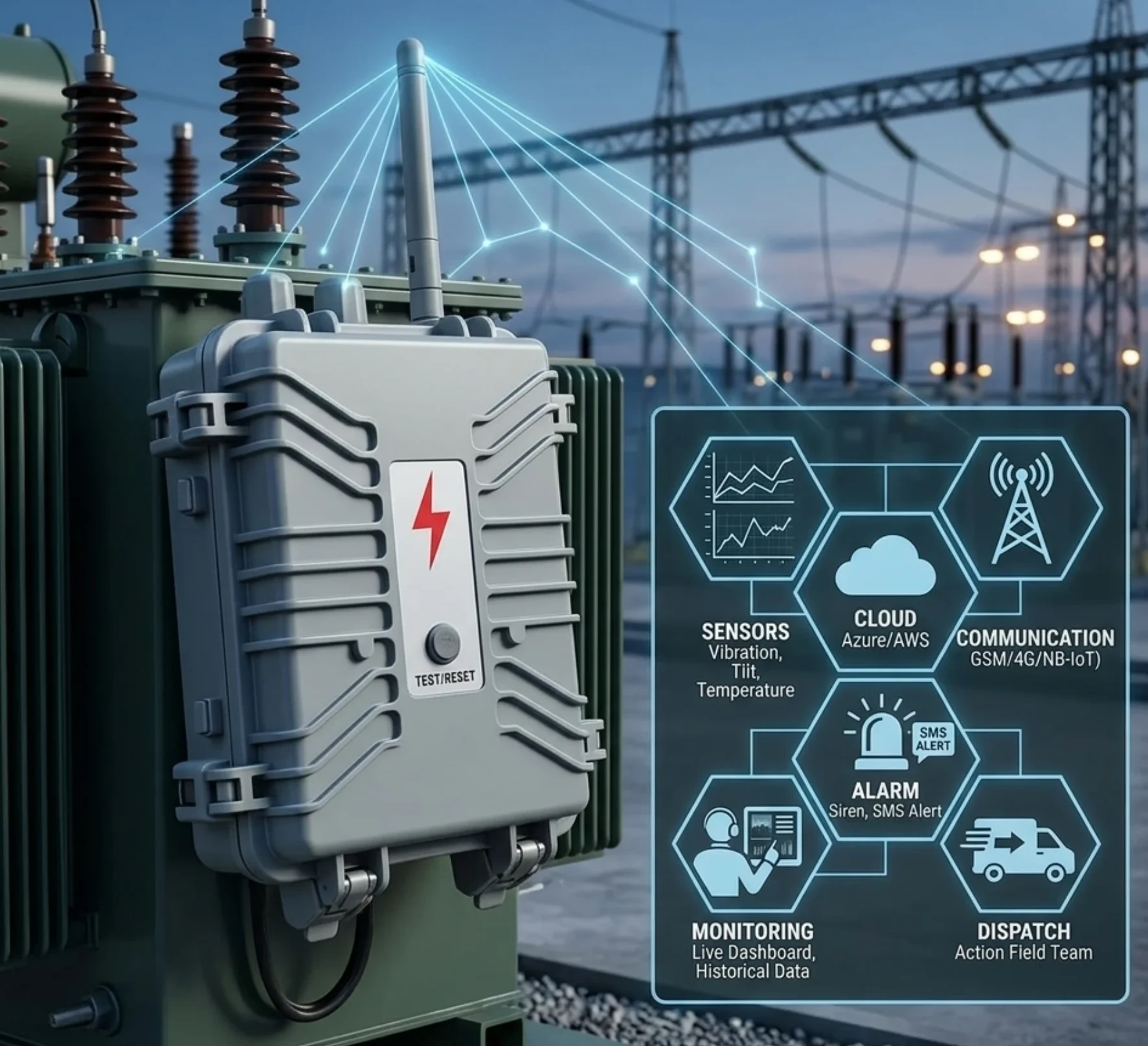
Transformer theft monitoring for remote substations is the practice of instrumenting an unmanned site so that an intrusion becomes a dated event at a control room rather than a discovery made weeks later by a patrol, and it is designed around a constraint that a guarded site does not have: the interval between detection and arrival.
Key Takeaways
- The difference between a guarded substation and an unattended one is not the equipment list. It is the clock. Detection, judgement and travel sit next to each other at a manned site, and are separated by hours at an unmanned one.
- Because the site cannot be defended in person, the design goal is to slow the removal procedure until the response can catch it, rather than to prevent the first contact with steel.
- Power autonomy sets a hidden ceiling on link availability. A site whose battery lasts three days reports for three days, whatever the radio is doing and whatever the coverage map claims.
- A false alarm costs a twenty-minute walk at a manned site and a three-hour journey at an unmanned one, which makes the alarm budget the scarcest resource in the whole design.
- Four channels carry most of the value at an unmanned site: power and phase state, communication continuity, position, and video verification. The four movement channels belong to their own pages in this cluster and are only mapped here.
What Is Transformer Theft Monitoring for Remote Substations?
Transformer theft monitoring for remote substations is the combination of four parts that only work as a set: sensors that can tell a removal in progress from normal operation, a controller that decides when readings deserve an alarm, a link that carries the alarm to a person, and a written response procedure somebody has agreed to follow.
Remove any one of the four and the remaining three produce nothing useful. Sensors without a controller produce data nobody reads. A controller without a link produces a local siren that the neighbourhood hears and the utility does not. A link without a response procedure produces a notification that is acknowledged and then forgotten, which is the most common failure found in deployed systems and the least visible one, because every component tests correctly on the day it is commissioned.
The transformer anti-theft monitoring system page describes how the sensor channels are combined on a single controller, and the detection pages in this cluster describe how each individual channel decides that something is happening. This page answers a narrower and more practical question: a substation with nobody in it, four hours from the nearest depot, and a cash-strapped regional operator. What gets installed, in what order, and what does it cost to keep honest?
Why an Unattended Substation Fails Differently From a Guarded One
An unattended substation fails in a different shape from a guarded one, because the four steps that convert an intrusion into a prevented theft are no longer adjacent: detection, judgement and travel are separated by hours, and every design decision that follows is a response to that separation. A guarded site compresses the whole sequence into minutes, and that compression is what does the protecting, not the fence.
| Step | Guarded substation | Unattended substation |
|---|---|---|
| Detection | A person present, or a sensor | Sensor only, always |
| Judgement | Immediate, by someone who knows the site | Rules, or a remote operator reading a screen |
| Travel | Under 20 minutes | 1 hour to a full working day |
| Intervention | Often arrives during the attempt | Frequently arrives after it |
[UNIQUE INSIGHT] The practical consequence is that the objective changes. At a manned site the objective can reasonably be described as prevention, because the last two steps are short enough to interrupt the attempt while it is still an attempt. At an unmanned site the objective has to be stated differently: make the removal procedure slow enough, and visible enough, that the response arrives while the equipment is still on site. That is a weaker promise, and it is the only honest one.
Three response layers are available, and a programme that relies on one of them without noticing is a programme with a single point of failure.
| Layer | What it does | What happens when it fails |
|---|---|---|
| Local | Siren, strobe, recorded voice challenge at the site | The deterrent disappears silently; nothing reports the loss |
| Regional | Patrol route, or an on-call team inside the district | Travel time grows with the distance the team is asked to cover |
| Central | Platform alarm, escalation list, work order | Alarms accumulate into a queue nobody clears |
A design that uses all three is not more expensive in hardware. It is more expensive in decisions taken before installation, which is why the layer assignment usually gets skipped in a procurement document that only specifies sensors.
_The figure below shows one unit with sensing points wired to a controller that supervises the local deterrent and the uplink at the same time._
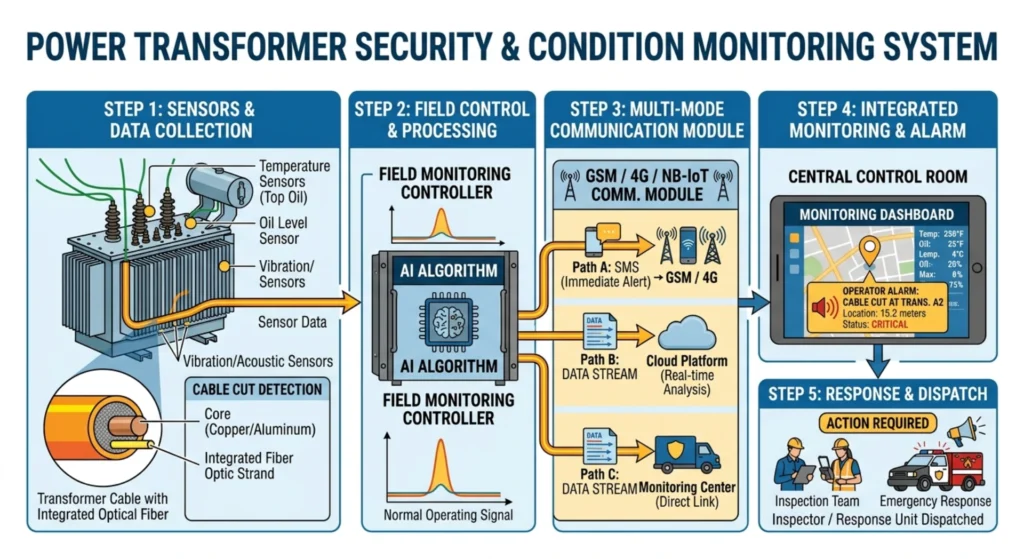
The second difference is the value of a correct alarm. At a manned site an alarm that proves to be nothing costs a walk down a corridor. At an unmanned site the same alarm costs a vehicle, a half-day of a technician’s time and the credibility of the programme, and it is that third cost that decides whether the installation survives its second winter. The detection discipline that follows from this is set out in the transformer theft detection overview, and the deployment method later on this page assumes it.
What Should Be Monitored at a Remote Transformer Site?
What should be monitored at a remote transformer site is decided by the alarm budget rather than by a wish list, because every additional channel adds events, and events at an unmanned site are expensive to clear. A site with eight channels and no confirmation rules generates more false alarms than a site with four channels and two correlation rules, and the second site is the one the operator keeps switched on.
| Channel | What it detects | Where it is covered |
|---|---|---|
| Vibration and impact | Prying, jacking, tool work on the body | vibration page |
| Attitude and displacement | The unit leaving its mounting | tilt page |
| Cable continuity and earth | Conductors cut before the unit is touched | cable cutting page |
| Enclosure and tamper switch | Cabinet or cover opened | tampering page |
| Power and phase state | Supply lost, phase missing, load abnormal | This page |
| Communication continuity | The link itself has been removed | This page |
| Position | The unit is no longer where it was installed | This page |
| Video verification | What is actually happening at the site | This page |
_The figure below maps the eight channels a remote site can carry, and shows which of them belong to a page of their own in this cluster._
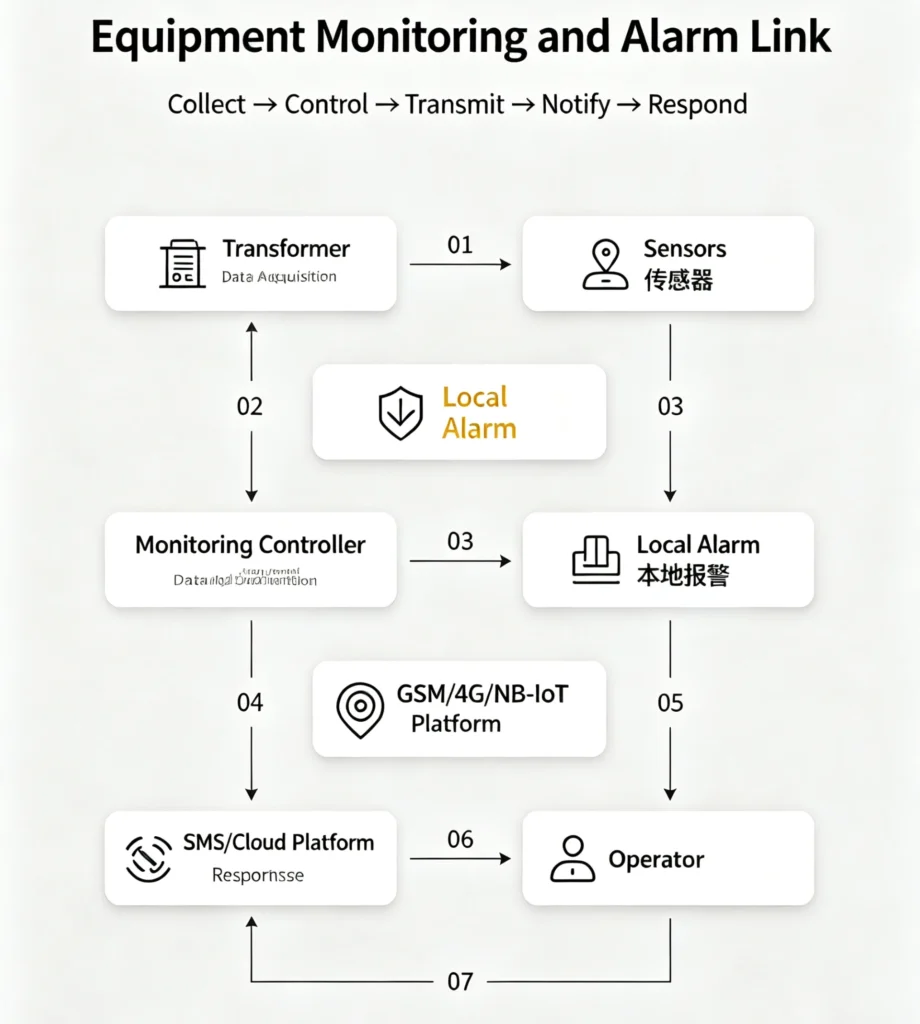
The four movement channels in the top half of the table are the ones a typical specification asks for first, and they are genuinely the highest-value channels per unit of cost. They are also the four that generate the most events, because a steel tank in a storm moves and a wooden pole in clay leans. The engineering that makes them usable is the correlation rule that requires two of them to agree before an alarm is raised, which is why the controller matters more than the sensor count.
The bottom four channels are what this page contributes, and each answers a question the movement channels cannot. Power and phase state answers whether the unit is still connected to anything. Communication continuity answers whether the site is being monitored at all right now, which is a different question from whether anything has happened. Position answers whether the equipment is still in the district. Video answers what a human would have seen had a human been there.
A channel list is therefore a budget rather than a wish list, and the first task in a transformer theft monitoring for remote substations programme is to decide which four channels the response team can actually clear without muting the site.
The order of installation matters as much as the list. Channels that report a unit leaving, such as position and displacement, are nearly useless without a continuity channel that reports the earlier stage, because by the time they fire the equipment is on a truck. The channels that fire earliest in the removal sequence are also the cheapest to install, which is a rare alignment of value and cost and one worth pointing out in any business case.
Unattended Substation Monitoring: What Replaces the Patrol
Unattended substation monitoring replaces a narrow slice of what a patrol used to provide, and being explicit about which slice is the difference between a programme that works and one that quietly loses capability. A patrol was never an intrusion detector, and treating a sensor set as a direct substitute for one sets up a comparison that no sensor can win.
| Patrol action | Can a sensor replace it? | What actually replaces it |
|---|---|---|
| Noticing a forced door | Yes | Enclosure and tamper switch |
| Noticing a missing unit | Yes, after the fact | Position and continuity |
| Smelling overheating insulation | Partly | Temperature or dissolved gas, at extra cost |
| Hearing an abnormal hum | Partly | Vibration, if a baseline is maintained |
| Spotting corrosion and weed growth | No | A retained quarterly visit |
| Checking a lock still works | No | A retained quarterly visit |
The two rows at the bottom are the ones programmes forget. Corrosion, water ingress, vegetation contact with a conductor, and a padlock that no longer closes are all conditions that a sensor set will report only once they have already caused a failure. Keeping a reduced physical visit in the schedule is not a failure of the monitoring programme; it is the part of the programme that protects the monitoring equipment itself.
The same argument applies to the alarm test schedule. A quarterly visit is the natural moment to re-fire one alarm per site and confirm that the notification still reaches the right handset, because an escalation list ages faster than any component in the system. People change roles, numbers change, and a list that was correct in January is often wrong by the following autumn without anyone noticing until the night it matters.
[PERSONAL EXPERIENCE] There is also an economic argument for retaining that visit, and it is stronger at an unmanned site than at a manned one. The quarterly visit that re-torques a terminal, clears the enclosure vent and photographs the installation is the visit that discovers a sensor bracket that has loosened, an antenna that has been bent by a branch, and a battery whose capacity has fallen below the level the design assumed. None of those three conditions generates an alarm on its own. All three silently degrade the protection until something else fails and the site is examined.
Centralized Monitoring of Remote Transformer Sites
Centralized monitoring of remote transformer sites moves the judgement step to a control room, and it solves the travel problem while introducing a capacity problem that is rarely quantified during procurement. A platform that receives events from thirty sites does not need thirty operators, and an unmanned substation programme fails more often from attention than from coverage; what it needs is a classification scheme that keeps the operator pointed at the events that matter.
| Class | What qualifies | How it is delivered |
|---|---|---|
| Event | A state change with no urgency, such as a door opening in daylight | Stored and summarised, read in a daily review |
| Alarm | A confirmed intrusion pattern | Pushed immediately to the on-call path |
| Fault | The monitoring equipment itself is unwell | Raised on the maintenance queue, not the security queue |
| Silence | The heartbeat has expired | Treated as an alarm, not as a fault |
The last row is the one that distinguishes a monitoring system from an instrumented one. A heartbeat that has stopped and a site where nothing has happened produce identical screens, and the only way to separate them is to make the absence of a message into a message of its own. The remote monitoring communication page treats that property as the central design problem of the link layer, and it applies here with more force than anywhere else because nobody is at the site to notice a dead antenna.
The second capacity problem is the alarm storm. A single event at a site with eight channels can produce eight messages, and a regional storm can produce the same burst at thirty sites at once. The northbound integration that a control centre expects is defined in IEEE C37.1-2007, the standard for SCADA and automation systems in substations, which is where the functional and environmental requirements for the remote terminal units in this architecture are set out (IEEE C37.1-2007). A specification that names the protocol without naming the rate at which it will be offered is a specification that will be tested by the first storm.
Remote Substation Security: From Conductor to Control Room
Remote substation security is best treated as four physical layers rather than as one problem, because the countermeasure that works at one layer is irrelevant at the next, and an attacker will always choose the cheapest layer rather than the most heavily defended one. The layers are the conductor and enclosure, the cabinet that holds the electronics, the site itself, and the control room that receives the result.
| Layer | Realistic attack | Control that buys time |
|---|---|---|
| Conductor and enclosure | Cutting, prying, jacking the unit | Continuity, vibration and tilt sensing |
| Equipment cabinet | Opening the housing, unplugging an antenna | Tamper switch, concealed mounting, antenna routing |
| Site | Removing the whole assembly, blocking access | Position sensing, physical hardening, lighting |
| Control room | Replaying a normal-state message over the link | Authenticated and encrypted communication |
The last row of that table is the one that surprises operators, because the attack it describes requires no presence at the site at all. A link that accepts a message without authenticating its origin can be fed a stream of plausible normal readings, and the monitoring platform will display a healthy site for as long as the feed continues. IEC 62443-3-3:2013 sets out the system security requirements and security levels for industrial automation and control systems, including the communication integrity and authenticity controls that apply to exactly this boundary (IEC 62443-3-3:2013).
The design order at each layer is the same: make the intrusion slow, then make it visible, then make it recorded. A programme that reaches for visibility first, by installing a camera and stopping there, produces a recording of a theft rather than an interruption of one. The separate tampering page in this cluster covers the cabinet layer in detail, including the supervised switch circuits that separate an opened door from a bypassed one.
Rural and Unattended Substation Monitoring
Rural and unattended substation monitoring is a narrower problem than rural network protection as a whole, because the variables that come from the network structure and the variables that come from having no staff on site are different in kind. The distribution layout, the supply radius and the patrol frequency of a rural network are covered on the rural transformer theft prevention page, and this section only adds the two variables that unattended operation contributes on top of them.
The first is that an end-to-end response time is measured in hours and cannot be improved by any monitoring decision. A district that covers two thousand square kilometres cannot place a team within thirty minutes of every site, and pretending otherwise produces a response procedure that is written down and not met. The honest specification states the achievable time per zone and then chooses the detection thresholds that the response can actually use.
The second is that the equipment is often mounted on a pole rather than on a foundation, which changes what the movement channels can see and changes the mounting method for the sensing hardware. Pole-mounted installations have their own page in this cluster, and the two constraints combine in a way that punishes over-specification: a pole that sways in wind produces attitude and vibration excursions that a foundation-mounted unit never generates, so a threshold copied from a pad-mounted site will alarm continuously at a pole site.
How to Deploy Transformer Theft Monitoring at a Remote Substation
How to deploy transformer theft monitoring at a remote substation is a sequence of six steps, and the first four of them happen before anything is purchased, because the failure modes that matter are decided by a measurement rather than by a product selection. Skipping to the sensor list is the most common shortcut and the most expensive one, since it produces a site that is instrumented and not monitored.
| Step | Action | Deliverable |
|---|---|---|
| 1 | Site assessment: measured arrival time, available power, received signal at the installed position | A site sheet with three numbers on it |
| 2 | Channel selection for a transformer theft monitoring for remote substations programme: which of the eight channels, correlated how | A channel list with a confirmation rule for each |
| 3 | Power and autonomy budget: load, duty cycle, backup duration | A stated reporting duration in days after mains loss |
| 4 | Installation: sensors, controller, antenna routing, concealment | A commissioning record including photographs |
| 5 | Rule and escalation configuration: thresholds, persistence, notification path | A written rule set and an escalation list with names |
| 6 | Live test of every alarm, and a drill of the response | A signed test sheet, and a measured response time |
Step 1 is where the two numbers that dominate the whole design get written down: the measured arrival time and the measured received signal level. Both are taken at the position the equipment will occupy, with the enclosure closed, and neither can be read off a map. A coverage prediction from an operator’s map and a signal reading at the installed position disagree often enough that the reading has to be the one that goes into the record.
Step 3 is the step that is most often omitted and most often regretted. A remote site that loses mains has a reporting life set by its battery, and a battery sized for a five-day outage turns a monitored site into an unmonitored one on the sixth day without any alarm that says so, unless the design has made low battery and heartbeat expiry into events of their own. The controller family that most of these deployments use is listed on the transformer monitoring category page, which is the right place to compare hardware once steps 1 to 3 have produced their numbers.
Step 6 is the step that gets compressed when a schedule slips. A test that fires one alarm, in daylight, with the cabinet open, proves that the sensor works. It does not prove that the notification reaches the on-call phone, that the escalation list is current, or that the response team can find the site at night. The drill is the only step that tests the response rather than the equipment.
What a Remote Site Needs That a Guarded Site Does Not
A remote site needs three things that a guarded site rarely needs at all, and all three of them are consequences of the arrival time rather than of the equipment list: energy autonomy, a position reference, and a means of verifying an alarm before a vehicle is sent. Each of the three changes the specification in a way that a generic anti-theft document will not mention.
| Need | Why the guarded site does not have it | Configuration and cost at a remote site |
|---|---|---|
| Energy autonomy | Mains and staff are both present | Battery bank sized in days, with low-battery as an event |
| Position reference | Somebody is there to see the unit leave | Satellite positioning with a movement fence |
| Verification | A person can be sent to look in minutes | Camera with on-demand capture rather than continuous streaming |
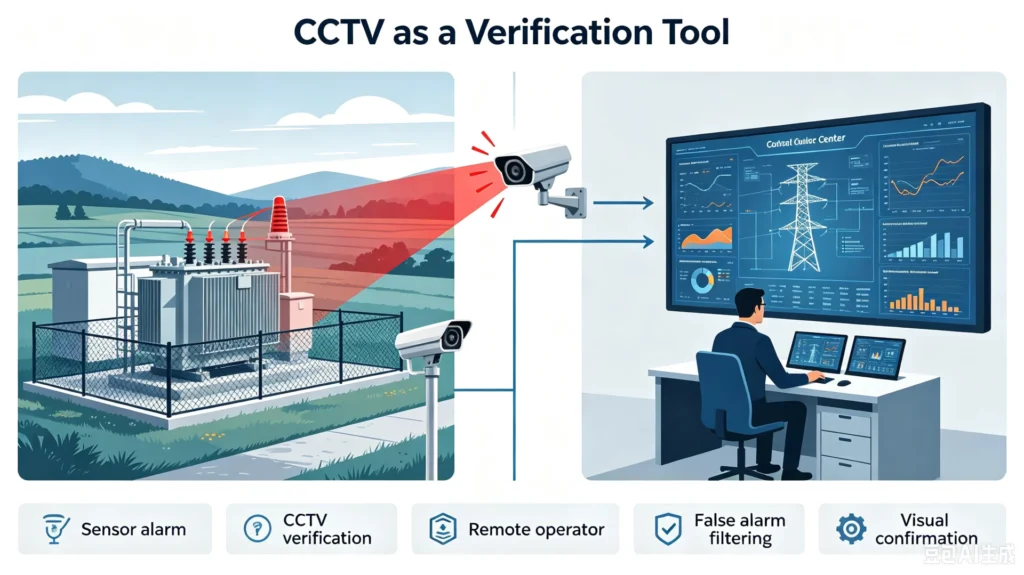
_The figure below shows the verification path from a confirmed alarm to an on-demand capture at a site nobody is watching._
Energy autonomy is the constraint that is easiest to underestimate because it degrades slowly. A battery that was specified for a five-day outage reports for five days in year one and for three days in year three, and nothing in the system announces the change unless the state of health of the battery is itself monitored. The honest way to write the requirement is as a reporting duration after loss of mains at the end of the battery’s service life, not as a capacity in ampere-hours.
Position reference is the one channel that reports an outcome rather than an attempt. Vibration, tilt and continuity all describe something happening to a unit that is still present; a position fix outside its permitted area is the only signal that says the equipment has left the district. Its limitation is equally clear and should be stated in the specification rather than discovered: a position channel tells you where the unit is now, which is useful for recovery and useless for prevention.
Verification is where the camera earns its place, and it is not the role most buyers expect. Continuous streaming from thirty rural sites is a bandwidth and storage problem with a poor return. On-demand capture triggered by a confirmed alarm, or by a request from the operator, is affordable, and its real value is that it lets an operator clear a false alarm without sending a vehicle. Applied that way, a camera reduces operating cost rather than adding to it. Where several sites report into one regional centre, the information exchange between substations described in IEC TR 61850-90-1:2010 is the reference for how that data is structured and moved (IEC TR 61850-90-1:2010).
The wider programme these three needs sit inside, including the physical and procedural measures that no monitoring channel replaces, is described on the prevention page of this cluster.
Limitations and Boundaries of Remote Substation Monitoring
Remote substation monitoring has boundaries that belong in the specification rather than in a post-incident review, because every one of them is knowable in advance and each has a countermeasure that costs a decision rather than a device. The list below is ordered by how often each one is discovered late.
- An unattended site with no response is only a recorder. If the escalation path ends at a screen nobody watches, the installation produces evidence after the loss and nothing during it. Monitoring does not create a response capability; it only gives an existing one something to aim at.
- Power autonomy sets a hard ceiling on availability. A site that reports for three days after losing mains is unmonitored from the fourth day, and any availability figure quoted without the autonomy figure beside it is not a measurement of anything.
- False alarms are more expensive here than anywhere else. A twenty-minute walk becomes a three-hour journey, and the third unnecessary journey of a season is usually the one after which the site gets muted. The corollary is that fewer channels with better confirmation beat more channels with none.
- Position and video are bounded by cost, not by technology. Satellite positioning is cheap to receive and can be defeated by a metal enclosure; cellular data for video is affordable on demand and unaffordable as a permanent stream. Both belong in the specification as named exceptions with a stated trigger.
- The link can be removed without visiting the site. A jammer within range, or an antenna unplugged at the connector, produces the same reading at the control room as an undisturbed night. This is why communication integrity is a security requirement rather than a maintenance preference, and why the requirements in IEC 62443-3-3:2013 are relevant to an anti-theft installation.
- Monitoring does not replace physical hardening. A site with no fence, no lighting and an unlocked cabinet is a site where the monitoring system will report a theft accurately and too late. The sensor set and the physical measures are complementary, not alternatives.
| Limit | Why it exists | What reduces it |
|---|---|---|
| Response gap | Distance is a planning fact | Zoned arrival commitments and realistic thresholds |
| Power autonomy | Energy budget of the site | Larger pack, duty cycling, autonomy as a stated number |
| False alarms | Channels without correlation | Confirmation rules, two-of-two logic, on-demand video |
| Position defeat | A conductive enclosure | External antenna, and continuity as the earlier signal |
| Link removal | Radio path outside the site | Heartbeat expiry, authenticated uplink, local output |
| Physical neglect | No staff on site | A retained quarterly visit with a checklist |
How Houfeng Delivers an Unattended Substation Programme
Delivery of a remote-site programme is a site survey and a configuration exercise rather than a hardware sale, because the parts that fail at an unmanned substation are the parts decided in an office: thresholds copied from a different mounting type, an autonomy figure nobody calculated, and an escalation list that was correct on the day it was written.
- Site survey with measured values. Arrival time, received signal level at the installed position and available power are measured on site and recorded per location, so that a later maintainer can tell an environmental change from a fault.
- Channel and correlation plan. The channel list is reduced to the ones the alarm budget can carry, and each alarm is given a confirmation rule that uses a second channel rather than a shorter timer.
- Autonomy and escalation design. The reporting duration after mains loss is fixed as a number, low battery is made an event, and the escalation path is agreed with the people who will actually answer the phone.
- Commissioning test and drill. Every alarm is fired and traced to the handset that must receive it, and the response procedure is walked through with the team that will execute it rather than with the team that wrote it.
If the site is already chosen, send us your requirement with the number of locations, the measured arrival time for each zone and the destination system the alarms must reach, and an application engineer will return a channel list, a correlation rule for each alarm and an autonomy figure per site, built around the transformer anti-theft monitoring device. You can request a datasheet for the reference configuration first if comparing interfaces is the more useful next step, or contact us with a photograph of the installation and the local operator’s coverage situation and we will work through the channel selection with you.
Frequently Asked Questions
What is transformer theft monitoring for remote substations? It is the practice of instrumenting a transformer so that an intrusion or a removal attempt becomes a recorded event rather than a discovery made later, and at a remote site it combines sensing, a controller, a communication link and a written response procedure. Its value at an unmanned site comes from the response the event triggers, not from the event itself.
Why do remote substations need transformer theft monitoring? Because the four steps that stop a theft are separated by hours when nobody is on site. Detection can be automated and judgement can be moved to a control room, but travel cannot be compressed, so the monitoring programme has to slow the removal procedure enough for the response to arrive while the equipment is still there.
What should be monitored at a remote transformer site? Four movement channels and four site channels are the usual set. The movement channels are vibration, attitude, conductor continuity and enclosure state, and they carry the highest value per unit of cost. The site channels are power and phase state, communication continuity, position and video verification, and each of them answers a question the movement channels cannot.
Can rural and unattended substations share one monitoring design? They share the same channels but not the same thresholds. A pole-mounted unit in an exposed location sways enough in wind to alarm on a threshold copied from a pad-mounted site, and the supply radius and patrol structure of a rural network change the arrival time that the thresholds are set against. The channel list transfers; the numbers do not.
What happens at a remote site when the mains supply is lost? The site reports for as long as its battery allows, and that duration is a design figure rather than a property of the equipment. A site sized for five days at commissioning may hold three days after several years of service, which is why low battery state and heartbeat expiry should both be configured as events rather than read as a maintenance detail.
Is a camera or satellite positioning necessary at an unmanned site? Neither is universal, and both are best specified with a trigger rather than as a default. Position sensing is the only channel that reports an equipment leaving rather than an attempt on it, which makes it valuable for recovery. Video is most useful on demand, triggered by a confirmed alarm, because its real contribution is clearing a false alarm without sending a vehicle.
Conclusion and References
Transformer theft monitoring for remote substations is a scheduling problem disguised as an equipment problem, because the sensor set determines when an event is known and the response determines whether knowing it was worth anything. A programme that buys eight channels and writes no escalation list has bought a recorder. A programme that buys four channels, correlates them into two rules and drills the response has bought protection.
The order that works is to measure first, choose channels second, budget the autonomy third, and test the whole path last. The transformer anti-theft monitoring system page describes the controller these channels are commissioned into, and the detection pages in this cluster describe how each channel decides. A deployment built against those two references is one that can be defended in a budget review and, more usefully, at three in the morning when a real alarm arrives.
Sources
- IEC 62443-3-3:2013, Industrial communication networks — Network and system security — Part 3-3: System security requirements and security levels. IEC Webstore
- IEEE C37.1-2007, IEEE Standard for SCADA and Automation Systems. IEEE Xplore
- IEC TR 61850-90-1:2010, Communication networks and systems for power utility automation — Part 90-1: substation-to-substation communication. IEC Webstore
Written by the engineering content team at Baoding Houfeng Trading Co., Ltd., which works with utilities, EPC contractors and industrial operators on transformer monitoring and protection projects. Technically reviewed by [Reviewer name], senior protection and metering engineer, [X] years in distribution network operations (to be confirmed by the client). Last updated: 4 October 2026.