

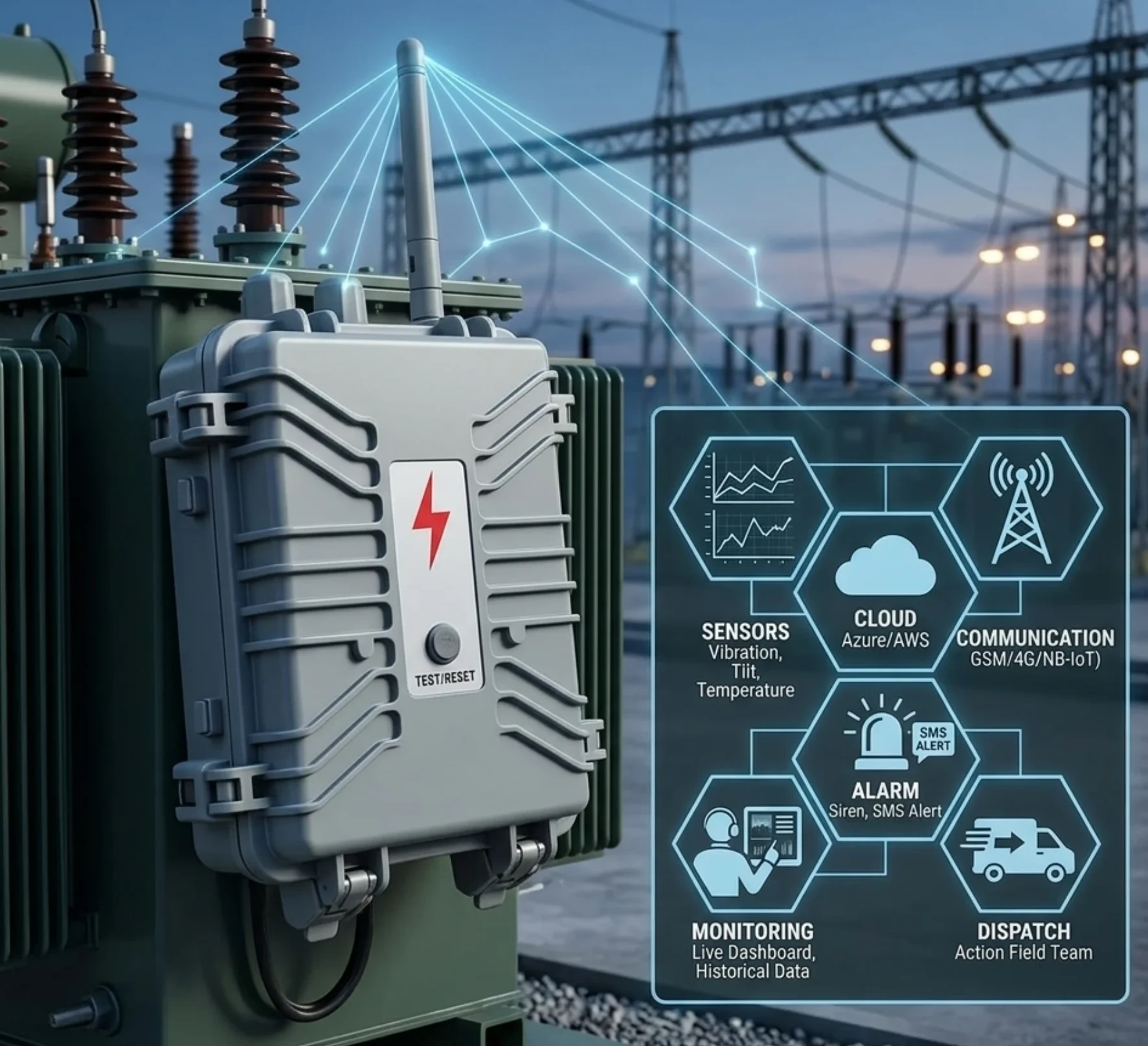
Remote substations are difficult to supervise. A site may only be visited during scheduled inspections, while a theft attempt can take place at any time—often without anyone nearby to notice it.
Transformer theft and vandalism have already caused significant losses in several power networks. In Zimbabwe, for example, reported annual losses from vandalism averaged about US$5 million over a five-year period, leading to the rollout of sensor-based monitoring systems. In India, PSPCL reported 2,443 transformer theft incidents in one year, with losses of more than ₹10 crore in one zone.
For utilities operating rural distribution networks, mining sites, agricultural facilities, and other remote installations, the problem is not simply preventing unauthorized access. The bigger issue is knowing that something is wrong while there is still time to respond.
A transformer theft monitoring system addresses this gap by detecting events such as vibration, movement, tampering, cable cutting, and power loss and sending an alarm to an operator. Instead of discovering the problem during the next site inspection, the utility can be notified as soon as an abnormal event occurs.
Why Is Transformer Theft a Problem at Remote and Unattended Substations?
Remote Transformers Are Difficult to Watch
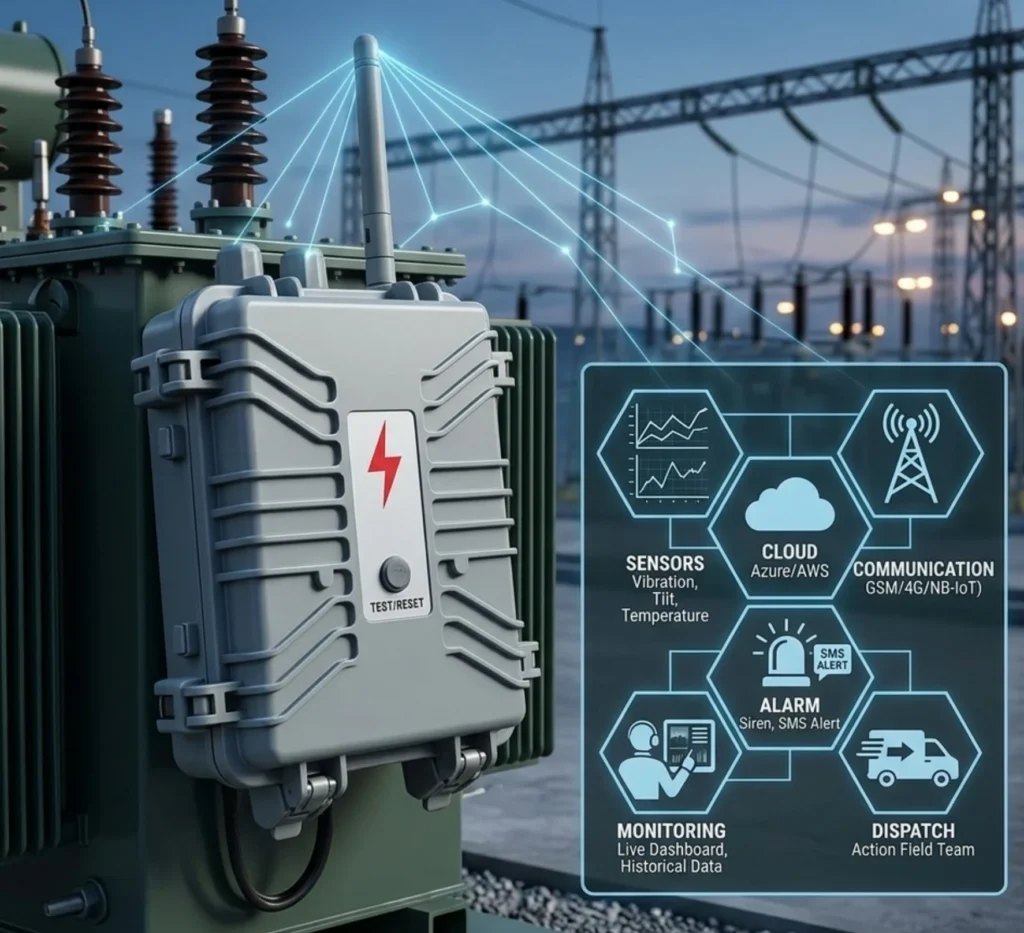
Many substations serving rural areas, farms, mines, and oilfields are located a long distance from the nearest control centre. Some have no permanent staff at all.
This creates an obvious security gap. A maintenance team may inspect a transformer every few weeks, but there is nothing stopping someone from accessing the site between inspections.
Cable theft illustrates the problem well. In South Africa, Eskom has dealt with repeated cable theft at rural and peri-urban substations. When control cables are damaged or removed, operators can lose visibility of equipment and may have to shut down affected equipment until the problem is repaired.
For a remote transformer, simply knowing that an inspection was completed yesterday does not tell the operator what is happening today.
Why Are Transformers Targeted?
Transformers contain copper and other valuable materials that can be sold as scrap. Remote installations are particularly attractive to thieves because they may have poor lighting, limited fencing, and little regular human activity.
The physical design of the installation can also make access easier. Pole-mounted transformers can be reached using ladders or climbing equipment, while pad-mounted units may be installed in open areas with limited protection.
In some cases, the transformer itself is not the only target. Thieves may cut cables, remove copper conductors, damage terminals, or break open enclosures before attempting to remove equipment.
What Happens When Theft Is Discovered Late?
The financial loss is only part of the problem.
A stolen or seriously damaged transformer can result in:
- An unexpected feeder outage
- Damage to cables, terminals, and enclosures
- Emergency transformer replacement
- Transportation and crane costs
- Additional installation and testing work
- Longer restoration times
- Emergency maintenance and inspection
- Safety risks caused by unauthorized access to energized equipment
At a remote substation, the restoration process can take considerably longer because replacement equipment and personnel may need to travel a significant distance.
That makes early detection particularly valuable.
What Is Transformer Theft Monitoring?
Transformer theft monitoring is a remote security and condition-monitoring system that detects unauthorized movement, tampering, cable cutting, power loss, and other abnormal conditions and reports them to operators.
The system normally combines several sensors with a controller and a communication module.
This is different from relying solely on CCTV. A camera can provide useful visual evidence, but someone still needs to watch the footage or review it after an incident. A monitoring device can generate an alarm automatically when a predefined condition occurs.
For example, if a transformer begins to tilt while vibration is detected at the same time, the system can identify the combination as a potential theft attempt and send an alert.
What Can a Transformer Theft Monitoring System Detect?
| Monitoring Function | What It Detects |
|---|---|
| Vibration monitoring | Impact, drilling, hammering, or forced entry |
| Tilt monitoring | Lifting, dragging, or abnormal transformer movement |
| Anti-theft bolt monitoring | Bolt loosening or unauthorized removal |
| Cable break detection | Cable cutting or loss of continuity |
| Power monitoring | Power interruption or abnormal voltage |
| Phase monitoring | Phase loss or abnormal supply conditions |
| Local alarm | Tampering or intrusion at the site |
| Remote alarm | Alarm transmission through GSM, 4G, or NB-IoT |
The exact sensor combination depends on the transformer and the site. A small rural installation may only need movement, tamper, and power-loss detection, while a high-risk substation may require several sensors working together.
Why Remote Substations Benefit From Theft Monitoring
There May Be Nobody at the Site
An unattended substation cannot rely on a security guard or operator hearing a local siren.
A local alarm is still useful because it can discourage an intruder, but remote notification is what allows the utility’s control room or maintenance team to know that an incident is taking place.
Inspection Cannot Provide 24/7 Visibility
Manual inspection remains important for maintenance, but it is periodic by nature.
Consider a transformer inspected once every two weeks. If thieves remove the transformer on the second day after inspection, the incident may remain unnoticed for another 12 days.
A remote monitoring device changes this from a periodic inspection problem into an event-based alarm system.
Response Time Matters
The earlier an operator receives an alarm, the sooner a response team can be contacted.
The response may involve:
- Checking the alarm information
- Confirming the affected site
- Contacting local security or field personnel
- Dispatching a response team
- Isolating equipment if necessary
- Recording the incident for further investigation
In Zimbabwe, Powertel’s sensor-based monitoring rollout has included links between alarm information, police, and loss-control teams, illustrating how detection can be connected to a wider response process.
Detection alone does not stop theft. Detection followed by a defined response procedure is what makes the system useful.
How Does a Transformer Theft Monitoring System Work?
A typical system can be understood as a simple chain:
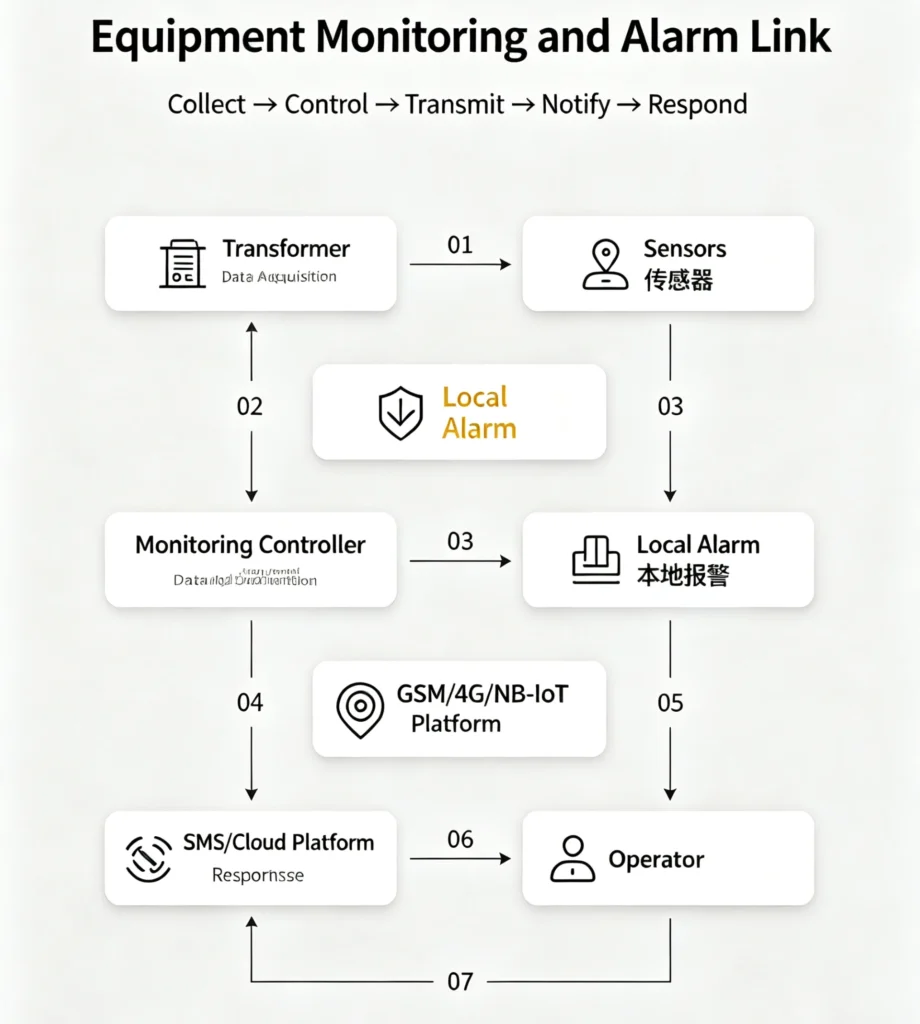
1. Sensors Detect Physical Changes
Sensors are installed at points where unauthorized activity is likely to occur.
Depending on the application, these may include:
- Vibration sensors
- Tilt or inclination sensors
- Tamper switches
- Anti-theft bolt sensors
- Cable continuity sensors
- Voltage and power sensors
For example, vibration may indicate someone is working on the transformer enclosure, while a sudden change in inclination may indicate that the transformer is being lifted.
2. The Controller Evaluates the Event
Not every abnormal signal means theft.
A transformer near a road may experience vibration from passing heavy vehicles. Strong wind can also produce movement or vibration. Maintenance work may trigger a sensor as well.
The controller therefore needs to evaluate the signal rather than simply react to every small change.
Depending on the system, this may involve:
- Threshold settings
- Alarm delays
- Event duration
- Multiple sensor inputs
- Different alarm levels
Using more than one signal can make the alarm more reliable. For example, vibration alone may not be enough to confirm an incident, while vibration combined with tilt and cable interruption provides a much stronger indication.
3. A Local Alarm Is Activated
Once an alarm condition is confirmed, the system can activate a siren or warning light.
A local alarm has an immediate deterrent effect and may attract attention if other people are nearby.
For isolated sites, however, the remote alarm is usually more important.
4. The Event Is Sent to the Operator
The monitoring unit can transmit alarm information using available communication networks, including:
- GSM
- 4G Cat.1
- NB-IoT
The choice depends on local network coverage, power availability, required data volume, and the type of monitoring platform being used.
An alarm message may include the event type, time, device identification, and location. Some systems can also transmit additional sensor information.
5. The Operator Responds
Once the alarm is received, the operator can decide what action is appropriate.
For a confirmed theft attempt, this may mean contacting local security personnel or dispatching a field team. For a communication failure or isolated power alarm, the response may instead be a technical inspection.
This distinction is important because a useful monitoring system should provide enough information for the operator to understand what happened—not simply generate another generic alarm.
What Parameters Should Be Monitored?
There is no single sensor that can identify every type of transformer theft. A practical system normally monitors several conditions.
Vibration
Vibration sensors can detect impact, drilling, hammering, and other mechanical disturbances.
Sensitivity needs to be adjusted according to the installation. A transformer close to a road or construction area may naturally experience more vibration than one installed in an isolated field.
Tilt and Movement
A tilt sensor detects changes in the transformer’s position.
This can be particularly useful when thieves attempt to lift, drag, or otherwise move the equipment.
For pole-mounted transformers, movement detection can also provide an additional layer of protection against unauthorized handling.
Anti-Theft Bolt Status
Special monitoring arrangements can be used to detect loosening or removal of security bolts.
This provides information about tampering with the physical mounting or protection system before the transformer itself is moved.
Cable Cutting
Cable monitoring is useful because thieves may disconnect or cut cables before attempting to remove equipment.
Loss of continuity can therefore be configured as an alarm condition.
Power and Voltage
A sudden loss of power can have several causes, so it should not automatically be treated as theft.
However, when power loss occurs together with another event—such as cable cutting, vibration, or movement—it becomes a much more useful indicator.
Backup power is important if the monitoring unit needs to continue reporting after the main supply has been disconnected.
Phase Status
Phase monitoring can identify phase loss or abnormal supply conditions. It can also provide additional information when investigating a cable or connection problem.
Communication Status
The monitoring device should ideally be able to report communication problems as well.
If a remote unit suddenly stops communicating, the operator needs to know whether the cause is a network outage, equipment failure, or possible tampering.
GPS and Camera Options
For some applications, GPS and camera functions can be added.
GPS can help identify the location of an asset, while a camera can provide visual confirmation of an event. These functions are particularly useful where the cost of dispatching a response team is high.
Transformer Theft Monitoring vs. Traditional Security Methods
No single security measure is suitable for every site.
| Method | Physical Protection | Tamper Detection | Remote Alert | 24/7 Monitoring |
|---|---|---|---|---|
| Security fence | ✓ | ✗ | ✗ | ✗ |
| Anti-theft bolts | ✓ | Limited | ✗ | ✗ |
| CCTV | ✓ | ✓ | Possible | ✓ |
| Local alarm | ✗ | ✓ | ✗ | ✓ |
| Manual inspection | ✗ | ✓ | ✗ | ✗ |
| Transformer theft monitoring | Depends on installation | ✓ | ✓ | ✓ |
The comparison does not mean that monitoring should replace fencing, locks, lighting, or other physical measures.
In practice, the better approach is usually layered protection:
Physical security + tamper detection + remote alarm + response procedure
A fence can make access harder. An anti-theft bolt can make removal more difficult. A camera can provide visual evidence. A monitoring system adds another capability: it can tell the operator that an abnormal event is happening without waiting for someone to visit the site.
Where Is Transformer Theft Monitoring Used?
Rural Distribution Substations
These are among the most obvious applications because sites can be isolated and widely distributed.
Long communication range and low power consumption are especially important where there is limited infrastructure.
Agricultural and Irrigation Transformers
Transformers serving irrigation systems may be located in fields or other areas with little human activity. Some installations may also remain unused for long periods.
Monitoring allows the equipment to remain under supervision even when there are no workers nearby.
Mining and Oilfield Facilities
Mining and oilfield sites can contain valuable electrical equipment spread across large areas.
A combination of tamper, movement, power, and communication monitoring can help reduce the time between an incident and the operator becoming aware of it.
Construction Sites
Temporary transformers are exposed to movement, unauthorized access, and changing site conditions.
Movement and location monitoring can be particularly useful where equipment is frequently relocated.
Pole-Mounted Transformers
Pole-mounted equipment can be relatively easy to access compared with equipment inside a secured substation.
Tilt, vibration, tamper, and power monitoring can provide additional protection against unauthorized access and removal.
Remote Industrial Facilities
Factories, pumping stations, telecommunications sites, and other industrial facilities may have their own remote transformers without permanent security personnel.
A remote alarm system can provide a practical way to supervise these installations from a central location.
Utility Distribution Networks
For utilities managing hundreds or thousands of transformers, manually increasing inspection frequency is expensive and difficult to scale.
Remote monitoring allows high-risk assets to be prioritized and alarms to be handled centrally.
How to Choose a Transformer Theft Monitoring System
Before selecting a system, look at the actual conditions of the installation rather than choosing sensors based only on a product specification sheet.
1. Start With the Theft Risk
Consider:
- Previous theft incidents
- Transformer location
- Accessibility
- Distance from populated areas
- Existing fencing and lighting
- Value of the equipment
- Availability of local security personnel
High-risk sites may justify a larger number of sensors and more communication options.
2. Match the Sensors to the Theft Scenario
Ask what you actually need to detect.
Does the system need to identify:
- Movement?
- Vibration?
- Enclosure opening?
- Bolt removal?
- Cable cutting?
- Power loss?
- Phase loss?
A system with more sensors is not necessarily better if those sensors do not address the site’s actual risks.
3. Check the Communication Network
GSM, 4G Cat.1, and NB-IoT have different advantages.
GSM can be sufficient for basic alarm messages where legacy cellular coverage remains available.
4G Cat.1 provides greater data capacity and is more suitable when the system needs to exchange more information.
NB-IoT is attractive for low-power remote applications, provided suitable network coverage is available.
The important point is to verify coverage at the actual transformer location, not simply assume that the network is available in the surrounding town or region.
4. Check Outdoor Protection
For outdoor installations, pay attention to:
- IP rating
- Operating temperature
- Water and dust resistance
- UV exposure
- Lightning protection
- Enclosure construction
For exposed equipment, an IP55-or-higher enclosure may be appropriate depending on the installation environment.
5. Consider Backup Power
If thieves disconnect the transformer supply, a monitoring device powered only from the transformer may stop reporting at exactly the wrong moment.
A battery backup allows the monitoring unit to continue operating after a power interruption.
The required standby time depends on the communication technology, sensor configuration, reporting frequency, and battery capacity. Instead of using a fixed figure for every installation, the backup requirement should be calculated for the actual site.
6. Check Integration Options
For larger utilities, it may be useful to integrate theft monitoring with existing systems such as:
- SCADA
- RTU
- CCTV
- Distribution management systems
- Cloud monitoring platforms
Integration becomes increasingly important as the number of monitored transformers grows.
How to Reduce False Alarms
False alarms can quickly become a problem if operators receive too many notifications that do not require action.
Typical causes include road traffic, construction, severe weather, scheduled maintenance, accidental impacts, and normal power interruptions.
Use More Than One Signal
A combination of signals generally provides better confidence than relying on one sensor.
For example:
Vibration + tilt + cable break
is more meaningful than vibration alone.
The exact alarm logic depends on the site and should be tested during commissioning.
Adjust Sensor Thresholds
Sensitivity should reflect the environment.
A transformer beside a busy road may require different vibration settings from one located in an isolated agricultural area.
Add an Alarm Delay
Very short disturbances can sometimes be ignored by requiring an abnormal condition to remain active for a specified period.
This helps prevent brief events from becoming unnecessary alarms.
Use Remote Data for Verification
When an alarm occurs, operators should be able to see what type of event triggered it and, where available, check other sensor values.
This allows the response team to distinguish between a likely theft attempt and a normal maintenance or environmental event.
Test the System Regularly
Sensors, batteries, SIM cards, communication modules, and alarm outputs should all be included in periodic testing.
A monitoring system is only useful if it can still communicate when an actual incident occurs.
How to Deploy Transformer Theft Monitoring at a Remote Substation
Step 1: Assess the Site
Record the transformer type, location, accessibility, previous incidents, power supply, and cellular coverage.
Step 2: Define the Detection Points
Decide whether the installation requires vibration, tilt, tamper, cable, voltage, phase, or other sensors.
Step 3: Install the Sensors
Sensors should be mounted at locations where they can detect the intended event without being unnecessarily affected by normal operation.
Step 4: Configure Communications
For GSM or 4G systems, install and test the SIM connection. For NB-IoT, confirm network availability and device registration.
Signal strength should be checked at the actual installation point.
Step 5: Set Alarm Parameters
Configure thresholds, alarm delays, notification recipients, and escalation rules.
Avoid using identical sensitivity settings for every transformer unless the sites have similar conditions.
Step 6: Connect the Monitoring Platform
Register the device and confirm that the operator can see the transformer status and receive alarms remotely.
Step 7: Test Every Alarm
Physically test each required detection function.
For example:
- Test vibration detection
- Test tilt detection
- Test tamper detection
- Test cable-break detection
- Test power-loss reporting
- Test remote alarm transmission
- Test battery backup
Step 8: Define the Response Procedure
The final step is often overlooked.
Operators should know who receives the alarm, who verifies it, who contacts local personnel, and what happens if the first response attempt fails.
A monitoring system becomes much more effective when the technology is connected to a clear operational procedure.
Transformer Theft Monitoring System Selection Checklist
| Requirement | Recommended Consideration |
|---|---|
| Transformer location | Remote / rural / industrial / urban |
| Transformer type | Pole-mounted / pad-mounted / substation |
| Theft risk | Low / medium / high |
| Physical monitoring | Vibration / tilt / tamper |
| Cable monitoring | Required / optional |
| Power monitoring | Required / optional |
| Communication | GSM / 4G / NB-IoT |
| Local alarm | Siren / warning light |
| Remote alarm | SMS / cloud platform |
| Backup power | Recommended for unattended sites |
| Environmental protection | Outdoor / weather-resistant / IP-rated |
| Integration | CCTV / SCADA / RTU / monitoring platform |
Frequently Asked Questions
What is transformer theft monitoring?
Transformer theft monitoring is a remote system used to detect events such as unauthorized movement, tampering, cable cutting, power loss, and other abnormal conditions. When an event is detected, the system sends an alarm to the designated operator.
How does transformer theft monitoring work?
Sensors monitor selected physical and electrical conditions around the transformer. A controller evaluates the sensor signals and activates an alarm when predefined conditions are met. The event can then be transmitted through GSM, 4G, NB-IoT, or another supported communication network.
Can it detect cable cutting?
Yes. A cable monitoring circuit can detect a loss of continuity and generate an alarm when the monitored cable is cut or disconnected.
Can it detect transformer movement?
Yes. Tilt or inclination sensors can detect changes in the transformer’s position. This is useful when equipment is being lifted, dragged, or otherwise moved.
Can the system work without personnel at the site?
Yes. The monitoring equipment can operate automatically and send alarms to a remote operator. This makes it suitable for unattended substations and remote distribution networks.
Which communication technology is best?
There is no universal answer. GSM, 4G Cat.1, and NB-IoT can all be suitable depending on local network coverage, power availability, data requirements, and the monitoring platform.
Can it send SMS alarms?
Yes. SMS can be used for alarm notifications. Some systems also support cloud platforms or other remote notification methods.
Can transformer theft monitoring work with CCTV or SCADA?
Many systems can be integrated with CCTV, SCADA, RTU, or other monitoring platforms. The available interface and communication protocol should be checked before deployment.
Is it suitable for rural substations?
Yes. Remote and rural substations are a major application because they are often difficult to patrol and may have no permanent personnel.
How can false alarms be reduced?
Use appropriate sensor thresholds, alarm delays, and multiple detection signals. Combining events such as movement, vibration, cable interruption, and power loss can provide more reliable confirmation than relying on a single sensor.
Protect Remote Transformers With Continuous Monitoring
For an unattended transformer, the biggest weakness is often not the lack of physical security. It is the lack of information.
A fence may delay an intruder. A security bolt may make removal more difficult. A camera may record what happened. But if nobody knows that an incident is taking place, these measures may not prevent the transformer from being damaged or removed.
Transformer theft monitoring adds that missing layer of visibility.
The basic process is straightforward:
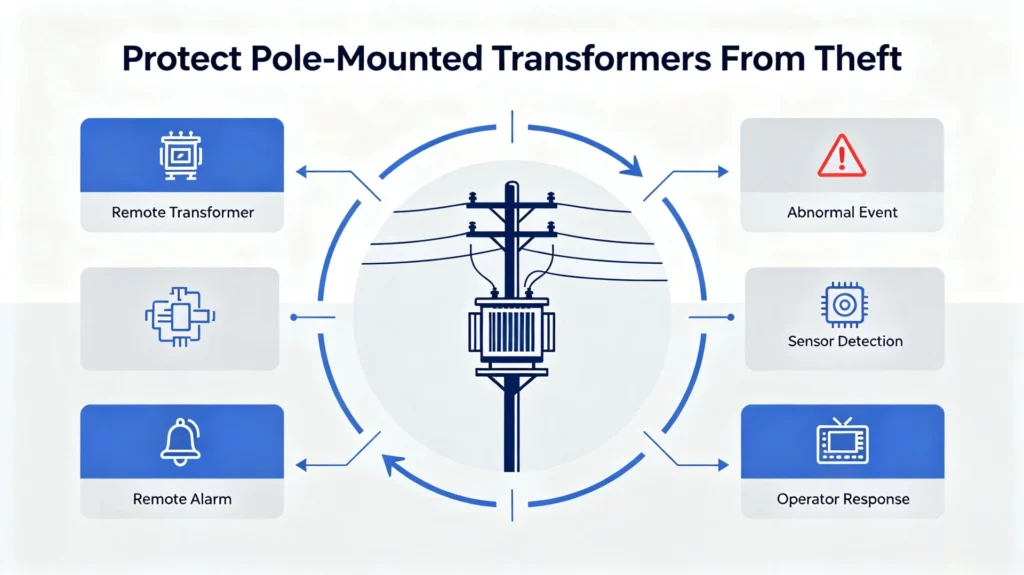
For utilities and operators managing remote substations, the right system should therefore be selected according to the actual site conditions: what needs to be detected, how the alarm will be transmitted, how long the equipment must operate on backup power, and how the response team will act when an alarm is received.
If you are evaluating a monitoring solution for rural or unattended substations, you can also review our Transformer Anti-Theft Monitoring Device solution to compare the available detection and communication functions.
References
- “Powertel rolls out hi-tech system to curb vandalism,” The Herald (Zimbabwe), July 2025.
- M. F. Khan, “Aggregated Wireless Sensor System for High-Risk Distribution Substations,” CIGRE Southern Africa Regional Conference, October 2025.
- “Wireless sensor system targets cable-theft disruptions at high-risk substations,” Energize, November 2025.
- “Ludhiana: Over ₹10 crore lost to transformer thefts in a yr, reveals PSPCL report,” Hindustan Times, June 2026.
- Y. Ji et al., “Intelligent diagnosis method for electricity theft behavior in distribution network based on three-layer edge computing model,” Energy Reports, vol. 9, pp. 428–432, October 2023.
- CIGRE WG B3.45, “Security of Critical Power Infrastructure,” CIGRE Technical Brochure, 2023.
- IEEE Std C57.12.00-2021, “IEEE Standard for General Requirements for Liquid-Immersed Distribution, Power, and Regulating Transformers.”