

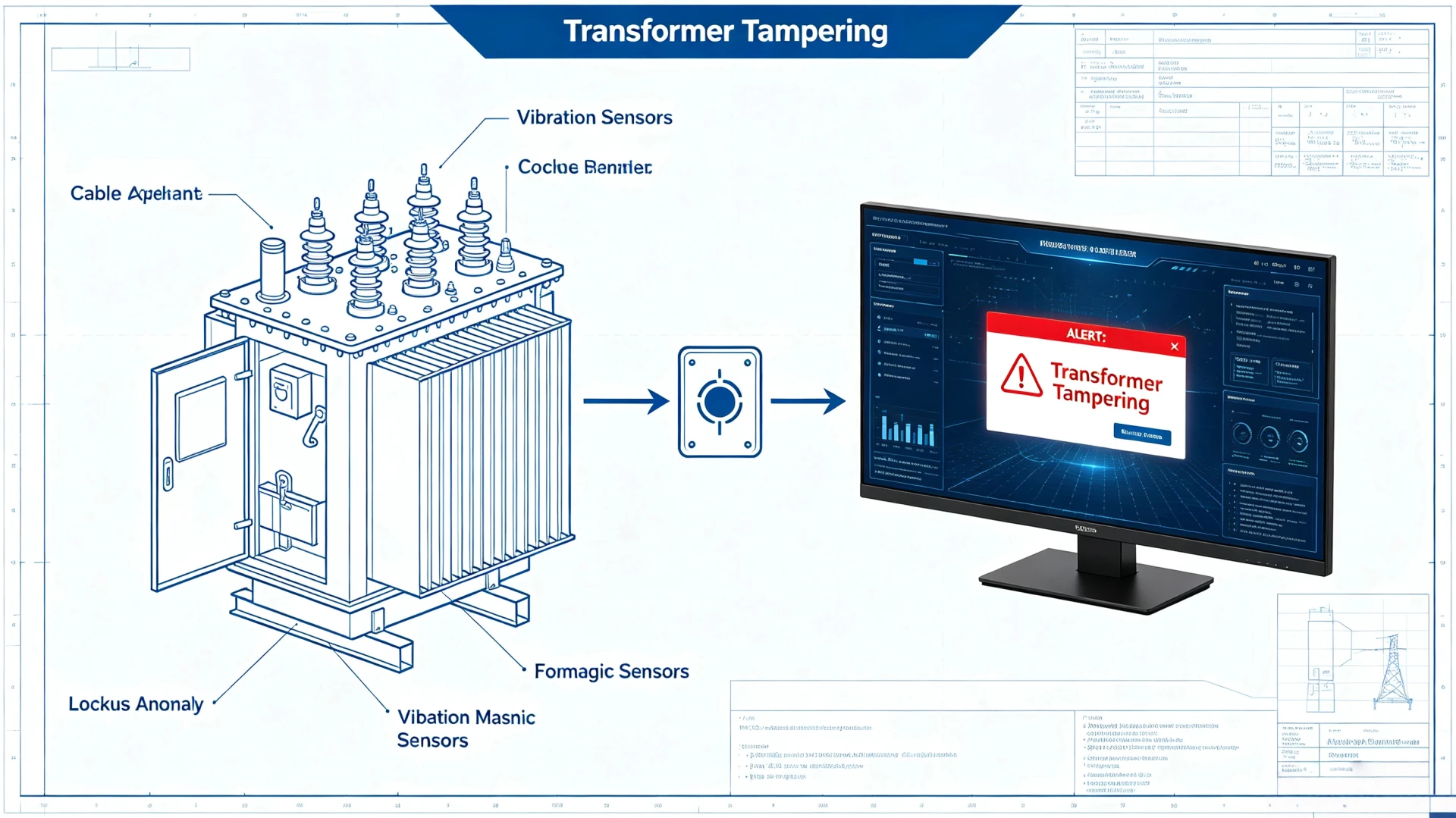
Remote transformers are not easy to supervise. A unit may be inspected regularly, but there can still be long periods when nobody is near the site. During that time, someone could open the enclosure, cut a cable, loosen mounting hardware, or try to move the transformer without being noticed.
In many cases, the problem is discovered only after the transformer has stopped supplying power or a field technician arrives at the site.
Transformer vibration monitoring provides an earlier indication of physical interference. A sensor installed on the transformer or its supporting structure can detect unusual mechanical activity and send an alarm to a remote operator.
The important point is that vibration monitoring is not simply about measuring whether a transformer is vibrating. Transformers naturally produce vibration during normal operation. The useful information comes from identifying vibration that is different from what is normally expected at that particular site.
This article explains how vibration monitoring can be used for transformer tampering detection, what can cause abnormal vibration, how it can be combined with other sensors, and what should be considered when installing a system at a remote transformer.
What Is Transformer Tampering?
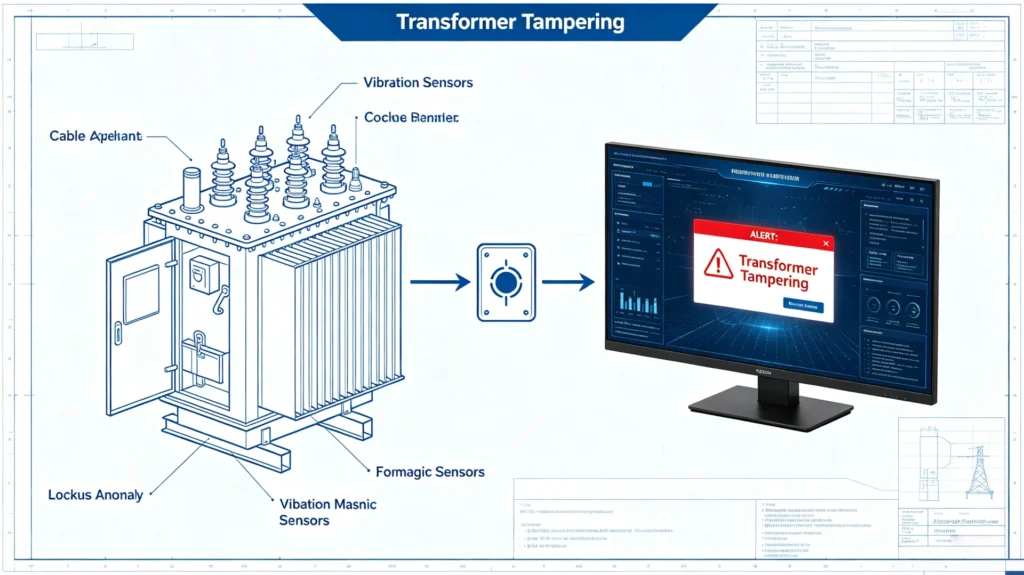
Transformer tampering means unauthorized physical interference with a transformer or its associated equipment.
It can take several forms:
- Striking or hitting the transformer
- Drilling or cutting
- Opening an enclosure
- Removing security bolts
- Cutting or disconnecting cables
- Moving or tilting the transformer
- Attempting to remove the transformer
- Deliberately damaging components
At a staffed substation, some of these events may be noticed immediately. At a remote distribution transformer, there may be no one around to see or hear what is happening.
Common Signs of Tampering
There is no single indication that proves a transformer is being tampered with. Operators may instead see a combination of abnormal conditions, such as:
- A sudden increase in vibration
- Repeated impact events
- Unexpected movement
- A change in tilt angle
- Cable interruption
- Loss of power
- Enclosure tampering
- Communication failure
Vibration is useful because it can provide an indication at the beginning of the event, before the transformer has necessarily been moved or disconnected.
Why Monitor Transformer Vibration?
A transformer already vibrates during normal operation. Core magnetostriction, electromagnetic forces, load changes, cooling fans, pumps, and other equipment can all contribute to the vibration measured at the transformer.
That means the presence of vibration itself is not unusual.
The monitoring problem is different:
Is the vibration consistent with normal operation, or does it look like an external mechanical disturbance?
This distinction is particularly important for anti-tampering applications.
Normal Transformer Vibration
Normal operating vibration can be associated with:
- Core magnetostriction
- Electromagnetic forces
- Load changes
- Cooling fans
- Cooling pumps
- Other connected equipment
The vibration level can vary with transformer loading and operating conditions. A transformer operating at a higher load may not produce exactly the same vibration pattern as it does at light load.
Vibration Caused by External Activity
External interference can produce a different type of mechanical signal.
Examples include:
- Hammering
- Drilling
- Cutting
- Striking
- Forced access
- Dragging
- Lifting
- Repeated attempts to loosen components
A monitoring system therefore needs to account for the normal operating condition of the transformer rather than simply applying one universal vibration threshold.
What Is Transformer Vibration Monitoring?
Transformer vibration monitoring is the continuous measurement of mechanical vibration from a transformer to identify unusual changes or external disturbances.
For anti-theft applications, the objective is different from transformer condition monitoring.
Vibration analysis is also used to investigate internal transformer problems such as core abnormalities, winding deformation, looseness, and other mechanical conditions. Those applications normally require more detailed signal analysis.
For theft and tampering detection, the focus is much simpler:
Detect physical interference with the transformer or its associated equipment.
This distinction is important when specifying the monitoring system. A device designed for transformer condition diagnosis should not automatically be assumed to provide effective anti-theft detection, and vice versa.
How Does Transformer Vibration Monitoring Work?
A typical arrangement consists of a vibration sensor, controller, communication module, and alarm output.
The process is straightforward:
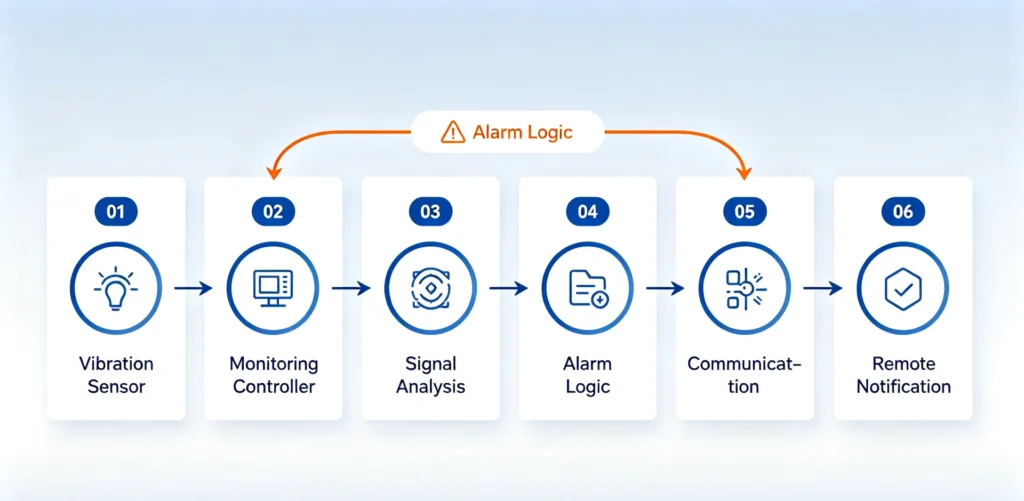
The Sensor Measures Mechanical Activity
A vibration sensor is mounted on the transformer body or an appropriate supporting structure.
The sensor detects mechanical movement and sends the signal to the monitoring controller.
The Controller Evaluates the Signal
The controller checks the incoming signal against configured alarm conditions.
Depending on the equipment, these conditions may include:
- Vibration amplitude
- Event duration
- Number of events
- Changes from a normal baseline
- Input from other sensors
This allows the system to distinguish a short disturbance from a longer physical interference event.
An Alarm Is Generated
If the measured condition meets the configured alarm criteria, the controller can activate a local siren or warning light.
The same event can be transmitted to a remote monitoring platform.
The Operator Receives the Information
Depending on the communication configuration, the alarm can be sent through GSM, 4G, NB-IoT, or another available network.
The operator can then decide whether field inspection or another response is required.
How Can Vibration Indicate Transformer Tampering?
Vibration monitoring is most useful when it is treated as an indication of an event rather than a direct diagnosis of theft.
For example, consider three different situations.
Passing heavy vehicle:
A short vibration occurs, but there is no change in tilt, cable status, or enclosure condition.
Maintenance activity:
Vibration occurs while authorized personnel are working at the transformer.
Possible theft attempt:
Repeated vibration is followed by a change in tilt angle or cable interruption.
The three situations can produce vibration, but the surrounding information is different.
This is why the quality of a transformer tampering detection system depends not only on the vibration sensor but also on the alarm logic and other available inputs.
What Types of Tampering Can Vibration Monitoring Detect?
Physical Impact
Hammering or striking a transformer enclosure produces mechanical vibration that can be detected by a properly installed sensor.
This is one of the simplest applications of vibration detection.
Drilling and Cutting
Drilling, sawing, and similar activities create repeated mechanical disturbances.
Whether these events can be reliably distinguished from other vibration sources depends on the sensor characteristics, installation, and signal-processing method.
Attempted Movement
Lifting or dragging a transformer can generate vibration as the equipment moves against its supports.
Vibration can provide an initial indication, while a tilt sensor can confirm that the transformer has actually changed position.
Security Hardware Tampering
Attempts to remove bolts, covers, or other components can generate short, repeated vibration events.
A dedicated tamper or bolt sensor can provide more direct confirmation.
Repeated Disturbance
Event records can also be useful.
Several vibration events occurring within a short period may indicate repeated attempts to access or move the equipment, even if each individual event is relatively small.
What Can Cause Abnormal Transformer Vibration?
Not every unusual vibration is related to theft.
| Source | Typical Examples |
|---|---|
| Normal operation | Load changes, core vibration, cooling equipment |
| Road traffic | Heavy trucks or machinery near the transformer |
| Construction | Drilling, excavation, piling |
| Weather | Strong wind or structural movement |
| Maintenance | Authorized work on the transformer |
| Tampering | Impact, drilling, cutting, forced access |
| Attempted removal | Lifting, dragging, movement |
This is one of the main limitations of vibration-based detection.
A system that treats every vibration event as an intrusion will generate too many alarms. The installation therefore needs suitable thresholds and, preferably, additional sensor inputs.
Why Combine Vibration With Other Sensors?
Vibration is useful as an early warning signal, but other sensors can provide the context needed to determine what happened.
Vibration + Tilt
This combination is useful when transformer movement is the main concern.
If vibration occurs at the same time as a significant change in inclination, the possibility of lifting or dragging becomes more credible.
Vibration + Cable Monitoring
If vibration is followed by cable interruption, the operator has more information about the event.
This can be useful in areas where cable theft or cable cutting is common.
Vibration + Tamper Sensor
A vibration event together with an enclosure or access-panel alarm provides stronger evidence of physical interference.
Vibration + Power Monitoring
A sudden power interruption does not necessarily mean theft. Grid faults happen.
However, power loss occurring together with physical vibration can be worth investigating.
Vibration + GPS
GPS does not detect tampering by itself, but it can help confirm the location of a remote asset and provide information if the equipment is displaced.
Vibration + Camera
A camera can provide visual confirmation after a vibration alarm.
This can be particularly useful when sending a field team to an isolated site would involve a long journey.
The objective is not to install every possible sensor. It is to use the combination that makes sense for the site’s actual risks.
How to Reduce False Alarms
False alarms are one of the first issues that should be considered when deploying vibration monitoring.
A monitoring system that sends too many unnecessary alarms can become difficult for operators to manage.
Establish the Normal Condition First
Before setting aggressive alarm thresholds, observe the transformer under normal operating conditions.
Record how vibration changes with:
- Transformer loading
- Cooling equipment operation
- Time of day
- Nearby traffic
- Weather
- Normal maintenance activity
The operating environment matters as much as the sensor itself.
Adjust the Vibration Threshold
A transformer installed beside a highway may experience considerably more background vibration than one located in an isolated field.
The threshold should reflect this difference.
A threshold that works well at one location may be unsuitable at another.
Use an Alarm Delay
A very short vibration spike may not justify an alarm.
An alarm delay or minimum event duration can help filter out brief disturbances.
The exact value should be determined through site testing rather than copied from another installation.
Combine Sensor Inputs
Where other sensors are available, use them to improve confidence.
For example:
Vibration + tilt
can be given a higher alarm priority than vibration alone.
Likewise:
Vibration + cable interruption + power loss
may warrant immediate investigation.
Allow Alarm Verification
Operators should have enough information to understand why the alarm occurred.
Useful information may include the alarm type, time, location, sensor status, and recent event history.
This makes it easier to decide whether a field visit is necessary.
Why Remote Transformers Need Vibration Monitoring
No Permanent Personnel
Many rural transformers are located far from staffed substations or maintenance centres.
A local alarm may not be heard by anyone. Remote notification removes the need for somebody to be physically present when the event occurs.
Long Inspection Intervals
Regular inspections remain necessary, but they cannot provide continuous visibility.
If an inspection takes place every few weeks, an incident occurring immediately afterward may remain undiscovered until the next visit.
Vibration monitoring fills that gap.
Difficult Access
Some transformers are located in agricultural fields, mountainous areas, mining zones, or other places that are expensive and time-consuming to reach.
An alarm allows maintenance teams to investigate a specific site instead of checking every transformer in the area.
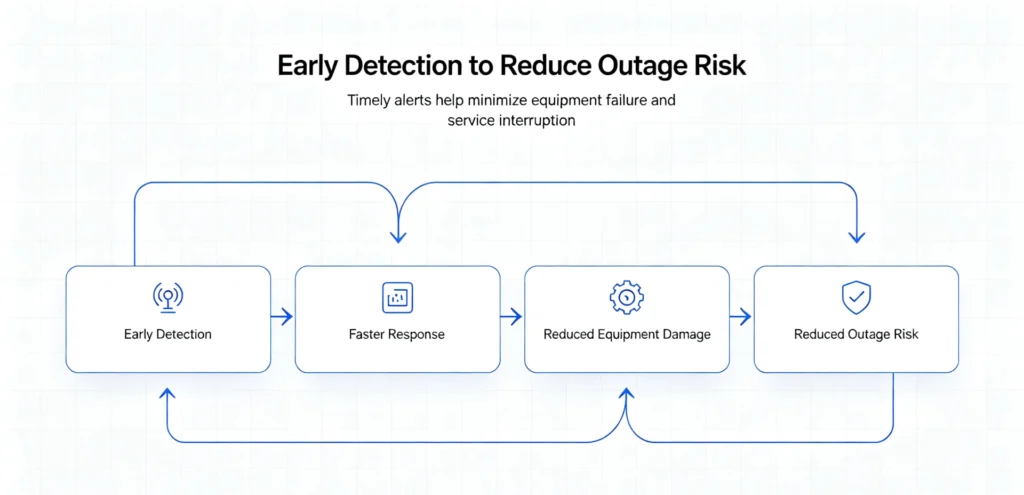
Earlier Warning
A physical inspection often identifies the result of tampering.
Vibration monitoring can identify the mechanical activity that may have caused it.
That difference can give the operator more time to respond.
Applications of Transformer Vibration Monitoring
Rural Distribution Transformers
Rural transformers are often dispersed over large areas and may have limited security infrastructure.
Vibration monitoring can provide an additional alarm layer without requiring a permanent security presence.
Agricultural and Irrigation Transformers
Transformers used for irrigation can remain unattended outside operating periods.
Monitoring can continue even when the equipment is not being actively used.
Mining and Oilfield Sites
Large industrial sites often have electrical equipment distributed over considerable distances.
Remote vibration monitoring can reduce dependence on frequent physical patrols.
Pole-Mounted Transformers
Pole-mounted transformers are physically accessible and can be exposed to unauthorized climbing, impact, or attempted removal.
Vibration combined with tilt detection is particularly relevant to these installations.
Construction Sites
Temporary transformers face changing surroundings and may be moved during the project.
Monitoring can help identify unauthorized interference and unexpected movement.
Unattended Distribution Substations
Where several transformers are installed at one site without permanent personnel, sensor information can be sent to a central monitoring point.
Utility Networks
Utilities managing large numbers of distribution transformers can use remote alarms to prioritize field inspections.
Rather than increasing the inspection frequency of every transformer, operators can investigate assets that generate abnormal events.
Transformer Vibration Monitoring vs Manual Inspection
| Feature | Manual Inspection | Vibration Monitoring |
|---|---|---|
| Continuous observation | ✗ | ✓ |
| Remote alarm | ✗ | ✓ |
| Detect sudden physical disturbance | Limited | ✓ |
| Monitor between inspections | ✗ | ✓ |
| Requires a site visit | ✓ | Not necessarily |
| Event history | Limited | ✓ |
| Detailed physical inspection | ✓ | ✗ |
The two methods serve different purposes.
Manual inspection is still needed to check physical condition, connections, corrosion, oil leakage, mounting hardware, and other details that a sensor cannot see.
Vibration monitoring provides another layer between those inspections.
How to Select a Transformer Vibration Monitoring System
Sensor Type and Sensitivity
The sensor should be suitable for the type of physical activity that needs to be detected.
Check the sensor’s measurement range, sensitivity, mounting method, and environmental rating.
Mounting Method
Sensor installation has a direct effect on the quality of the measurement.
A loose or poorly mounted sensor can produce unreliable readings or excessive noise.
The mounting location should also be selected carefully so that normal transformer operation does not overwhelm the signal from external activity.
Alarm Configuration
The controller should allow alarm thresholds and event duration to be adjusted.
This is particularly important when several transformers are installed in different environments.
Multi-Sensor Capability
If the project requires more reliable tampering detection, check whether vibration can be combined with tilt, tamper, cable, power, or other inputs.
Communication
The monitoring unit should support the communication network available at the installation site.
Depending on the project, this may be:
- GSM
- 4G
- NB-IoT
- Wired communication
Network coverage should be checked at the transformer location rather than assumed from coverage in the nearest town.
Environmental Protection
For outdoor transformers, the monitoring equipment should be suitable for:
- Rain
- Dust
- Temperature changes
- Humidity
- UV exposure
- Electrical surges
The enclosure and sensor should have an appropriate IP rating for the actual installation.
Backup Power
If the monitoring device needs to continue reporting after the transformer supply is interrupted, a backup power source is required.
Battery life depends on the communication method, reporting frequency, sensor load, operating temperature, and battery capacity. It should therefore be specified according to the actual operating requirements.
How to Install Transformer Vibration Monitoring
Choose the Installation Point
The sensor should be mounted where mechanical disturbances can be detected reliably.
The transformer body and supporting structure are common locations, but the correct point depends on the transformer design and the expected theft scenario.
Secure the Sensor
The sensor needs a firm mechanical connection.
A loose installation can create its own vibration and make the monitoring data difficult to interpret.
Connect the Controller
Connect the sensor to the monitoring controller and check that the controller is receiving a stable signal.
Configure Communication
Set up the selected cellular or wired communication method and verify the connection from the actual installation location.
Record Normal Operation
Observe the transformer under normal conditions before finalizing alarm thresholds.
This helps identify background vibration that could otherwise produce nuisance alarms.
Test the Alarm
Use a controlled and safe test to confirm that the system detects the intended event.
Check both local alarm outputs and remote notification.
Review the System After Deployment
Initial settings may need adjustment after the system has operated in the real environment.
Reviewing alarm records during the first period of operation can help identify thresholds that are too sensitive or too conservative.
Transformer Vibration Monitoring Checklist
| Item | What to Check |
|---|---|
| Monitoring objective | Tampering, movement, or general vibration monitoring? |
| Transformer type | Pole-mounted, pad-mounted, or substation transformer? |
| Sensor | Suitable sensitivity and measurement range? |
| Installation | Secure mounting and suitable location? |
| Alarm threshold | Adjustable for site conditions? |
| Alarm delay | Available if required? |
| Other sensors | Tilt, cable, tamper, power? |
| Communication | GSM, 4G, NB-IoT, or wired? |
| Backup power | Required during mains failure? |
| Environment | Outdoor-rated and suitable IP protection? |
| Remote platform | Alarm history and device status available? |
| Maintenance | Sensor, battery, communication, and alarm testing? |
Frequently Asked Questions
What is transformer vibration monitoring?
It is the continuous measurement of mechanical vibration from a transformer to identify abnormal physical activity or changes from normal operating conditions.
Can vibration monitoring detect transformer tampering?
It can detect mechanical disturbances associated with activities such as impact, drilling, cutting, forced access, and attempted movement. However, vibration alone cannot prove that theft is taking place.
What causes abnormal transformer vibration?
Possible causes include external impact, drilling, cutting, construction, heavy vehicles, severe weather, maintenance activity, and attempted movement. Changes in transformer loading or cooling equipment can also affect normal vibration.
Can vibration monitoring detect transformer movement?
Vibration can indicate the mechanical activity associated with movement. A tilt or inclination sensor is more suitable for confirming that the transformer has actually changed position.
Can vibration monitoring detect transformer theft?
It can provide an early indication of physical interference, but it should not be treated as a standalone theft detector. Combining vibration with tilt, tamper, cable, or power monitoring provides more information for alarm verification.
Can it be used on unattended transformers?
Yes. Remote transformers are one of the main applications because the monitoring equipment can detect events without requiring someone to be present at the site.
Can vibration sensors be used outdoors?
Yes, provided the sensor and enclosure are designed for outdoor conditions and have appropriate protection against water, dust, temperature changes, and other environmental factors.
How do you reduce false alarms?
Start by recording normal vibration at the actual site. Then adjust the threshold and event duration according to the local environment. Multi-sensor verification can further reduce unnecessary alarms.
Should vibration monitoring be combined with other sensors?
For theft and tampering applications, it is generally useful to combine vibration with sensors that detect movement, cable interruption, enclosure access, or power status. The appropriate combination depends on the site’s security risks.
Detect Suspicious Transformer Activity Earlier
Vibration monitoring is not intended to replace physical security or regular inspection.
Its value is in the period between inspections.
A fence can make access more difficult. A lock or security bolt can slow down removal. A camera can provide visual evidence. Vibration monitoring adds another capability: it can alert the operator when physical activity begins.
For remote transformers, that early indication can be useful when a response team is available to investigate the event.
A practical installation may therefore combine:
Vibration detection + movement detection + tamper monitoring + remote communication
The exact configuration should depend on the transformer, site environment, communication coverage, and the type of theft or vandalism that has occurred in the area.
For applications requiring transformer tampering detection and remote alarms, see our Transformer Anti-Theft Monitoring Device product page.