

By Leon Zhang, Transformer Condition Monitoring Engineer · Published September 9, 2026 · Last updated: October 5, 2026 · 9 min read
DGA monitoring for power transformers is the continuous or periodic measurement of dissolved gases in transformer oil to detect developing internal faults. By tracking gases such as hydrogen, acetylene, ethylene and carbon monoxide, it reveals partial discharge, thermal overheating and arcing weeks before a functional failure — turning transformer maintenance from time-based to condition-based.
For utilities and industrial operators, this matters because a single unplanned transformer failure can cost far more than an entire fleet’s monitoring programme. This guide explains how transformer DGA monitoring works, which gases and faults it detects, the IEEE C57.104 alarm limits to apply, how online monitoring compares with laboratory testing, and how to deploy it across a transformer fleet.
What Is DGA Monitoring for Power Transformers?
DGA stands for dissolved gas analysis — a diagnostic technique that measures gases dissolved in transformer oil to assess the condition of oil-filled electrical equipment. DGA monitoring for power transformers applies this principle continuously or at intervals, converting gas concentrations into an early-warning signal about incipient faults.
Faults inside a transformer decompose the insulating oil and cellulose, and the gases produced dissolve into the oil. Because each fault type generates a characteristic gas pattern, the composition and rate of change of dissolved gases reveal what is happening inside the tank without opening it.
What Does DGA Stand For in Transformer Monitoring?
DGA stands for dissolved gas analysis. In transformer monitoring the term covers two activities: sampling and laboratory measurement of gases dissolved in insulating oil, and the continuous online measurement performed by permanently installed monitors.
DGA Testing vs. DGA Monitoring: What Is the Difference?
DGA testing is a discrete event: an oil sample is taken and analysed in a laboratory, producing a snapshot on the day of sampling. DGA monitoring is an ongoing process — either a repeat sampling programme or a permanent online monitor that measures automatically and tracks trends. In short, testing answers “what are the gas levels today?”, monitoring answers “how fast are they changing, and is that dangerous?”
How DGA Monitoring for Transformers Works
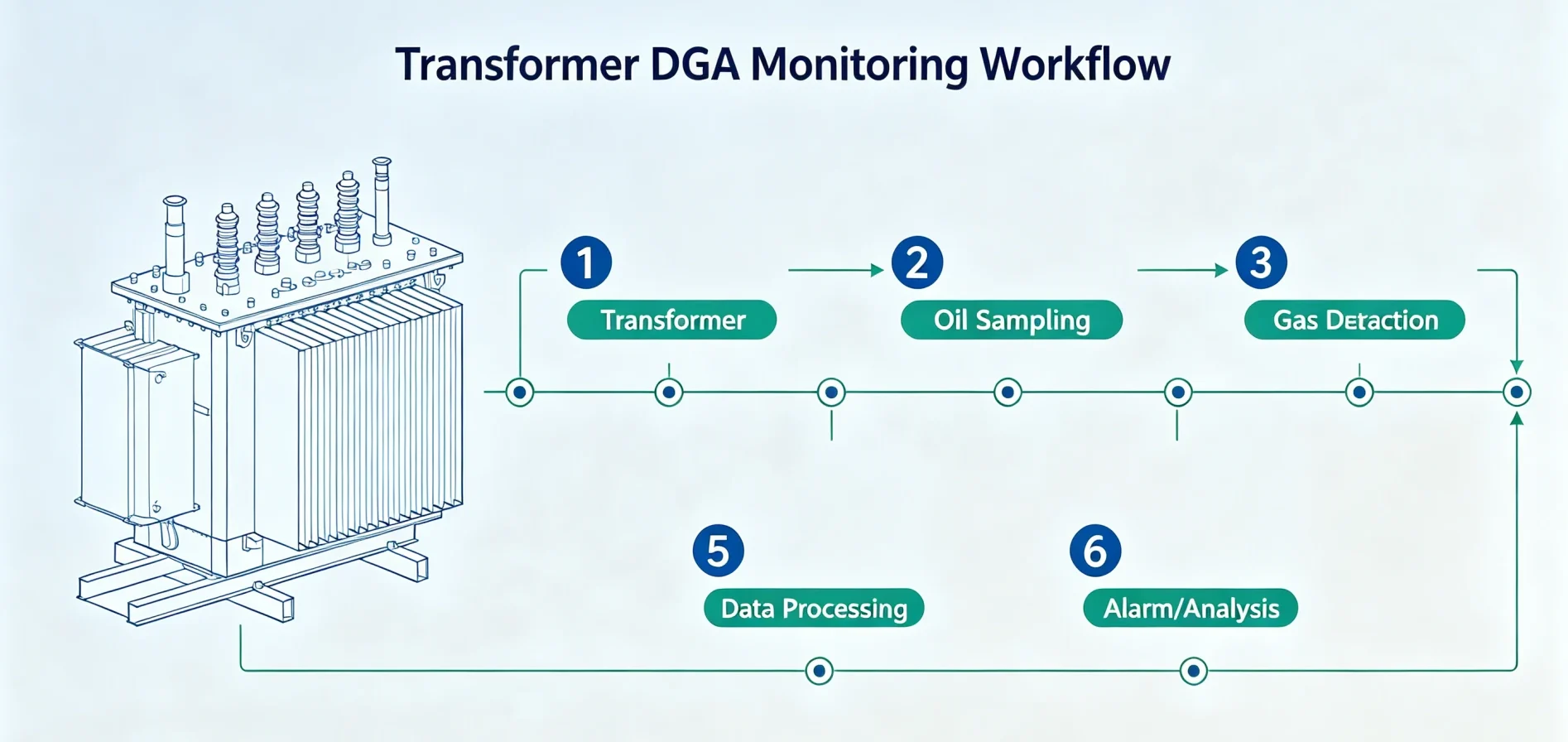
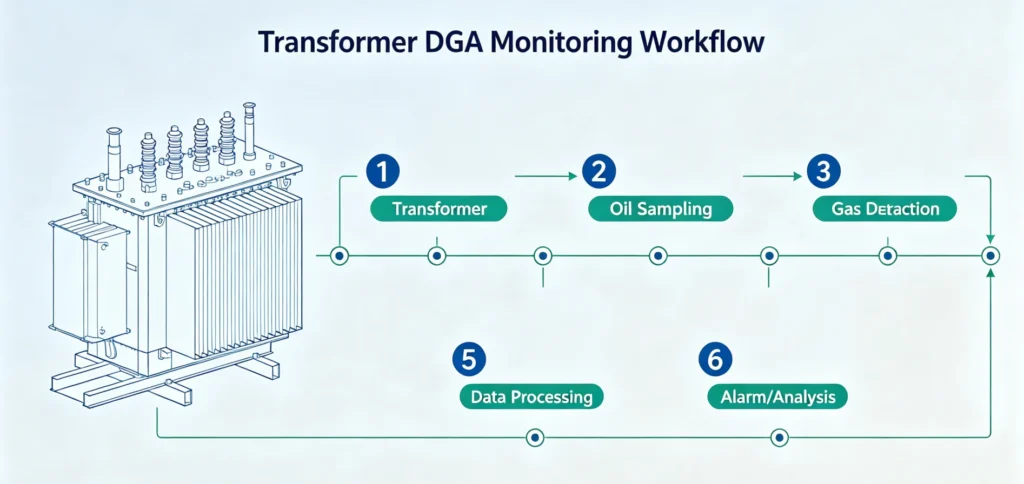
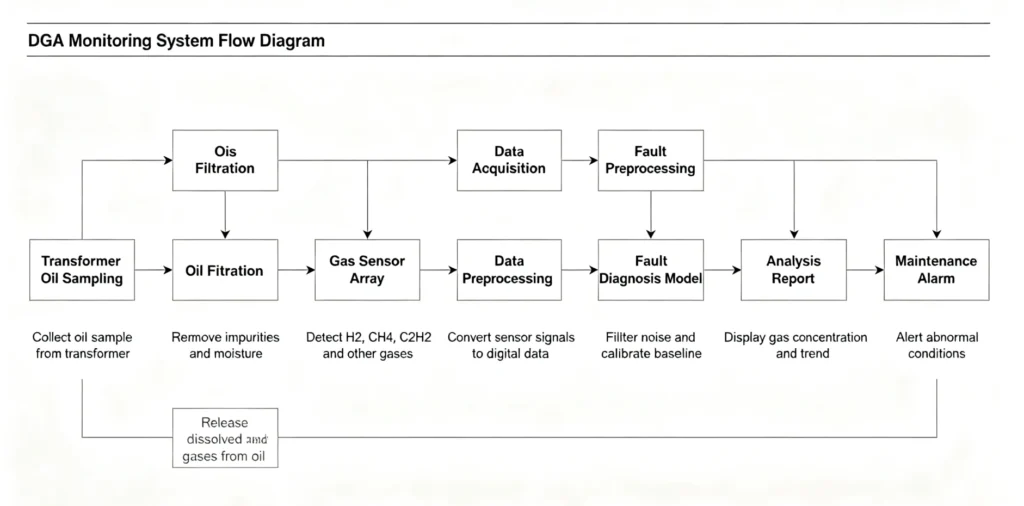
An online DGA monitoring system performs three steps in a closed loop: it extracts dissolved gases from a circulating oil stream, measures their concentrations with an optical or chromatographic sensor, and analyses the results against thresholds and historical trends to classify the fault type and urgency.
Transformer Oil as a Diagnostic Medium
Transformer oil serves two primary purposes — electrical insulation and heat transfer — but it also acts as a diagnostic medium. Under thermal or electrical stress, oil molecules break down into hydrogen, methane, ethane, ethylene and acetylene, while overheating of paper insulation releases carbon monoxide and carbon dioxide. These gases remain dissolved in the oil, where they can be measured.
Gas Extraction and Detection
Online systems circulate oil through a measurement cell and extract dissolved gases by headspace or membrane contact. Detection then uses one of three technologies: gas chromatography, photoacoustic spectroscopy (PAS) or infrared spectroscopy. PAS and infrared detectors suit compact field units, while gas chromatography remains the reference laboratory method. See the portable dissolved gas analyzer for a field instrument that performs 7-gas plus moisture measurement in about 20 minutes.
Data Analysis, Trend Tracking and Rate of Change
Raw concentrations alone are rarely decisive. Modern systems combine absolute values with rate-of-change analysis, because the speed at which a gas is generated often indicates a fault more reliably than the absolute level. A transformer sitting steadily at 60 ppm hydrogen is behaving differently from one that climbed from 10 to 60 ppm in a week — and it is the second unit that needs attention.
Which Gases Does DGA Monitoring Detect?
Standard DGA monitors measure seven fault gases — hydrogen, methane, ethane, ethylene, acetylene, carbon monoxide and carbon dioxide — with moisture measured alongside, plus optional nitrogen and oxygen channels for a nine-component configuration. Each gas points to a different stress mechanism, and IEC 60599 provides the interpretation framework while IEEE C57.104 sets the alarm levels applied to each gas.
| Gas | Formula | Primary indication | Source material |
|---|---|---|---|
| Hydrogen | H₂ | Partial discharge, low-energy sparking, stray gassing | Oil |
| Methane | CH₄ | Low-temperature thermal fault (<300 °C) | Oil |
| Ethane | C₂H₆ | Thermal decomposition | Oil |
| Ethylene | C₂H₄ | High-temperature overheating (>700 °C) | Oil |
| Acetylene | C₂H₂ | Arcing, high-energy discharge — most decisive indicator | Oil |
| Carbon monoxide | CO | Cellulose (paper) overheating | Paper / pressboard |
| Carbon dioxide | CO₂ | Long-term cellulose insulation ageing | Paper / pressboard |
Interpretation framework per IEC 60599 and IEEE C57.104. For a gas-by-gas explanation of what each reading means, see what DGA gases mean in transformer oil.
Gas combinations carry more diagnostic value than single readings. Elevated hydrogen alone suggests partial discharge; hydrogen plus acetylene indicates arcing; ethylene dominating with rising ethane points to a hot spot above 700 °C.
What Faults Can DGA Monitoring Detect?
DGA fault diagnosis identifies four main fault families — partial discharge, thermal overheating, arcing and cellulose ageing — together with the mixed or developing faults that precede them. It works by matching gas signatures and generation trends against the diagnostic patterns defined in IEC 60599.
| Fault type | Characteristic gas signature | Typical temperature |
|---|---|---|
| Partial discharge (corona) | H₂ dominant, small CH₄ | — |
| Low-energy discharge (sparking) | H₂ + CH₄, C₂H₂ begins to appear | — |
| High-energy discharge / arcing | C₂H₂ + C₂H₄ dominant | >700 °C |
| Thermal fault, low range | CH₄ + C₂H₆ | 150–300 °C |
| Thermal fault, high range | C₂H₄ rising, then C₂H₂ | >700 °C |
| Cellulose / paper ageing | CO and CO₂ rising together | 120–150 °C local |
For a step-by-step diagnostic workflow, see DGA fault detection and transformer fault diagnosis.
DGA Alarm Limits: IEEE C57.104 and IEC 60599 Thresholds
IEEE C57.104-2019 defines four condition levels for in-service oil-immersed transformers, based on individual gas concentrations and total dissolved combustible gas (TDCG = H₂ + CO + CH₄ + C₂H₆ + C₂H₄ + C₂H₂). Condition 1 is normal; Condition 4 indicates imminent failure risk and prompts consideration of removing the unit from service.
| Component (μL/L = ppm) | Condition 1 Normal | Condition 2 Caution | Condition 3 Warning | Condition 4 Critical |
|---|---|---|---|---|
| Hydrogen (H₂) | ≤100 | 101–700 | 701–1,800 | >1,800 |
| Methane (CH₄) | ≤120 | 121–400 | 401–1,000 | >1,000 |
| Acetylene (C₂H₂) | ≤1 | 2–9 | 10–35 | >35 |
| Ethylene (C₂H₄) | ≤50 | 51–100 | 101–200 | >200 |
| Ethane (C₂H₆) | ≤65 | 66–100 | 101–150 | >150 |
| Carbon monoxide (CO) | ≤350 | 351–570 | 571–1,400 | >1,400 |
| Carbon dioxide (CO₂) | ≤2,500 | 2,501–4,000 | 4,001–10,000 | >10,000 |
| TDCG (total) | ≤720 | 721–1,920 | 1,921–4,630 | >4,630 |
Guidance values from IEEE C57.104-2019, Table 1, for a generic population of oil-immersed power transformers. Two rules override the table: (1) an abnormal gas generation rate outranks any absolute concentration, and (2) unit-specific limits from the OEM baseline for that serial number always supersede the standard’s generic values.
IEC 60599 provides the international equivalent, adding ratio-based interpretation methods: the Key Gas method, Rogers Ratio, Doernenburg Ratio and the Duval Triangle. Acetylene above 35 ppm — Condition 3 to 4 in the table above — is the classic arcing alarm requiring urgent investigation. For the detailed standards comparison, see IEC 60599 for transformer DGA and the Duval Triangle method.
Why Is DGA Monitoring Important for Power Transformers?
DGA monitoring matters because the most expensive transformer failures are the ones nobody saw coming. A transformer fault gas monitoring programme converts an unpredictable event into a scheduled maintenance task, and it does so at a fraction of the cost of forced replacement or emergency spares.
Early Fault Detection
DGA detects overheating, partial discharge, arcing and insulation deterioration at the incipient stage, when the fault is still reversible or repairable. Most other diagnostic methods require an outage to be applied; DGA works while the transformer is energised and loaded.
Fewer Unplanned Outages
Because gas trends develop over days to weeks, an alarm gives maintenance planners a window to schedule an outage, arrange a spare unit, and shift load. That window is the difference between a planned intervention and an emergency response.
Better Asset Management and Longer Service Life
DGA trend data supports condition-based maintenance and objective end-of-life decisions. Utilities use it to prioritise investment across a fleet: units that are stable can have sampling intervals extended, while units whose gas levels are drifting are inspected sooner.
Lower Life-Cycle Cost
Early detection lowers failure risk, reduces downtime cost and avoids premature replacement of healthy assets. A 2025 field study published on ScienceDirect, which cross-checked DGA results against physical inspections, confirmed DGA-based fault prediction across multiple fault categories, and utilities that combine online and offline DGA consistently report lower O&M cost with higher data confidence.
How DGA Monitoring Prevents Catastrophic Transformer Failure
DGA monitoring prevents catastrophic transformer failure by detecting the fault signature long before the fault becomes destructive. The mechanism is a detection window: gas generation precedes insulation breakdown, so a rising trend gives engineers time to reduce load, schedule an inspection or replace the unit before tank rupture.
A typical sequence runs from “hydrogen rising with trace methane” (incipient partial discharge) to “acetylene appearing” (arcing has begun) to “acetylene and ethylene climbing fast” (active high-energy discharge). At the first stage the fix may be a load reduction or bushing inspection; at the last stage the unit is at risk of tank rupture. Continuous monitoring catches the first stage automatically, whereas quarterly or annual sampling can miss it entirely — the failure can develop inside one sampling interval.
This is why monitoring is normally reserved for the assets where failure is least acceptable: generator step-up units, substation transformers supplying dense load areas, and ageing units already carrying known thermal or electrical defects.
Online DGA Monitoring vs. Laboratory DGA Testing
Online DGA monitoring and laboratory DGA testing are complementary rather than competing: online systems provide continuous condition visibility and immediate alarms, while laboratory analysis provides higher-precision diagnostic verification and full gas speciation. Most utilities run both — continuous monitoring on critical units, periodic sampling on the wider fleet.
| Feature | Laboratory DGA testing | Online DGA monitoring |
|---|---|---|
| Sampling | Manual, periodic | Automatic, continuous |
| Measurement frequency | Quarterly to annual | Hourly to daily |
| Response to a developing fault | Delayed until next sample | Immediate alarm |
| Trend resolution | Snapshots at intervals | Continuous trend and rate of change |
| Data precision | Reference-grade | Field-grade, sufficient for alarming |
| Operator effort | Sampling, logistics, shipping | Minimal |
| Best fit | Fleet screening, verification, warranty disputes | Critical and high-value transformers |
For the full decision framework, including accuracy, cost and hybrid programmes, see online DGA monitoring vs laboratory DGA testing.
Deploying DGA Monitoring Across a Transformer Fleet
A fleet deployment is a prioritisation exercise, not a hardware purchase. Utilities get the best return by matching the monitoring method to asset criticality, using continuous online monitors on the units whose failure would cause widespread outage and periodic testing or portable analysis elsewhere.
| Asset category | Recommended approach | Typical interval |
|---|---|---|
| Generator step-up and 220 kV+ transmission transformers | Multi-gas online monitoring with SCADA alarms | Continuous |
| Critical substation transformers feeding dense load | Multi-gas online monitoring (or single-gas H₂ as a minimum) | Continuous |
| Ageing units with known thermal or electrical defects | Online monitoring plus targeted lab verification | Continuous + quarterly lab |
| Units with previous fault history | Online monitoring to detect recurrence | Continuous |
| Remote or hard-to-access sites | Online monitoring to eliminate manual sampling trips | Continuous |
| Healthy mid-life distribution fleet | Periodic sampling, or portable DGA testing during site visits | Quarterly to annual |
Installation and Commissioning Essentials
- Record a baseline oil sample before commissioning the monitor, so every later reading has a reference point.
- Verify oil circulation and leak-tightness of the sampling loop; air ingress distorts readings.
- Configure alarm thresholds from the unit’s own OEM data, not from generic standard values alone.
- Integrate alarms into SCADA with clear escalation logic — an alarm nobody sees is not monitoring.
Five Mistakes That Undermine DGA Programmes
- Reading concentration without trend. A stable 400 ppm is often less concerning than a jump from 20 to 200 ppm in two weeks.
- Ignoring sampling quality. Poor sampling technique and air contamination are leading causes of false results.
- Using generic thresholds only. Limits vary with transformer class, rating and design; OEM baselines supersede the standard.
- Over-alarming. Badly set thresholds create alarm fatigue, and the real event gets missed.
- Monitoring without response capability. The value of DGA depends on having a defined action plan for each condition level.
How to Choose an Online DGA Monitoring System
Choosing an online DGA monitoring system comes down to six decisions: how many gases are measured, which detection technology is used, how the oil sampling loop is handled, what alarm and diagnosis functions are provided, how the unit integrates with SCADA, and what installation and maintenance demand it places on site.
| Selection criterion | What to check | Why it matters |
|---|---|---|
| Gas coverage | Single-gas (H₂ only) vs multi-gas (5–9 gases + moisture) | Single-gas units alarm but cannot classify fault type |
| Detection technology | Gas chromatography, photoacoustic or infrared spectroscopy | Determines accuracy, cross-sensitivity and calibration interval |
| Accuracy and repeatability | ±5% of reading or better; stated detection limits | Drives false-alarm rate and trend reliability |
| Oil handling | Circulation reliability, oil consumption, response time | Affects maintenance load and environmental handling |
| Alarm and diagnosis | Configurable thresholds, rate-of-change alarms, fault classification | Converts data into decisions |
| Communication | Modbus, IEC 61850, Ethernet, RS-485, remote access | Integration with SCADA and asset management systems |
| Calibration and service life | Calibration interval, consumables, sensor life | Determines ten-year cost of ownership |
For a criteria-by-criteria buyer’s guide with model comparisons, see how to choose an online DGA monitoring system, or review our online DGA monitoring system for power transformers.
What Are the Limitations of DGA Monitoring?
DGA is a diagnostic tool, not a fault locator: it shows that a fault exists and what type it is, but not where it is. Gas levels are also influenced by transformer design, loading history and oil volume, and poorly set thresholds cause false alarms — so results should be read alongside temperature, moisture, load and partial discharge data.
Laboratory analysis remains the verification step when a diagnosis is ambiguous, and no DGA programme should rely on a single measurement taken in isolation.
DGA Monitoring vs. Other Transformer Condition Monitoring Technologies
DGA monitoring is the most sensitive method for detecting developing internal faults, but it covers only part of the condition picture: it identifies the fault type and urgency, not the location. A complete transformer condition monitoring strategy therefore combines DGA with temperature, moisture, partial discharge, bushing and OLTC monitoring, integrated through SCADA or IEC 61850.
| Technology | Primary purpose | Typical fault targeted |
|---|---|---|
| DGA monitoring | Detect developing internal faults | Thermal, electrical, insulation faults |
| Temperature monitoring | Track thermal conditions and loading | Overheating, cooling failure |
| Moisture monitoring | Detect water in oil and insulation | Insulation ageing, dielectric weakness |
| Partial discharge monitoring | Detect insulation defects | Voids, contamination, surface tracking |
| Bushing monitoring | Monitor bushing condition | Bushing insulation failure |
| OLTC monitoring | Monitor tap changer condition | Tap changer contact wear, coking |
Frequently Asked Questions About DGA Monitoring
These are the questions utilities, EPC contractors and maintenance engineers ask most often about DGA monitoring for power transformers. Each answer below is written to stand on its own, covering definition, gas coverage, testing frequency, alarm thresholds, applicable standards and suitability for different transformer classes.
What is DGA monitoring in a transformer?
DGA monitoring in a transformer is the measurement of dissolved gases in the insulating oil to detect developing internal faults. It may be performed by periodic oil sampling in a laboratory or by a permanently installed online monitor that measures automatically, and it reveals thermal, electrical and insulation faults before they become failures.
What does DGA stand for in transformer monitoring?
DGA stands for dissolved gas analysis. It is a diagnostic technique that evaluates the condition of oil-filled electrical equipment by measuring and interpreting the concentrations of gases dissolved in the insulating oil, most commonly hydrogen, methane, ethane, ethylene, acetylene, carbon monoxide and carbon dioxide.
What gases are monitored in transformer oil?
Seven fault gases are routinely monitored: hydrogen, methane, ethane, ethylene, acetylene, carbon monoxide and carbon dioxide. Most online systems also measure moisture, and optional channels add nitrogen and oxygen for a nine-component configuration that fully covers the gas set defined in IEC 60599.
How does online DGA monitoring work?
An online DGA monitor continuously circulates transformer oil through a measurement cell, extracts the dissolved gases, and measures their concentrations using gas chromatography, photoacoustic spectroscopy or infrared spectroscopy. Software then tracks trends, compares readings against alarm thresholds, and reports the data to the operator or SCADA system.
What is the difference between DGA testing and DGA monitoring?
DGA testing is a one-off laboratory analysis of a manually drawn oil sample, producing a snapshot of gas concentrations on that date. DGA monitoring is an ongoing process — either scheduled repeat sampling or a permanent online monitor — that provides trend data and immediate alarms when gas levels or generation rates change.
How often should transformer oil be tested for DGA?
Common practice is annual sampling for healthy transformers, increasing to quarterly or monthly when gas levels approach Condition 2 or 3, and moving to continuous online monitoring for critical and high-value units. New or repaired transformers are usually sampled more frequently during the first months of service.
Can DGA monitoring detect transformer faults before failure?
Yes. Because fault gases are generated before insulation breakdown, DGA detects incipient faults — partial discharge, overheating, arcing and cellulose ageing — while the damage is still limited. That detection window allows planned maintenance instead of an emergency response, which is the core value of transformer condition monitoring.
Is online DGA monitoring suitable for all power transformers?
No. Online monitoring delivers the greatest return on large, critical, ageing or remotely located transformers where failure would cause widespread outage or where manual sampling is impractical. For healthy mid-life units, periodic laboratory sampling or portable DGA testing during site visits is often sufficient and more economical.
What standards are used for transformer DGA analysis?
IEC 60599 is the primary international standard for interpreting dissolved gas analysis in mineral oil-filled electrical equipment, supported by IEC 60422 for oil supervision. In North America, IEEE C57.104 covers DGA interpretation, including the four condition levels used for alarm setting and action planning.
What acetylene level is dangerous in transformer oil?
Acetylene is the most decisive fault gas because it forms only at temperatures above roughly 700 °C or during arcing. IEEE C57.104-2019 places acetylene above 35 ppm in Condition 4, indicating an active high-energy fault that requires urgent investigation and prompt follow-up testing or inspection.
Conclusion: Is Online DGA Monitoring Worth It?
For critical and high-value power transformers, online DGA monitoring is worth it: it provides continuous visibility of incipient faults, enables planned maintenance instead of emergency repair, and typically pays back through a single avoided forced outage. For healthier, lower-criticality units, periodic laboratory testing remains an appropriate and cost-effective alternative.
The practical answer is a tiered programme: continuous multi-gas monitoring on the transformers whose failure you cannot afford, periodic or portable DGA testing across the rest of the fleet, and a defined action plan for every alarm condition. Gas data on its own changes nothing; a programme built on it prevents failures.
Looking for an online DGA monitoring system for your transformers? Explore our transformer DGA online monitoring systems, compare them with our portable dissolved gas analyzer, or contact our engineers for a fleet deployment recommendation.
References and Technical Sources
- IEEE Std C57.104-2019, Guide for the Interpretation of Gases Generated in Mineral Oil-Immersed Transformers — four condition levels, TDCG and individual gas thresholds.
- IEC 60599:2022, Mineral oil-filled electrical equipment in service — Guidance on the interpretation of dissolved and free gases analysis — ratio methods and Duval Triangle.
- IEC 60422, Mineral insulating oils in electrical equipment — Supervision and maintenance guidance.
- “Experimental investigation of transformer fault diagnosis using integrated DGA and physical inspection,” ScienceDirect, 2025 — field-validated correlation between DGA results and physical inspection findings.
- “Enhanced Edge-Device Analysis for Online DGA Monitoring in OLTCs,” IEEE Xplore, 2024 — dynamic gas production rate modelling for early fault detection.
- “Research progress of online monitoring techniques for dissolved gas analysis in insulating oil,” Frontiers in Chemistry, 2025 — review of online detection methods including gas chromatography and spectral analysis.
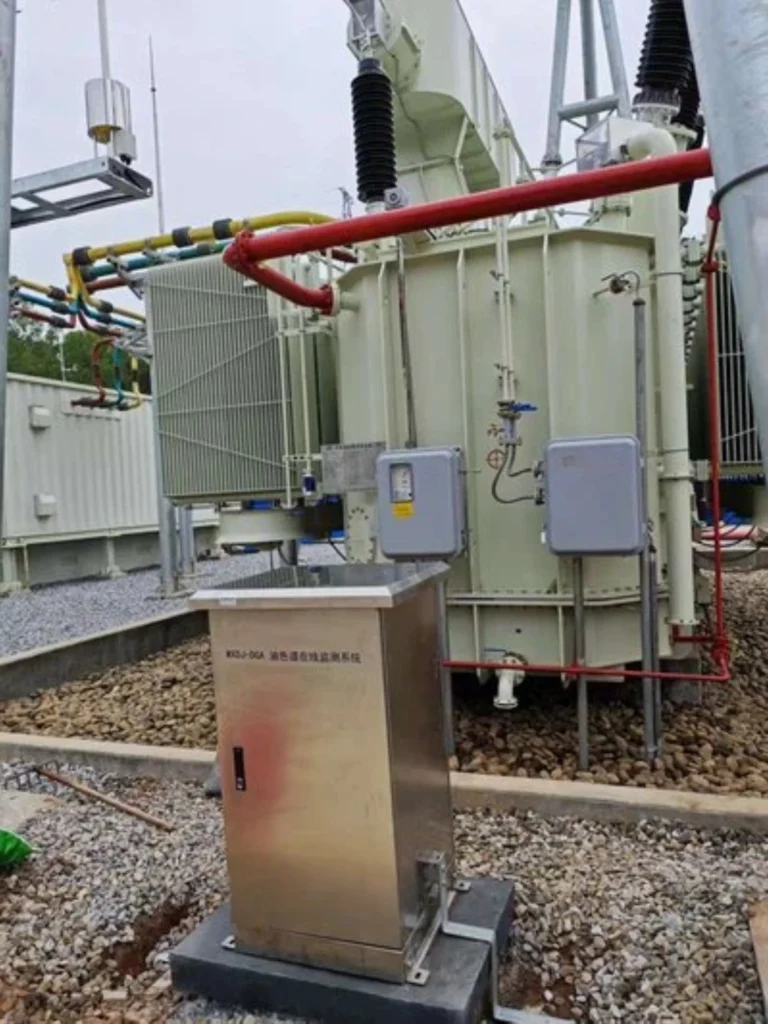
[…] Online DGA monitoring is an automated, real-time technology for transformer monitoring, designed for continuous asset supervision. Unlike offline laboratory testing, it eliminates manual sampling and interval limitations, enabling 24/7 uninterrupted monitoring of transformer oil gas changes. It is the core equipment of modern online transformer monitoring systems. […]