

How to Choose an Online DGA Monitoring System
Choosing an online DGA monitoring system requires more than comparing the number of gases measured. Power engineers should evaluate the transformer application, gas configuration, detection performance, sampling method, installation requirements, communication interfaces, maintenance requirements, data analysis functions, and long-term reliability.
The right configuration depends on the transformer type, voltage level, criticality, expected fault modes, and monitoring objectives.
This guide focuses on online DGA monitoring system selection, covering commercial evaluation and engineering selection rather than basic DGA principles, serving the full decision‑making process before equipment procurement.
10 Key Factors for Online DGA Monitoring System Selection
| Step | Selection Factor |
|---|---|
| 1 | Transformer Application |
| 2 | Gas Configuration |
| 3 | Detection Performance |
| 4 | Oil Sampling Method |
| 5 | Measurement Frequency |
| 6 | Installation Requirements |
| 7 | Communication & SCADA Integration |
| 8 | Data Analysis & Alarms |
| 9 | Maintenance & Reliability |
| 10 | Supplier & Service Capability |
How to Choose an Online DGA Monitoring System (10-Step Professional Selection Guide)
Selecting a suitable online transformer monitoring system and transformer DGA monitor is critical for reliable power transformer operation. Many buyers only compare surface product parameters, while ignoring the matching degree between equipment and on-site operating conditions. This 10-step professional guide helps power engineers and project purchasers select a cost-effective, site-adaptive, and long-term stable DGA monitoring system based on actual application demands, rather than simply pursuing redundant functions.
1. Define the Transformer Application
Before checking any product specifications, clarify the core demand: Why does this transformer need DGA monitoring? Different transformer scenarios have completely different selection standards and monitoring priorities, which is the fundamental basis for all subsequent configuration decisions.
Common transformer application scenarios include:
- Power transformers
- Generator step-up transformers
- Distribution transformers
- Industrial transformers
- Transformers in critical substations
- Renewable energy (wind/solar) transformers
Meanwhile, comprehensively evaluate key on-site and equipment attributes to lock monitoring objectives:
- Transformer rating and voltage level
- Total oil volume of the equipment
- Operational importance and grid connection priority
- Complexity of the operating environment
- Operational risks and consequences of transformer failure
2. Choose the Required Gas Configuration
Gas configuration is one of the most core commercial selection parameters of online DGA monitors. There is no absolute “better” configuration—only the most matching one for application scenarios.
Single-gas monitoring mainly targets hydrogen (H₂). It is suitable for conventional low-risk distribution transformers and basic real-time anomaly early warning scenarios, with low cost and stable operation, meeting the minimum monitoring demands of general equipment.
Multi-gas DGA monitoring covers mainstream characteristic gases including H₂, CH₄, C₂H₆, C₂H₄, C₂H₂, CO, and CO₂. It can comprehensively capture insulation aging, local overheating, high-energy discharge and various internal faults of transformers.
A multi-gas DGA monitor generally provides a broader and more accurate diagnostic picture, but the final gas configuration should be determined by the transformer application scenario and actual monitoring goals, avoiding excessive configuration waste or insufficient monitoring functions.
3. Evaluate DGA Monitor Detection Performance
Detection performance is the core technical standard for screening high-quality DGA analyzers, directly determining the accuracy and credibility of monitoring data. Engineers need to focus on six key technical parameters to verify the instrument’s professional detection capability.
| Parameter | Why It Matters |
|---|---|
| Detection Limit | Determines the instrument’s sensitivity to trace low-concentration fault gases, ensuring early capture of potential minor faults inside the transformer. |
| Accuracy | Guarantees the authenticity and reliability of measured gas concentration values, which is the premise of accurate fault diagnosis. |
| Measurement Range | Covers the full concentration change range of fault gases under normal and abnormal operating conditions of transformers, avoiding measurement dead zones. |
| Repeatability | Reflects the consistency of repeated measurements of the same oil sample, eliminating data fluctuation errors caused by the instrument itself. |
| Response Time | Supports real-time capture of sudden changes in gas concentration, suitable for early warning of rapidly developing electrical faults. |
| Long-Term Stability / Drift Resistance | Ensures long-term continuous and stable operation of the equipment, reducing data drift and frequent calibration caused by environmental changes. |
4. Evaluate the Online DGA Analyzer Technology
Different core technologies of online DGA analyzers determine the equipment’s detection accuracy, stability, environmental adaptability and later maintenance cost. When selecting products, do not only focus on parameters, but deeply verify the rationality of the technical route.
- Oil-gas extraction principle and separation efficiency
- Core gas detection principle (NDIR, TCD, semiconductor sensor, photoacoustic spectroscopy, chromatographic technology, etc.)
- Sensor technical grade and service life
- Standard measurement cycle and data update frequency
- Regular calibration requirements and calibration difficulty
- Temperature and humidity environmental tolerance of the whole machine
Mature and matching technical routes can balance detection performance and on-site adaptability, avoiding equipment failure or data distortion caused by technical mismatch.
5. Check Oil Sampling and Installation Requirements
Many high-parameter DGA monitors fail to operate stably on site due to mismatched sampling and installation conditions. Before selecting a transformer DGA monitor, it is necessary to verify whether the sampling and installation design is compatible with the actual transformer and substation site conditions.
Oil Sampling Conditions:
- Rationality and accessibility of transformer sampling points
- On-site oil flow, oil pressure and operating oil temperature range
- Tubing matching specification and layout feasibility
- Automatic oil circulation sampling stability
Field Installation Conditions:
- Indoor or outdoor installation environment
- Equipment enclosure grade and IP protection rating
- Adaptable ambient temperature and humidity range
- On-site vibration interference and anti-vibration capability
- Adaptability to hazardous and special operating environments
6. Determine the Required Measurement Frequency
There is no unified standard for DGA measurement frequency. Blindly pursuing high-frequency continuous monitoring will increase unnecessary operating costs, while low-frequency measurement may miss sudden fault changes.
Three mainstream monitoring modes can be selected according to actual demands:
- Continuous real-time monitoring
- Fixed periodic automatic measurement
- Freely configurable measurement intervals
The final measurement frequency is determined by multiple factors: transformer criticality, internal gas generation risk level, core monitoring objectives, project budget and fault emergency response requirements.
7. Check Communication and SCADA Integration
The online DGA monitoring system must be seamlessly integrated with the substation’s existing monitoring architecture. Independent monitoring equipment that cannot be networked cannot realize remote centralized management, which greatly reduces practical application value.
Key communication and SCADA integration verification items are as follows:
| Requirement | Key Check Content |
|---|---|
| Local Communication | Supports standard RS485 and Ethernet interfaces |
| Communication Protocol | Compatible with Modbus and IEC 61850 mainstream industry protocols |
| SCADA Connection | Realizes real-time data transmission and remote alarm integration |
| Remote Access | Adapts to on-site network architecture to support remote viewing and management |
| Data Management | Supports flexible data export and complete historical DGA data recording |
The core selection principle: The DGA system should perfectly fit the customer’s existing substation or plant monitoring architecture to achieve unified data management.
8. Evaluate Data Analysis and Alarm Functions
High-quality hardware monitoring needs to be matched with professional data analysis and alarm systems to realize closed-loop fault early warning. This module determines whether the monitoring data can effectively guide operation and maintenance work.
Core functional configurations include:
- Fixed threshold alarms for single gas concentration
- Rate-of-rise alarms for sudden gas concentration changes
- Long-term historical data trend curve analysis
- Built-in professional DGA fault diagnostic algorithms
- Flexible custom threshold configuration function
- Complete fault event records and multi-channel alarm notifications
This selection step solves the problem of “whether the equipment has analysis and early warning capabilities”, while the subsequentDGA Results Interpretation system solves the problem of “how to accurately analyze and judge faults after obtaining monitoring data”.
9. Consider Maintenance and Calibration Requirements
For online DGA monitoring equipment, the initial purchase price is only a small part of the overall cost. The long-term total cost of ownership (TCO) is determined by later maintenance, calibration and accessory replacement costs.
Key maintenance evaluation indicators:
- Standard calibration cycle and on-site calibration difficulty
- Sensor service life and replacement cost
- Daily maintenance cost of oil sampling pipeline and circulation system
- Consumable replacement cycle and unit price
- Support of remote fault diagnosis and online firmware/software upgrade
- Spare parts supply stability and after-sales service timeliness
Equipment with low purchase price but high later maintenance costs will greatly increase the long-term operation burden of the project.
10. Evaluate Supplier Support and Long-Term Reliability
The stable operation of DGA monitoring systems depends not only on product quality, but also on the supplier’s comprehensive technical strength and after-sales support capability, which is the key to long-term reliable operation of the equipment.
Focus on assessing supplier comprehensive strength:
- Years of industry experience and power project application cases
- Completeness of professional technical documents and test reports
- Factory strict testing and quality control system
- Professional on-site installation guidance and commissioning services
- Complete warranty policy and long-term spare parts guarantee
- Professional after-sales technical support and SCADA docking engineering capability
Choosing a reliable supplier can effectively avoid equipment idle failure, difficult technical docking and unattended after-sales problems in the later stage of the project.
Online DGA Monitoring System Selection Checklist
| Category | Questions to Ask |
|---|---|
| Transformer | What type and rating is the transformer? |
| Gas Configuration | Which gases need to be measured? |
| Detection | What are the detection limits? |
| Accuracy | What measurement accuracy is required? |
| Sampling | How is transformer oil sampled? |
| Measurement | How frequently are gases measured? |
| Installation | Indoor or outdoor installation? |
| Communication | Which protocols are supported? |
| SCADA | How will data be integrated? |
| Alarm | What alarms are required? |
| Maintenance | What calibration/service is required? |
| Support | What commissioning and after-sales support is provided? |
Common Mistakes When Choosing an Online DGA Monitoring System
Choosing based only on the number of gases
More gases does not automatically mean better fit. The key is whether the measured gases match the transformer type, voltage level, and diagnostic requirements.
Comparing only detection limits
Detection limit is one indicator, not the whole picture. Repeatability, long-term stability, and calibration performance matter just as much in real operation.
Ignoring installation conditions
Temperature, pressure, outdoor exposure, and oil sampling conditions all affect performance. A system that works well in a lab may not perform reliably in an outdoor substation.
Ignoring SCADA integration
Communication compatibility is often overlooked until commissioning. Protocol support such as IEC 61850, Modbus, Ethernet, and RS485 should be confirmed early to avoid integration problems.
Ignoring maintenance requirements
Consumables, calibration cycles, and maintenance frequency directly affect lifecycle cost. A consumable-free, maintenance-free design reduces long-term workload and cost.
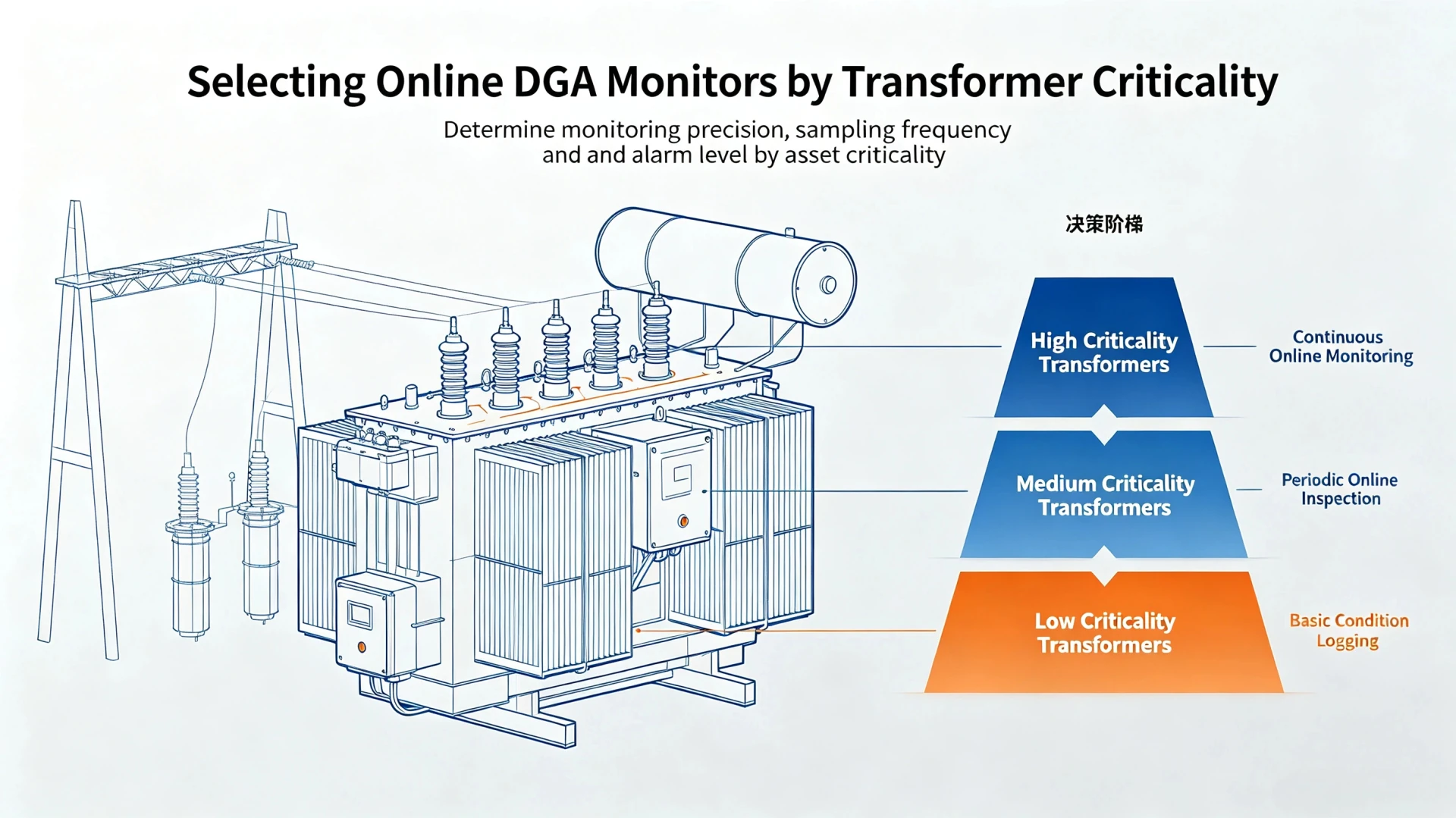
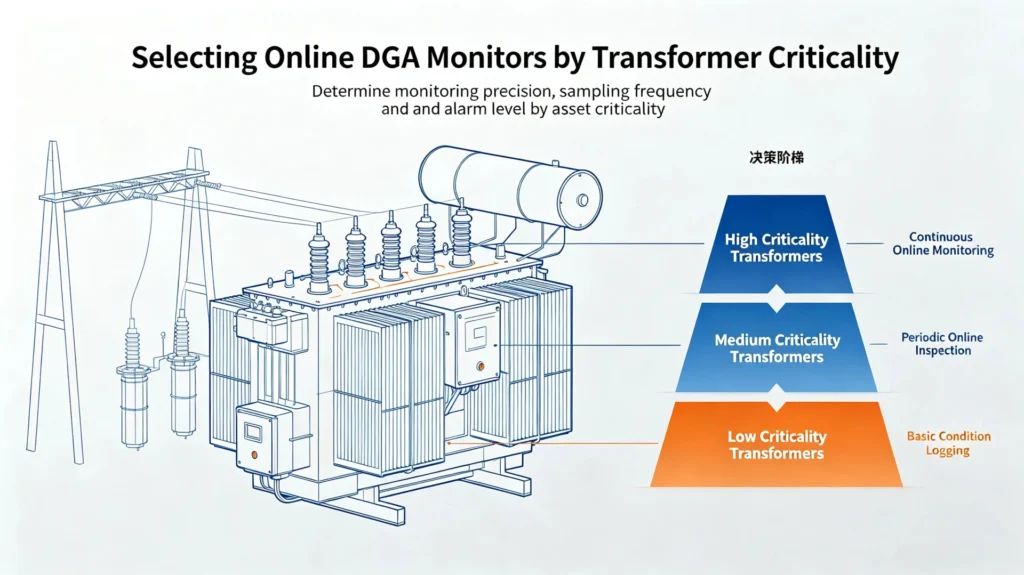
Choosing without considering transformer criticality
Not every transformer needs the same level of monitoring. High-value, critical, or hard-to-reach transformers usually justify a more capable system, while less critical units may not.
FAQs About Online DGA Monitoring System Selection
What should I consider when selecting an online DGA monitoring system?
Focus on transformer criticality, monitoring objectives, gas matching scheme, detection performance, sampling response capability, system integration compatibility and lifecycle maintenance cost, rather than simply comparing parameters and prices.
How many gases should an online DGA analyzer measure?
Ordinary distribution transformers can choose single hydrogen monitoring; important grid transformers need full 7-gas monitoring (H₂, C₂H₂, CH₄, C₂H₄, C₂H₆, CO, CO₂) to meet standard fault diagnosis requirements.
Is a single-gas or multi-gas DGA monitor better?
No absolute superiority. Single-gas devices are cost-effective for basic early warning; multi-gas devices support professional fault diagnosis and are suitable for high-value critical transformers.
What is the most important specification of an online DGA analyzer?
Long-term operational stability, effective early warning capability and on-site system compatibility are more important than nominal single accuracy parameters.
What detection limit should an online DGA monitor have?
It shall comply with IEC 60567 standard requirements, with ultra-low detection limit to capture early subtle gas changes of transformer latent faults.
How often should an online DGA system measure transformer oil?
Standard transformers support hourly periodic measurement; critical transformers adopt continuous high-frequency measurement to ensure real-time tracking of fault changes.
Does an online DGA monitor need to connect to SCADA?
Yes. System integration is a basic requirement for smart substation monitoring, which realizes unified data management and unattended operation.
Can an online DGA analyzer replace laboratory DGA testing?
No. Online DGA provides real-time continuous monitoring and early warning, while laboratory testing provides accurate offline data calibration and in-depth fault verification. The two are complementary and cannot replace each other.
Conclusion
Scientific selection of online DGA monitoring systems must take transformer operational requirements as the core, rather than blindly superposing equipment functions. Engineers need to complete demand grading, gas scheme matching, performance parameter verification, on-site adaptation evaluation and lifecycle cost accounting in sequence, and screen targeted solutions according to transformer criticality and project actual conditions.
A reasonable DGA configuration can effectively reduce transformer outage risks, optimize equipment asset management, and reduce long-term operation and maintenance costs for power enterprises and EPC projects.
After defining your gas configuration, detection requirements, installation conditions, and communication requirements, you can compare the selected criteria with our Transformer DGA Online Monitoring System.
Reference Standards & Technical Sources
- IEC 60567: Oil-Filled Electrical Equipment — Sampling of Gases and Analysis of Free and Dissolved Gases
- IEC 60599: Mineral Oil-Filled Electrical Equipment — Guidance on Interpretation of Dissolved and Free Gas Analysis Data
- IEEE C57.104: Guide for the Interpretation of Gases Generated in Oil-Immersed Transformers
- IEEE C57.143: Guide for Application of Online Monitoring Equipment for Power Transformers
- CIGRE TB 296: Transformer Condition Monitoring Best Practice Guidelines