Leave your message

-
Leon Zhang sales consultant
-
Email: zxl635973785@gmail.com
-
Phone/WhatsApp/Wechat: +86 13655813266

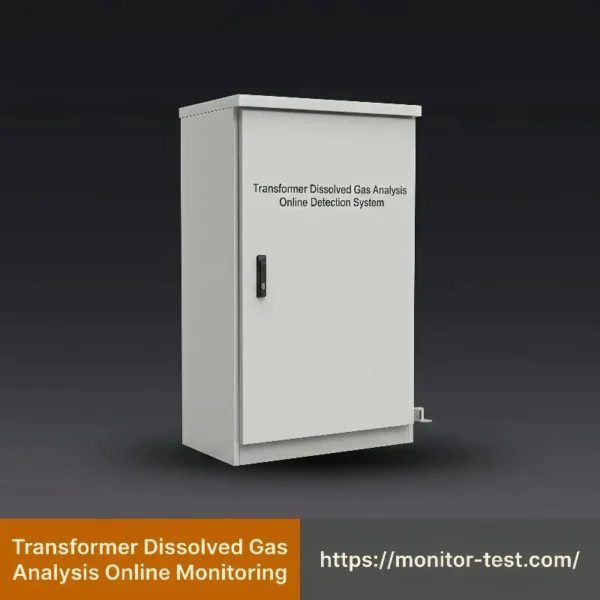
HF-T-602 Transformer DGA Online Monitoring System
HF-T-602 is an online DGA monitoring system for oil-immersed power transformers, providing continuous measurement of dissolved gases and moisture for early detection of transformer internal faults.
Key Highlights
- Continuous online DGA monitoring
- 9 dissolved gases + moisture measurement
- Real-time trend monitoring and alarm
- IEC 61850 / Modbus communication
- IP66 outdoor installation
- Customized configuration available
Request a Quote
Send us your transformer specifications, monitoring requirements and communication requirements for a customized quotation.
Send your requirements, we will quote for you within 12 hours
Transformer DGA Monitoring System Overview
A transformer DGA monitoring system is an online solution for continuously monitoring dissolved gases in transformer oil.
This transformer DGA monitor uses next-generation photoacoustic spectroscopy to continuously measure dissolved gases and moisture in transformer oil, providing real-time data for transformer condition monitoring and early fault detection.
It tracks key fault gases, including H₂, CH₄, C₂H₆, C₂H₄, C₂H₂, CO, CO₂, O₂, and N₂, as well as moisture.
By providing continuous trend data rather than relying on occasional laboratory samples, the system helps detect early signs of overheating, partial discharge, insulation deterioration, and other developing internal faults. This enables timely maintenance and prevents unexpected failures.
Typical users include power utilities, substations, transformer operators, EPC contractors, and industrial power systems that need reliable, real-time insight into transformer health.
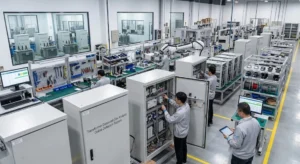
Key Features of the Online DGA Monitoring System
Consumable-Free & Maintenance-Free Design
Eliminates consumable components such as high-pressure carrier gas cylinders and chromatographic columns required by traditional oil chromatography devices. No carrier gas replacement or regular consumable refilling is needed during operation, eliminating safety hazards caused by high-pressure gas cylinders near transformers. Annual maintenance workload is reduced by over 90% compared with conventional equipment.
High Precision & Anti-Interference Detection
Adopts narrow-linewidth DFB laser and active resonant photoacoustic cell together with intelligent spectrum analysis algorithms to effectively eliminate cross-interference between different gases. The measurement accuracy of acetylene (key indicator) reaches 0.1ppm, fully meeting the demand for trace fault gas capture in extra-high voltage and ultra-high voltage scenarios.
Closed-Loop Operation with Zero Oil Sample Loss
Equipped with a constant-temperature vacuum degassing module. The whole detection process is isolated from ambient air, and 100% of the analyzed oil flows back into the transformer tank, achieving zero contamination and zero loss of oil samples without any negative impact on transformer oil quality.
Fast Response & Multi-Dimensional Sensing
The full-component detection cycle is shortened to 60 minutes, and a dedicated acetylene test delivers results within 30 minutes. It supports multi-point polling detection with a new set of monitoring data refreshed every 10 minutes, boosting fault early warning speed by more than twice versus traditional products.
Full Protocol Compatibility & Remote Management
Natively supports mainstream power communication protocols including IEC 61850, MODBUS and DNP3, enabling seamless connection with grid PMS3.0 systems and local SCADA platforms. The matched remote centralized management software realizes unified monitoring of multiple online DGA monitors and automatically generates trend analysis reports and hierarchical early warnings.
Product at a Glance
| Item | Specification |
|---|---|
| Application | Oil-immersed power transformers |
| Monitoring method | Online dissolved gas monitoring |
| Gas components | 9 gases |
| Moisture monitoring | Yes |
| Detection technology | Photoacoustic spectroscopy |
| Communication | IEC 61850, Modbus, Ethernet, RS485 |
| Protection rating | IP66 |
| Power supply | 100–240 V AC |
| Operating temperature | -40°C to +70°C |
| Installation | Wall-mounted |
| Service life | ≥15 years |
How the Transformer DGA Online Monitoring System Works
Transformer DGA online monitoring provides continuous, real-time insight into the health of oil-immersed transformers. Instead of relying on periodic laboratory sampling, an online DGA monitoring system for transformers continuously extracts and analyzes dissolved gases directly from the operating unit. A transformer dissolved gas analyzer detects key fault gases such as H₂, CH₄, C₂H₆, C₂H₄, C₂H₂, CO, CO₂, O₂ and N₂, together with moisture, while a transformer DGA monitor converts these measurements into actionable condition data.
The working process follows five key steps
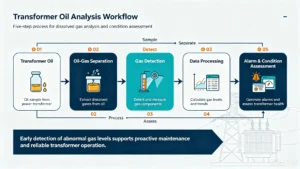
Transformer Oil → Oil-Gas Separation → Gas Detection → Data Processing → Alarm & Condition Assessment
-
Transformer oil is continuously sampled. Oil is drawn from the transformer sampling port through a closed-loop path, with no power cut required during installation or operation.
-
Dissolved gases are separated from the oil. The oil-gas separation unit applies vacuum bubbling principles with a compact structure and self-adaptive degassing volume, delivering strong long-term stability and solving the clogging and aging failures common to traditional membrane degassing units.
-
Gas concentrations are measured. The core detection module uses fully digital microphones and high-stable light source drivers, with no moving mechanical parts, avoiding mechanical wear and vibration interference. MTBF exceeds 100,000 hours.
-
Monitoring data are processed and analyzed. The built-in edge diagnosis engine of the transformer dissolved gas analyzer incorporates industry-standard models including the improved Duval Triangle and Three-Ratio Method, automatically analyzing data and outputting probability evaluations of fault types without manual calculation.
-
Trends and alarms are transmitted to the monitoring platform. The system supports comprehensive self-diagnosis, resumes operation automatically after power failure or communication interruption, and preserves all historical data—perfectly fitting unattended substation operation.
With an integrated wall-mounted structure, stainless steel IP66 enclosure, fully sealed optical components, and stable operation from -40℃ to 70℃, the device delivers reliable detection performance and a designed service life over 15 years.
Transformer DGA Monitoring System Specifications
Technical Specifications of the Transformer DGA Monitoring System
The HF-T-602 is DGA monitoring equipment designed for continuous dissolved gas and moisture measurement on oil-immersed power transformers.
| Detection Item | Measuring Range | Measurement Accuracy |
|---|---|---|
| Hydrogen (H₂) | 0~5000ppm | ±0.5ppm or ±5% of reading |
| Methane (CH₄) | 0~10000ppm | ±4ppm or ±5% of reading |
| Ethane (C₂H₆) | 0~10000ppm | ±4ppm or ±5% of reading |
| Ethylene (C₂H₄) | 0~10000ppm | ±4ppm or ±5% of reading |
| Acetylene (C₂H₂) | 0~5000ppm | ±0.1ppm or ±5% of reading |
| Carbon Monoxide (CO) | 0~10000ppm | ±4ppm or ±5% of reading |
| Carbon Dioxide (CO₂) | 0~10000ppm | ±4ppm or ±5% of reading |
| Oxygen (O₂) | 0~10000ppm | ±5ppm or ±5% of reading |
| Nitrogen (N₂) | 0~10000ppm | ±5ppm or ±5% of reading |
| Moisture Content | 0~100ppm | ±1ppm or ±3% of reading |
| Overall Ingress Protection | IP66 | — |
| Power Supply | 100~240V AC 50/60Hz | — |
| Data Interface | IEC61850, MODBUS, Ethernet, RS485 | — |
| Designed Service Life | ≥15 years | — |
General Specifications
| Item | Specification |
|---|---|
| IP Rating | IP66 |
| Power Supply | 100–240 V AC |
| Communication | IEC 61850 / Modbus / Ethernet / RS485 |
| Operating Temperature | -40°C to +70°C |
| Service Life | ≥15 years |
Installation and System Integration
The system can be integrated into an existing transformer online monitoring system, SCADA platform or power asset management system through IEC 61850, Modbus, Ethernet or RS485.
Installation
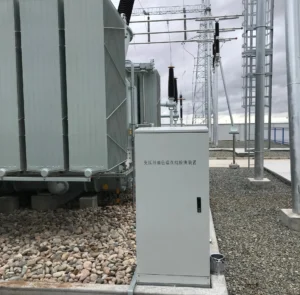
- Site Survey: Professional technicians confirm oil sampling port, power supply and communication conditions on site before installation, and customize mounting brackets and pipeline schemes.
- Deployment: Wall-mounted installation directly fixed on brackets or cabinets near transformers; no civil construction or power outage required.
- Pipeline Connection: Link the equipment inlet port to the transformer sampling valve and route the outlet oil back to the transformer tank with full sealing inspection.
- Power-On Commissioning: Connect power supply and communication cables, complete parameter configuration, degassing exhaust and baseline calibration.
- Acceptance & Handover: The equipment runs continuously for 72 hours without abnormalities. Project acceptance is completed after deviation from laboratory oil chromatography data meets standard requirements.
Communication and SCADA Integration
The transformer DGA online monitoring system supports multiple standard protocols and interfaces for seamless integration with substation automation and higher-level monitoring platforms.
It supports IEC 61850 for direct connection to digital substation process and station control layers, enabling standardized interoperability with protection, measurement, and monitoring devices. It also supports Modbus (RTU and TCP) for traditional automation systems and third-party platforms.
Ethernet and RS485 interfaces ensure flexible adaptation to different substation architectures. Monitoring data can be uploaded to SCADA for centralized monitoring, trend analysis, and alarms on dissolved gas and moisture. It also integrates with PMS to link condition assessment with O&M workflows, supporting condition-based maintenance and unattended substation operation.
Applications of Online DGA Monitoring for Transformers
Transformer DGA online monitoring delivers continuous, real-time gas and moisture data across a wide range of power assets. Unlike periodic laboratory sampling, a transformer gas monitoring system provides uninterrupted trend visibility, making it valuable in the following scenarios.
Power Substations
Continuous DGA monitoring helps operators track transformer gas trends without relying only on periodic oil sampling. It enables early detection of overheating, partial discharge, and insulation deterioration, supporting timely intervention and unattended substation operation.
Power Transformers
For individual critical transformers, a transformer online monitoring system provides direct, real-time insight into dissolved gas levels and moisture. This allows operators to correlate gas behavior with load conditions and detect developing faults before they escalate into failures.
Utility Transformer Fleets
For utilities managing large transformer fleets, transformer online DGA monitoring enables centralized condition assessment across multiple sites. Operators can prioritize maintenance based on actual gas trends and fault probabilities rather than fixed schedules.
Industrial Power Systems
In industrial facilities, unexpected transformer failure can interrupt production and cause significant losses. Online DGA monitoring provides early warning of internal faults, helping maintenance teams plan interventions without disrupting operations.
Condition-Based Maintenance
Online DGA monitoring shifts maintenance from time-based to condition-based. By continuously analyzing gas trends with models such as the improved Duval Triangle and Three-Ratio Method, it supports data-driven maintenance decisions, extends transformer service life, and reduces unnecessary outages.
Why Use Online DGA Monitoring for Transformers?
| Traditional Periodic Sampling | Online DGA Monitoring |
|---|---|
| Periodic oil sampling | Continuous monitoring |
| Data available after sampling | Real-time/trend data |
| Manual sampling required | Automated measurement |
| Limited sampling frequency | 24/7 monitoring |
| Suitable for periodic assessment | Suitable for continuous condition monitoring |
Learn more about Online DGA Monitoring vs Laboratory DGA Testing →
Why Choose This Transformer DGA Monitoring System?
This transformer DGA monitoring system is built on proven monitoring technology, integrating optoelectronic detection, vacuum bubbling oil-gas separation, intelligent sensing, and edge computing in an integrated wall-mounted design. It provides reliable, continuous measurement of key fault gases and moisture, helping operators detect overheating, partial discharge, insulation deterioration, and other internal faults at an early stage.
Proven Monitoring Technology
The oil-gas separation unit applies vacuum bubbling principles with self-adaptive degassing volume, solving the clogging and aging issues common to traditional membrane degassing units. The core detection module uses fully digital microphones and high-stable light source drivers with no moving mechanical parts, achieving an MTBF exceeding 100,000 hours.
Multi-Gas Detection
It measures H₂, CH₄, C₂H₆, C₂H₄, C₂H₂, CO, CO₂, O₂, N₂, and moisture, providing comprehensive coverage of fault gases for accurate condition assessment.
Flexible Communication
It supports IEC 61850 and Modbus (RTU and TCP), with Ethernet and RS485 interfaces, enabling seamless integration with SCADA, PMS, and substation automation systems.
Outdoor Installation
The stainless steel IP66 enclosure and fully sealed optical components allow stable operation from -40℃ to 70℃, with a designed service life over 15 years.
Customized Configuration
Gas measurement ranges, communication protocols, and system configurations can be tailored to different transformer types and project requirements.
Technical Support
Professional technical support covers installation guidance, commissioning, and after-sales service, ensuring reliable long-term operation.
Customized Transformer DGA Monitoring Solutions
Every transformer installation has different technical requirements. This transformer DGA monitoring system can be configured to match specific project conditions, ensuring accurate measurement, reliable communication, and efficient integration.
Transformer Configuration
System design begins with the transformer itself — voltage level, oil sampling point, number of transformers, and installation environment all influence the configuration. Whether for a single critical unit or a fleet of transformers across multiple sites, the solution can be adapted accordingly.
Communication Requirements
Communication options include IEC 61850 and Modbus (RTU and TCP), with Ethernet and RS485 interfaces. The system can be integrated with SCADA, PMS, or existing substation automation platforms, supporting both digital substations and conventional architectures.
Monitoring Requirements
Gas types, moisture monitoring, alarm thresholds, data intervals, and remote monitoring functions can all be customized. This allows operators to focus on the parameters most relevant to their transformers and maintenance strategy.
Send Your Technical Requirements
Share your transformer specifications, communication needs, and monitoring objectives. Our team will provide a tailored configuration and technical proposal based on your project conditions.
FAQ
Q1. What is a Transformer DGA Online Monitoring System?
A Transformer DGA Online Monitoring System is an online solution for continuously monitoring dissolved gases in transformer oil. It provides real-time, trend-based insight into transformer health without relying on periodic laboratory sampling.
Q2. What gases does the system monitor?
The transformer gas monitoring system measures H₂, CH₄, C₂H₆, C₂H₄, C₂H₂, CO, CO₂, O₂, and N₂, along with moisture, covering the key fault gases used for accurate condition assessment.
Q3. How does online DGA monitoring work?
The online DGA monitoring system follows five key steps: transformer oil is continuously sampled, dissolved gases are separated from the oil, gas concentrations are measured, monitoring data are processed and analyzed, and trends and alarms are transmitted to the monitoring platform.
Q4. Can the system monitor transformer moisture?
Yes. Moisture monitoring is integrated into the measurement, alongside dissolved gas analysis, providing a more complete picture of transformer insulation condition.
Q5. Can the DGA monitoring system connect to SCADA or IEC 61850 networks?
Yes. The system supports IEC 61850 and Modbus (RTU and TCP), with Ethernet and RS485 interfaces, enabling seamless integration with SCADA, PMS, and substation automation platforms.
Q6. Does the system require regular consumables or maintenance?
No. The system features a consumable-free, maintenance-free design. The oil-gas separation unit uses vacuum bubbling principles instead of traditional membranes, and the core detection module contains no moving mechanical parts, achieving an MTBF exceeding 100,000 hours.
Q7. Can the system be customized for different transformers?
Yes. Transformer voltage level, oil sampling point, number of transformers, installation environment, communication requirements, gas types, moisture monitoring, alarm thresholds, and data intervals can all be configured to match specific project conditions.
Q8. Can the system be installed without a transformer shutdown?
Yes. On-site installation can be completed without a power cut. Only connection to the transformer oil sampling port, power supply, and communication link is required, with full deployment and commissioning finished within 2 hours.
Q9. What technical information is required for quotation?
Please provide transformer specifications (voltage level, oil sampling point, number of units), installation environment, communication requirements (IEC 61850, Modbus, Ethernet, RS485, SCADA/PMS integration), and monitoring requirements (gas types, moisture monitoring, alarm thresholds, data intervals, remote monitoring). Our team will provide a tailored configuration and technical proposal based on your project conditions.


Reviews
There are no reviews yet.