Leave your message

-
Leon Zhang sales consultant
-
Email: zxl635973785@gmail.com
-
Phone/WhatsApp/Wechat: +86 13655813266

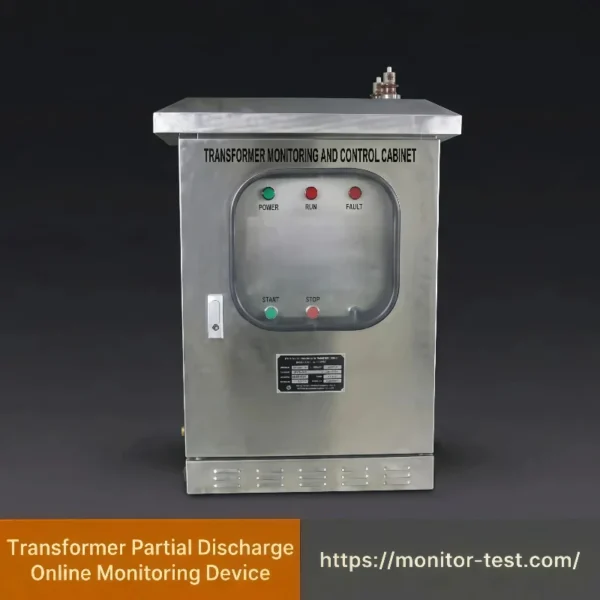
HF-T-605 Transformer Core Clamp Earth Current Monitoring
The Transformer Core Clamp Earth Current Monitoring Device is an online monitoring unit for transformer core and clamps. With high-precision sensors, it tracks grounding leakage current to identify multi-point earthing and insulation faults, overcoming drawbacks of offline regular tests.
Send your requirements, we will quote for you within 12 hours
Functional Overview
This Core Clamp Earth Current Monitoring system adopts high-precision wide-range zero-flux current sensors, field data acquisition units and communication modules.
Field collectors turn analog grounding current signals into digital data right at the transformer. Powerful signal processing locks in stable accurate readings over all working frequencies.
The system records exact real-time current values from the transformer core and clamp frame grounding paths. It also logs ambient temperature and humidity to build a complete set of equipment operating data.
Features
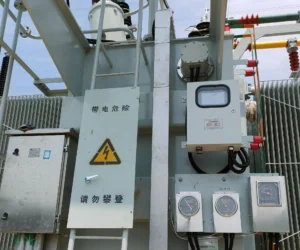
- This unit runs online real-time monitoring on transformer core grounding current. It automatically switches in preset resistors once current rises above 100mA in auto mode. The device records all switch actions, sends on-site and remote alarms, and retracts resistors right after faults resolve.
- Technicians set scheduled cycles for routine compensation tests. When the timer ends in automatic mode, the system verifies compensation status. It cuts off the compensation circuit once faults vanish, and the transformer core directly links to the grounding grid.
- The device constantly measures voltage on the resistor switching circuit. This real-time check prevents voltage surges and protects compensation components from burnout after resistor activation.
- Field workers switch freely between automatic and manual modes without conflicting control logic. Auto mode adjusts current-limiting resistors according to live grounding current data. Manual mode only keeps monitoring active, and on-site personnel toggle resistors manually.
- The device stores up to 1000 fault logs in local memory. Supervisors export all historical fault data through upper-level monitoring software for later review.
- Standard Modbus-RTU serves as the default communication protocol. Our engineering team modifies program codes to match other protocols, enabling easy integration with most mainstream monitoring systems.
- The primary communication interface adopts standard RS485 wired connection. Users pick optional wireless modules for cable-free data transmission. These factory-supplied wireless devices support 2-kilometer stable transmission on license-free frequency bands with no ongoing service fees.
- The front panel shows real-time temperature and humidity inside the control cabinet. Integrated modules automatically adjust internal environment parameters. This design guarantees stable performance during outdoor installation and severe working weather.
Technical Specifications
| No. | Specification Details |
|---|---|
| (1) | Current measuring range: 1 mA–10 A
Voltage measuring range: 1 V–300 V |
| (2) | Measurement accuracy: ±(2% of reading + 2 digits) |
| (3) | Resolution: 1 mA for current readings
Resolution: 1 mV for voltage readings |
| (4) | Compensation settings: 4 adjustable total levels |
| (5) | Operating power supply: 220 V alternating current (tolerance ±10%), 50 Hz grid frequency |
| (6) | Operating ambient temperature: -20 °C to 40 °C |
| (7) | Allowed relative humidity: 85% maximum; no surface condensation |
Product Application
Hub Substation Main Transformer Safety Protection
This device monitors 110kV and above main transformers around the clock. It issues early warnings for multi-point grounding faults. These alerts prevent core overheating and insulation damage, and stabilize regional power grid operation.
New Energy Boost Station Unmanned Monitoring
This device adapts to remote wind and photovoltaic booster stations. It enables remote unattended detection of transformer core abnormalities. It eases staffing shortages and heavy inspection burdens at off-grid field stations.
Aging Transformer Status Assessment
Teams use continuous online monitoring instead of regular power-off tests for aging transformers. Operators optimize equipment load distribution based on real monitoring data. This method extends transformer lifespan while maintaining safe running conditions.
Industrial Key Transformer Protection
The system offers 24-hour monitoring for core transformers in petrochemical, metallurgy and rail transit industries. It stops unexpected production halts caused by sudden core failures. Early fault identification helps enterprises avoid heavy economic losses.
Fault Backtracking & Analysis Assistance
The equipment stores full-cycle historical current data during operation. Technicians trace the entire development process of faults with these records. The data provides key basis for fault troubleshooting and equipment optimization.
Smart Grid Condition-Based Maintenance
Quantified equipment status data helps power departments shift from periodic maintenance to condition-based maintenance. It slashes unnecessary power-cut inspections and greatly reduces overall operation and maintenance expenses.
Installation Instructions
On-site Survey & Planning
Field technicians visit the site ahead of installation. They mark grounding downlead positions for transformer cores and clamping frames. Staff map sensor and monitor host mounting spots based on site layout, then build a live-wire installation plan that runs without halting transformer operation.
Sensor Deployment
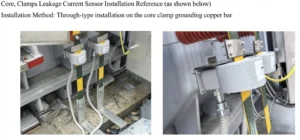
Workers slide the through-core current sensor straight over the core grounding downlead. This setup keeps the original grounding circuit fully intact. Technicians lock the sensor in place and add shielding layers, placing hardware far from heavy electromagnetic interference.
Monitoring Host Installation
Mount the main unit on a wall next to control cabinets or outdoor poles near the transformer. Pick dry, well-ventilated spots with easy access for routine checks. All installations meet IP54 protection standards.
Wiring & Commissioning
Run shielded cables to link sensors and the main monitoring unit. Power on the system and test signal stability. Set current alarm limits to match real field operating conditions, then calibrate the unit to lock in accurate signal capture.
Communication Interconnection
Lay communication wiring and tune connections for local monitoring servers or remote operation platforms. Test remote data upload and alarm alert functions to confirm steady, reliable signal delivery.
Acceptance & Handover
Train maintenance teams on device operation and fault alarm response steps. Hand over full installation records and official operation guides, then complete formal project acceptance and site handover.
Why Choose Us
Deep Sourcing Edge & Application Engineering
We work directly with our partner factories’ engineering teams and hold full control over the specification, testing and QC of every unit we supply. Core technologies such as high-precision zero-flux sensors and digital anti-interference algorithms are specified by us and built by our partner factories. Our engineers build custom-fit solutions fast to match unique field operating environments.
Strict Industry Quality Control
National power equipment test labs complete full-type certification for all our devices. Every unit runs through a 72-hour high-temperature aging cycle, full-scale accuracy calibration and heavy electromagnetic interference testing before shipment. This multi-step screening locks in consistent, dependable long-term performance.
Proven Mass On-site Application
Our hardware runs stable operations across hundreds of substations nationwide. Real field records confirm the system catches early transformer core grounding hazards and sends advance fault alerts repeatedly. These timely warnings shield clients from costly power shutdowns and million-scale financial losses.
Optimized Installation & O&M Experience
Technicians install our devices fully online without cutting power, and finish full deployment in just a few hours. Built-in self-check functions cut regular maintenance workload drastically. Clients slash total construction and ongoing operation expenses as a result.
Open & Compatible System Architecture
The device supports all widely used power communication protocols. It connects smoothly with existing substation automation and smart operation platforms without full system replacement or complicated secondary coding. This compatibility breaks isolated data gaps between different site devices.
Localized Rapid After-sales Support
We operate a full service network covering Baoding, Hebei and all nearby regions. Our team delivers 24-hour remote technical support and sends field engineers to sites within 48 hours. We provide full-lifecycle local services including installation guidance, operator training and scheduled on-site inspections.
FAQ
Q1: Do technicians need to disconnect the transformer grounding downlead during installation? Does this affect overall equipment safety?
Technicians do not disconnect the transformer grounding downlead during installation. The split through-core sensor fits over the downlead and preserves the original grounding circuit.
This installation keeps transformer grounding fully reliable. It brings no safety risks to equipment operation.
Q2: Substation environments carry strong electromagnetic interference. Will this interference cause inaccurate measurement data or frequent false alarms?
The sensor resists strong substation electromagnetic interference via three-layer shielding and adaptive digital filtering.
It maintains stable measurement accuracy. Field data shows its false alarm rate ranks well below industry averages.
Q3: Can the sensor’s measurement range capture heavy fault currents during transformer operation faults?
It captures tiny normal operating currents and large multi-point grounding fault currents with zero blind spots.
This solid-state device has no moving parts and leaves the factory fully calibrated.
Q5: Can this sensor connect directly to existing substation monitoring systems?
The Transformer Core Clamp Earth Current Monitoring device supports IEC 61850, IEC 103, IEC 104 and other mainstream power protocols. It connects to monitoring platforms directly without extra programming work. It comes with an IP54 metal housing resistant to rain, dust and corrosion, and works steadily in outdoor field environments.
Reviews
There are no reviews yet.