Leave your message

-
Leon Zhang sales consultant
-
Email: zxl635973785@gmail.com
-
Phone/WhatsApp/Wechat: +86 13655813266

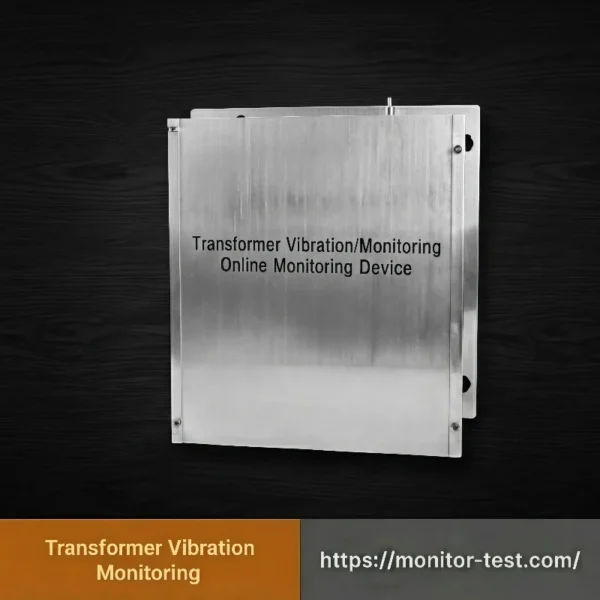
HF-T-609 Transformer Vibration Monitoring
Transformer Vibration Monitoring continuously collects vibroacoustic signals from transformer core, windings and cooling system. It analyzes vibration data to identify hidden faults like loose clamping parts and winding deformation, realizing online early warning of potential equipment defects.
Send your requirements, we will quote for you within 12 hours
Generation of Vibroacoustic Vibration
In Transformer Vibration Monitoring, the vibroacoustic vibration of a transformer originates from the vibration of its cooling system as well as the main transformer body (collectively referring to the iron core and windings).
The vibroacoustic vibration on the surface of a power transformer is closely related to the compression state of its windings and iron core, along with winding displacement, deformation and other conditions.
By analyzing the variation degree of vibroacoustic vibration signals collected from multiple positions on the transformer, defects in the windings or iron core can be identified.
Online monitoring of abnormal vibroacoustic vibration in power transformers enables defect detection and location.
Under short-circuit conditions, transformer vibration is primarily induced by winding vibration.
The vibroacoustic vibration signals captured during short-circuit faults can be adopted to monitor whether winding deformation or loosening has occurred.
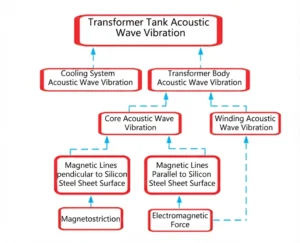
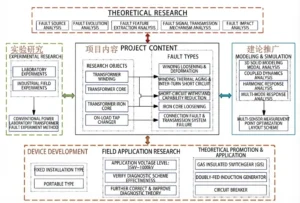
Technical Route
System Composition
This vibroacoustic vibration online monitoring system can monitor up to 6 channels of vibroacoustic vibration signals simultaneously.
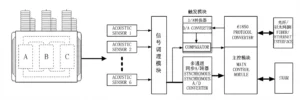
The Transformer Vibration Monitoring system mainly consists of piezoelectric vibroacoustic sensors, signal conditioning units, trigger modules, synchronous sampling A/D converters and main control modules.
The piezoelectric vibroacoustic vibration sensors convert the vibroacoustic vibration signals on the transformer tank surface into electrical signals.
The signal conditioning module supplies constant current to the vibration sensors to ensure their normal operation, while isolating the DC component from the sensor output signals.
The trigger module dynamically sets the threshold for vibration signal acquisition according to on-site conditions.
The multi-channel synchronous A/D converter performs synchronous digital conversion of vibration signals from all channels inside the IED.
The main control module completes data acquisition, storage and analysis for the entire system, and transmits analysis results in compliance with the IEC 61850 standard.
Fiber Ethernet serves as the standard communication interface to realize data interconnection between the vibration monitoring IED and other systems.
Technical Parameters
| Item | Specification |
|---|---|
| Sensitivity (@250 Hz) | 11.2mV/Pa (-39 dB re 1V/Pa) |
| Frequency Response | 20 Hz ~ 10 kHz
10 kHz ~ 20 kHz |
| Dynamic Range | 29 dBA ~ 140 dB |
| Installation Mode | Permanent Magnet Adsorption Mounting / Adhesive Mounting / Bracket Mounting |
| Power Supply | 220V AC |
| Overall Dimensions | 1U Chassis |
| Functional Feature | Equipped with characteristic fingerprints of faults and defects and fingerprint analysis technology |
FAQ
Q1: What is transformer vibroacoustic vibration monitoring?
A1: It is a non-invasive online monitoring solution that captures sound and vibration signals from transformer tank to diagnose hidden mechanical faults of winding, iron core and on-load tap changer.
Q2: What transformer faults can this system detect?
A1: It identifies winding looseness & deformation, core clamping slack, OLTC mechanical failure, loose internal fittings and hidden damage from short-circuit shock.
Q3: Does installation require transformer power outage?
A3: No power cut is necessary. Sensors are mounted via magnet adsorption or glue sticking on transformer exterior without opening primary equipment.
Q4: How many monitoring channels are available?
A4: The host device supports up to 6 channels for synchronous signal collection.
Q5: Which communication protocols are supported?
A5: IEC 61850, IEC 104 and RS485 Modbus are supported for docking with substation SCADA and central monitoring platform.
Q6: What is the sensor frequency range?
A6: Frequency response ranges from 20Hz to 20kHz, covering all mainstream mechanical vibration frequency bands of power transformers.
Q7: Is regular sensor calibration required?
A7: Piezoelectric sensors are highly stable with long lifespan. No periodic calibration is needed; only visual check for damage or detachment during annual maintenance.
Q8: Will site background noise affect monitoring accuracy?
A8: Built-in denoising algorithm filters ambient interference to extract effective fault characteristic signals precisely.
Q9: Can it be retrofitted on existing in-service transformers?
A9: Yes. No modification to main transformer equipment, perfectly suitable for substation renovation projects.
Q10: What is the host device size?
A10: Standard 1U rackmount chassis, easy to install inside secondary control cabinets.
Q11: Does the system support historical data storage and export?
A11: Local long-term data storage is available; historical trend curves and fault logs can be exported for equipment condition assessment.
Q12: How does the system realize fault positioning after alarm?
A12: Each sensor corresponds to a fixed measuring point. The system pinpoints the abnormal position through the abnormal signal channel number.

Reviews
There are no reviews yet.