

Introduction
Transformer theft detection uses sensors and monitoring technologies to identify abnormal movement, vibration, tampering, cable cutting and power loss before or during a theft attempt.
Traditional inspection methods face a fundamental limitation: a remote transformer may be visited once a month, but a theft can be completed in under two hours. The gap between inspection cycles is where theft occurs.
The shift from passive inspection to active detection follows this logic:
Remote Transformer → No Personnel → Theft Occurs → Delayed Discovery
Modern detection replaces this with:
Sensor → Detection → Alarm → Remote Notification → Operator Response
This article covers what transformer theft detection is, which sensors are used, how alarms work, how remote monitoring operates, and how different detection technologies compare.
What Is Transformer Theft Detection?
Transformer theft detection refers to the technologies and monitoring methods used to identify unauthorized activity affecting distribution transformers. Detection focuses on recognizing abnormal conditions that indicate a theft attempt is in progress or has occurred.
What Does Transformer Theft Detection Mean?
Theft detection systems monitor specific physical and electrical parameters that change when a transformer is tampered with, moved, or damaged. These include:
- Unauthorized movement or displacement
- Abnormal vibration or impact
- Tilting beyond normal angle limits
- Cable cutting or disconnection
- Sudden power loss or phase loss
- Enclosure opening or access attempts
- Tampering with security hardware
Transformer Theft Detection vs Transformer Theft Prevention
| Concept | Main Question |
|---|---|
| Theft Prevention | How can theft be prevented? |
| Theft Detection | How can theft attempts be detected? |
| Theft Monitoring | How can events be monitored remotely? |
Prevention makes theft harder. Detection makes theft visible. Both are necessary for remote transformer protection, but they serve different functions and use different technologies.
How Does Transformer Theft Detection Work?
A detection system operates through a defined sequence:
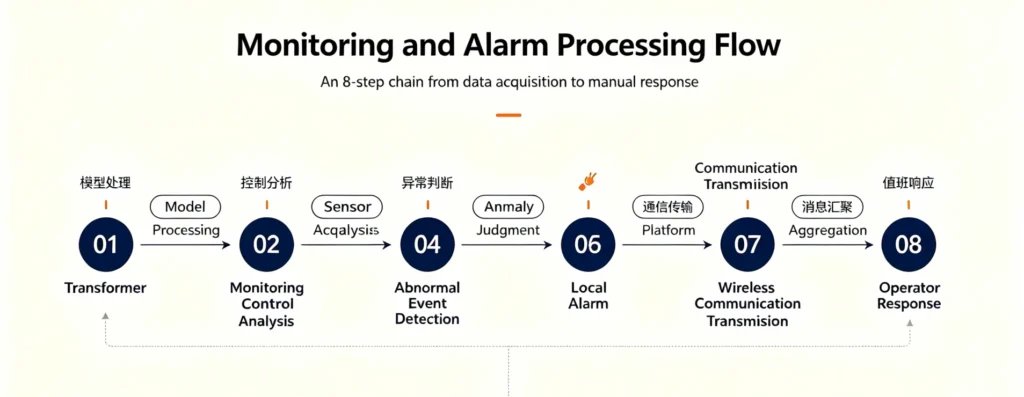
Each component has a specific role. Sensors continuously monitor physical and electrical conditions. The controller evaluates sensor data against preset thresholds. When an abnormal event is confirmed, the system activates a local alarm and transmits a remote notification. Operators receive the alert and determine the appropriate response.
What Sensors Are Used for Transformer Theft Detection?
A transformer theft detection system uses multiple sensor types to cover different threat scenarios. No single sensor can detect all types of theft attempts.
Vibration Sensors
Vibration sensors detect impact, abnormal vibration, and mechanical disturbance. They respond to hammering, drilling, or any forced attempt to break into the transformer enclosure. Any vibration pattern exceeding preset thresholds triggers an alert. Transformer vibration detection provides early warning of physical attacks before significant damage occurs.
Tilt Sensors
Tilt sensors monitor the transformer’s physical orientation. A transformer that is being lifted or dragged will change angle. Tilt detection identifies this movement and generates an alarm. Transformer tilt detection is particularly effective for detecting attempted removal of pole-mounted transformers.
Cable Cutting Detection
Cable cutting detection monitors the continuity of incoming and outgoing power cables. When a cable is cut or disconnected, the system detects the loss of continuity and triggers an alarm. Transformer cable cutting detection addresses the common tactic of cutting cables to isolate the transformer before tampering.
Power Loss Detection
Power loss detection monitors the transformer’s supply voltage and phase status. A sudden loss of power, phase imbalance, or abnormal voltage can indicate intentional disconnection. Transformer power loss detection is most effective when combined with other sensor data—power loss accompanied by vibration and tilt provides a stronger indication of theft than any single parameter alone.
Tamper and Enclosure Sensors
Tamper sensors detect enclosure doors being opened, security bolts being removed, or access panels being forced. Transformer tamper detection and transformer tampering detection cover unauthorized physical access attempts. These sensors are typically magnetic reed switches or micro-switches installed on access points.
| Sensor Type | What It Detects | Typical Application |
|---|---|---|
| Vibration | Impact, drilling, mechanical attack | Tampering detection |
| Tilt | Lifting, dragging, displacement | Movement detection |
| Cable detection | Cable cutting, disconnection | Cable theft prevention |
| Power monitoring | Power loss, phase loss, voltage anomaly | Unauthorized disconnection |
| Tamper sensor | Enclosure opening, bolt removal | Access attempt detection |
How Does a Transformer Theft Alarm Work?
A transformer theft alarm provides both local and remote notification of detected events. The alarm function is what transforms sensor data into actionable information.
Local Audible Alarms
A siren (typically 110dB or higher) produces a loud audible warning at the transformer site. The purpose is to draw attention, deter thieves, and alert anyone nearby that an incident is occurring.
Visual Alarm Indicators
Flashing red-and-blue warning lights provide a visual signal that can be seen from a distance. Visual alarms are effective in both daylight and darkness and help direct attention to the specific transformer location.
Alarm Trigger Conditions
| Event | Detection Method | Alarm Trigger |
|---|---|---|
| Excessive vibration | Vibration sensor | Threshold exceeded |
| Abnormal tilt | Tilt sensor | Angle beyond limit |
| Cable cutting | Cable monitoring | Loss of continuity |
| Power loss | Power monitoring | Sudden supply loss |
| Unauthorized access | Tamper sensor | Enclosure opened |
A transformer theft alarm system typically combines multiple trigger conditions with configurable thresholds to balance sensitivity against false alarms.
How Does Remote Transformer Theft Detection Work?
Remote detection extends the alarm beyond the transformer site. A local alarm only warns people within hearing distance—which in rural areas is often no one.
The remote detection sequence follows this path:
- Sensor Detection — Physical or electrical parameter changes
- Controller Processes the Event — Evaluates signals against thresholds
- Wireless Communication — Transmits alarm data via GSM, 4G, or NB-IoT
- Remote Notification — Sends SMS and/or cloud platform alert
- Operator Response — Dispatches personnel to verify and respond
This chain ensures that remote transformer theft detection works regardless of whether anyone is physically present at the site.
Transformer Theft Detection Using GSM, 4G and NB-IoT
Communication network selection affects system performance and suitability for different locations.
| Communication | Main Advantage | Typical Application |
|---|---|---|
| GSM | Widely available, simple alarm transmission | Basic remote monitoring |
| 4G Cat.1 | Higher bandwidth, lower latency | Real-time monitoring with richer data |
| NB-IoT | Low power consumption | Remote low-power sites with battery operation |
Selection should consider network coverage at the installation site, power availability, data requirements, and local telecom infrastructure. A transformer theft detection system for distribution networks should support the network options available in the deployment region.
What Happens When Transformer Theft Is Detected?
The following sequence illustrates a typical detection and response cycle.
Step 1 — Abnormal Activity Occurs
A thief approaches the transformer and begins to cut the incoming cable.
Step 2 — Sensors Detect the Event
The cable detection module identifies the loss of continuity. If the transformer is also being moved, tilt sensors may detect displacement.
Step 3 — Controller Evaluates the Signal
The controller receives the sensor signals, compares them against preset thresholds, and confirms the event as a valid alarm.
Step 4 — Local Alarm Is Activated
The system triggers the siren and flashing lights at the transformer site.
Step 5 — Remote Alarm Is Sent
The communication module transmits an alarm message via GSM, 4G, or NB-IoT.
Step 6 — Operator Verifies the Event
Operators receive an SMS and cloud alert containing event type, timestamp, and GPS location.
Step 7 — Security or Maintenance Team Responds
Personnel are dispatched to the site to secure the equipment, assess the situation, and take appropriate action.
This sequence replaces the traditional “discover after failure” model with “detect during attempt.”
Transformer Theft Detection for Remote and Unattended Transformers
Different environments present different detection priorities.
Rural Distribution Transformers
Isolated locations with long distances between patrols. Vibration and tilt detection are priorities, combined with remote SMS alerting.
Pole-Mounted Transformers
Easily accessible via ladders. Tilt and vibration sensors detect climbing or tampering attempts.
Agricultural Transformers
Located in open fields, often operating seasonally. Power loss detection and tamper sensors provide year-round protection.
Mining and Oilfield Sites
Harsh environments with valuable equipment. Multi-sensor detection with rugged hardware and cloud monitoring.
Construction Sites
Temporary installations, equipment moved frequently. Movement detection and GPS tracking help locate transformers.
Unattended Substations
Multiple assets at one site, no permanent staff. Comprehensive multi-sensor detection with centralized cloud alerting.
| Environment | Detection Priority |
|---|---|
| Rural area | Vibration + Tilt |
| Mining site | Cable cutting + Tampering |
| Unattended substation | Multi-sensor + Remote alarm |
| Construction site | Movement + Tampering |
| Pole-mounted transformer | Tilt + Vibration + Power loss |
Single-Sensor vs Multi-Sensor Transformer Theft Detection
| Detection Method | Detects | Limitation |
|---|---|---|
| Vibration only | Impact / movement | May have false triggers from wind or animals |
| Tilt only | Movement / displacement | Cannot detect cable cutting or electrical events |
| Cable detection only | Cable cutting | Limited to cable-related events only |
| Power monitoring only | Power interruption | Does not confirm theft, could be grid fault |
| Multi-sensor | Multiple abnormal events | Higher system complexity but better accuracy |
Multi-sensor transformer theft detection provides a more complete picture than relying on a single detection signal. A single sensor can indicate an event, but multiple sensors can confirm a pattern. When vibration, tilt, and power loss occur simultaneously, the system can classify the event with higher confidence than any single reading alone.
How Accurate Is Transformer Theft Detection?
Why False Alarms Can Occur
False alarms are a challenge for any detection system. Common causes include:
- Strong vibration from nearby construction or traffic
- Severe weather conditions (wind, lightning, storms)
- Scheduled maintenance or inspection activities
- Accidental impact by vehicles or equipment
- Grid power outages unrelated to theft
How to Reduce False Alarms
Several methods improve detection accuracy:
- Sensor threshold settings — Adjusting sensitivity to match site conditions
- Multiple sensor confirmation — Requiring two or more sensors to trigger before alarm
- Event duration checks — Requiring the abnormal condition to persist for a defined period
- Combined signal analysis — Evaluating vibration, tilt, and power together
- Remote verification — Operators confirm event before dispatching
For example, tilt plus vibration plus power loss is a stronger indicator of potential theft than power loss alone. A transformer security system that supports multi-parameter correlation will produce fewer false alarms than single-sensor systems.
Transformer Theft Detection vs CCTV Monitoring
| Technology | Main Function | Remote Alert | Works in Darkness |
|---|---|---|---|
| CCTV | Visual monitoring | Yes | Depends on configuration |
| Vibration Sensor | Movement detection | Yes | Yes |
| Tilt Sensor | Position detection | Yes | Yes |
| Cable Detection | Cable cutting | Yes | Yes |
| Multi-Sensor Monitoring | Multiple events | Yes | Yes |
CCTV is better at answering who and what happened — it provides visual evidence. Sensors are better at answering what abnormal event occurred — they detect the event itself. The two technologies are complementary. A combination of CCTV and sensors provides both event detection and visual verification, offering the most complete protection for high-value assets.
How to Choose a Transformer Theft Detection System
For EPC contractors and project engineers, selecting a system requires evaluating multiple factors.
Identify the Main Theft Risks
Assess the site-specific risks: Is cable cutting the primary threat? Or is transformer removal more likely? The risk profile determines sensor priorities.
Choose the Right Sensors
Select sensors that cover the identified risks. A comprehensive system includes vibration, tilt, cable, power, and tamper detection.
Check Communication Network Availability
Confirm which networks (GSM, 4G, NB-IoT) are available at the site. The system must support the local operator’s frequency bands.
Check Local Alarm Functions
Does the system include a siren and visual warning lights? Local alarms provide on-site deterrence even before remote notification is received.
Check Remote Notification Methods
Does the system support SMS, cloud platform alerts, or both? Multiple notification channels increase the likelihood that an operator receives the alarm.
Check Backup Power
For remote sites without reliable mains power, the system must operate on battery. A 3-5 year standby duration is achievable with low-power designs.
Check Outdoor Protection
The system must withstand rain, dust, UV exposure, and temperature extremes. IP55 or higher is recommended for outdoor installations.
Consider Integration With Existing Monitoring Systems
Does the system support integration with existing SCADA or distribution management systems? Compatibility with standard protocols reduces integration effort.
Do not choose a transformer theft detection system only by sensor quantity. Evaluate the complete solution: detection + communication + alarm + power + environment + response capability.
Transformer Theft Detection System Installation
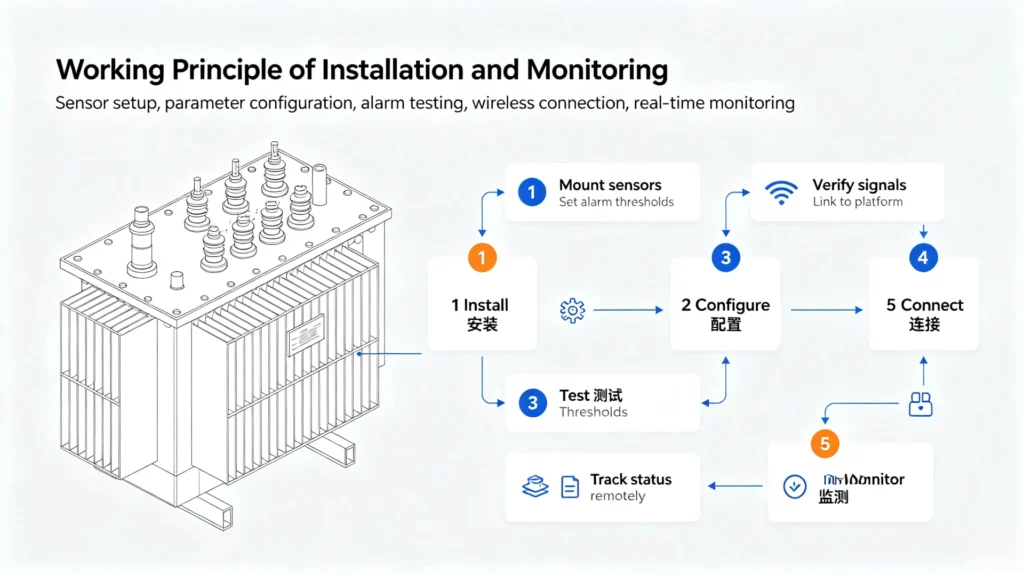
The installation process follows these general steps:
Sensor Installation: Mount vibration and tilt sensors on the transformer body. Install cable monitoring modules on incoming and outgoing cables. Place tamper sensors on enclosure doors and access panels.
Controller Installation: Mount the monitoring controller securely near the transformer. Connect all sensors to the controller inputs.
Communication Setup: Insert the SIM card (for GSM/4G) or configure NB-IoT settings. Verify network registration and signal strength.
Alarm Configuration: Set threshold values for vibration, tilt, cable loss, and power parameters.
Remote Notification Testing: Trigger each sensor to verify SMS and cloud platform alerts are received correctly.
System Commissioning: Arm the system and confirm normal operation. Document configuration settings for future reference.
Installation and alarm testing should be performed according to the equipment manufacturer’s instructions and the site’s electrical safety requirements.
Transformer Theft Detection Maintenance
Regular maintenance ensures reliable long-term operation.
Test Sensors Regularly: Trigger each sensor to confirm it is reporting correctly and not damaged.
Check Communication Status: Verify the communication module is connected to the network and transmitting data.
Test Alarm Functions: Periodically activate local and remote alarms to confirm outputs.
Check Backup Battery: Test battery voltage and estimate remaining life.
Review Alarm Records: Check for patterns, repeated false alarms, or signs of attempted tampering.
Inspect Outdoor Enclosures: Check for moisture ingress, corrosion, physical damage, or loose connections.
A documented maintenance plan with defined intervals (e.g., quarterly for communication checks, annually for battery testing) helps ensure system reliability over time.
Transformer Theft Detection Checklist
- [ ] Vibration detection
- [ ] Tilt detection
- [ ] Cable cutting detection
- [ ] Power loss monitoring
- [ ] Tamper detection
- [ ] Local siren
- [ ] Remote SMS alarm
- [ ] Cloud monitoring
- [ ] Backup power (battery)
- [ ] Communication network (GSM/4G/NB-IoT)
- [ ] Outdoor protection (IP55+)
- [ ] Alarm testing completed
- [ ] Maintenance plan established
Frequently Asked Questions About Transformer Theft Detection
What is transformer theft detection?
Transformer theft detection refers to technologies and methods used to identify unauthorized movement, vibration, tampering, cable cutting, power loss, or other abnormal conditions affecting a distribution transformer.
How does transformer theft detection work?
Sensors continuously monitor physical and electrical parameters. A controller evaluates sensor signals against preset thresholds. When abnormal conditions are detected, the system activates a local alarm and sends remote notifications via GSM, 4G, or NB-IoT to operators.
What sensors are used for transformer theft detection?
Common sensors include vibration sensors, tilt sensors, cable continuity monitors, power monitoring modules, and tamper switches on enclosures and access panels.
Can vibration sensors detect transformer theft?
Yes. Vibration sensors detect hammering, drilling, and mechanical impact—activities that typically precede theft attempts. Any vibration exceeding preset thresholds triggers an alarm.
Can a tilt sensor detect transformer movement?
Yes. Tilt sensors monitor the transformer’s physical orientation. Significant inclination changes indicate lifting, dragging, or displacement.
Can transformer theft detection systems detect cable cutting?
Yes. Cable continuity monitoring detects loss of integrity in incoming and outgoing cables, triggering an alarm when cables are cut.
Can transformer theft be detected remotely?
Yes. Remote detection is a core function of modern systems. Alarms are transmitted via wireless networks to operators through SMS and cloud platforms, enabling response without physical presence at the site.
What is the difference between transformer theft detection and prevention?
Prevention makes theft harder (locks, cages, bolts). Detection identifies when a theft attempt is occurring (sensors, alarms, monitoring). Both are needed for effective transformer security.
Can transformer theft detection work when the transformer loses power?
Yes. Systems with backup batteries remain operational during power loss. The device continues monitoring and can report the power loss event itself.
What communication methods are used for remote transformer theft detection?
GSM, 4G Cat.1, and NB-IoT are the most common methods. Selection depends on coverage availability, power constraints, and data requirements at the installation site.
Which transformers are most at risk of theft?
Rural distribution transformers, pole-mounted transformers, agricultural transformers, construction-site transformers, and transformers at remote substations are the most vulnerable due to their isolated locations and lack of physical security.
What is the best way to detect transformer theft in remote areas?
A low-power, multi-sensor monitoring system with vibration, tilt, cable, power, and tamper detection, combined with remote SMS and cloud alerts, provides the most practical solution for remote areas.
Can theft detection sensors be installed on existing transformers?
Yes. Most sensors can be retrofitted to existing transformers without major modification. Installation is typically straightforward and can be completed by trained technicians.
How long do transformer theft detection devices last?
With low-power designs and high-capacity batteries, devices can operate for 3-5 years without external power. Service life of the hardware is typically 5+ years with proper maintenance.
Conclusion
Transformer theft detection is not a single technology but a combination of sensors, controllers, alarms, communication, and remote notification systems working together. Each component addresses a specific part of the detection challenge.
Sensors → Detect abnormal events
↓
Controller → Analyze signals
↓
Local Alarm → Warn people nearby
↓
Wireless Communication → Send information remotely
↓
Cloud / SMS → Notify operators
↓
Human Response → Verify and respond
The fundamental advantage of detection over inspection is the ability to identify theft attempts while they are in progress, rather than discovering the loss after the equipment is already gone. For remote and unattended distribution transformers, multi-sensor detection with remote notification provides the practical means to achieve this.
For utilities and operators managing remote or unattended transformers, a comprehensive detection solution that covers vibration, tilt, cable cutting, tampering, and power abnormalities—combined with local and remote alarms—offers the most effective protection against transformer theft.
To explore integrated detection solutions for transformer protection, visit our Transformer Anti-Theft Monitoring Device product page.
References
- M. F. Khan, “Aggregated Wireless Sensor System for High-Risk Distribution Substations,” CIGRE Southern Africa Regional Conference, October 2025.
- “Wireless sensor system targets cable-theft disruptions at high-risk substations,” Energize, November 2025.
- “Ludhiana: Over ₹10 crore lost to transformer thefts in a yr, reveals PSPCL report,” Hindustan Times, June 2026.
- “Gang steals 440 kVA transformer, cuts power to 300 homes in Lucknow’s Shivpuri area,” The Times of India, February 2026.
- “Transformer copper thefts: LESA to install cameras, intensify night patrols,” Hindustan Times, February 2026.
- “CX-032946: EAL Substation Fence and Transformer Hardening Project,” U.S. Department of Energy, January 2025.
- “How outdated infrastructure, weak security and corruption are fueling power equipment theft in Zimbabwe,” ZAWYA, December 2025.
- CIGRE WG B3.45, “Security of Critical Power Infrastructure,” CIGRE Technical Brochure, 2023.
- IEEE Std C57.12.00-2021, “IEEE Standard for General Requirements for Liquid-Immersed Distribution, Power, and Regulating Transformers.”
- “Thieves bring in crane, try to snatch 700kg transformer,” The Indian Express, September 2013.