

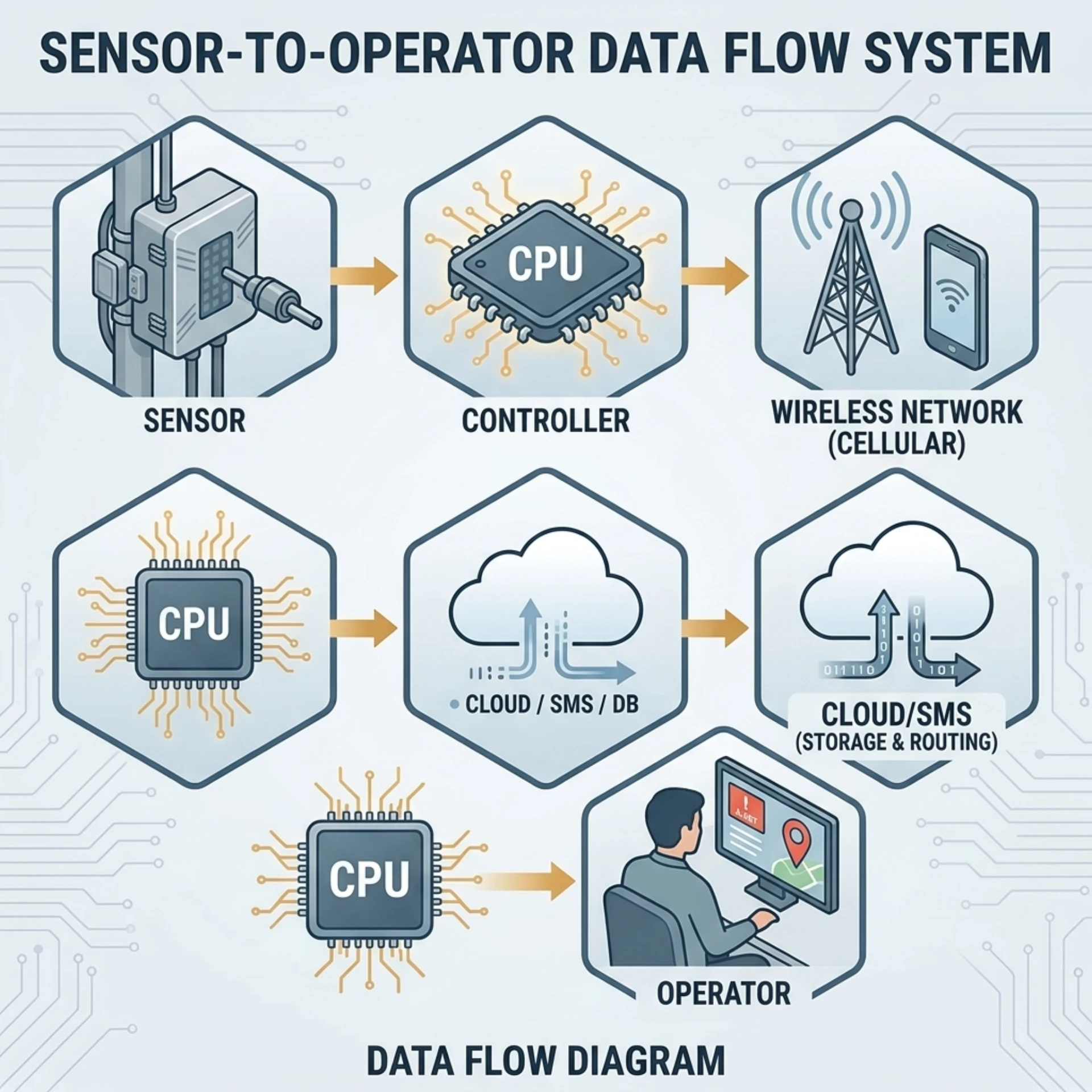
Introduction
Preventing transformer theft requires more than physical locks or fences. Remote distribution transformers need a combination of physical security, tamper detection, local alarms and remote monitoring to identify suspicious activity before equipment is removed or damaged.
Remote transformers present three fundamental challenges: they are difficult to supervise, traditional physical protection cannot always detect an active theft attempt, and response times are typically long. When a theft occurs in a remote area, the operator often discovers the loss only after power has been interrupted—at which point the equipment is already gone.
This guide explains how utilities, EPC contractors and distribution network operators can prevent transformer theft using practical security measures and remote monitoring methods. The focus is on actionable strategies, not theoretical concepts.
Why Are Remote Transformers Vulnerable to Theft?
Unattended Transformer Locations
Transformers in remote power distribution networks are inherently exposed. The most vulnerable locations include:
- Rural distribution networks serving small communities and farmland
- Agricultural areas with seasonal irrigation loads
- Construction sites where equipment is temporary and often unmonitored
- Mining areas with valuable equipment and limited access
- Remote substations with no permanent on-site staff
- Solar and PV installations spread across large areas with minimal staffing
The common factor across these locations is the absence of continuous human oversight. A transformer in a village feeder or a solar farm inverter station may be visited once a month for routine inspection—leaving 29 days of unmonitored exposure.
Limited Physical Security
Most remote transformer sites lack basic security infrastructure. There are no security personnel, minimal or no lighting, no CCTV coverage, and no perimeter fencing. The large geographical coverage of distribution networks makes it impractical to secure every transformer individually. This creates an environment where thieves can operate with minimal risk of detection.
Valuable Transformer Components
Copper remains the primary driver of transformer theft. A single medium-sized distribution transformer contains copper windings worth several hundred dollars on the informal scrap market. Copper cables, aluminium components, transformer oil, and other recoverable materials are also targeted. In many regions, scrap-metal dealers operate with minimal regulatory oversight, providing a ready market for stolen components.
Long Response Times
The distance between remote transformers and utility control centres creates a critical weakness:
Theft attempt → Damage → Power loss → Operator discovers later → Response dispatched → Equipment already removed
By the time an outage is reported and a crew reaches the site, the thieves have usually completed the job and left. This delay is the single biggest reason why conventional security measures fail in remote areas.
What Are the Risks of Transformer Theft?
Understanding the consequences helps justify investment in prevention. When a transformer is stolen or vandalized, the following impacts occur:
Power Supply Interruption: Affected feeders lose supply, disrupting households, farms, and industrial consumers.
Transformer Replacement Costs: Replacement involves not only the transformer itself but also transportation, crane hire, installation, and commissioning—often exceeding the original equipment cost.
Damage to Distribution Infrastructure: Thieves rarely remove components cleanly. Cable cutting damages terminations, forced entry damages enclosures, and rough handling can compromise mounting structures.
Safety Risks: Unauthorized access to high-voltage equipment poses electrocution and arc-flash hazards to thieves and the public.
Service Downtime and Customer Complaints: Extended outages damage utility reputation and may trigger regulatory penalties or customer compensation claims.
Higher Maintenance and Emergency Response Costs: Each theft event requires emergency dispatch, police reporting, insurance claims, and administrative follow-up.
Theft attempt → Equipment damage → Power outage → Emergency repair → Replacement cost
The financial impact extends far beyond the value of the stolen materials themselves.
How to Prevent Transformer Theft: 8 Practical Methods
1. Install Physical Security Barriers
Physical barriers are the first layer of protection. The most common options include:
- Protective cages or steel enclosures that cover the transformer tank and bushings
- Locked enclosures with tamper-resistant hinges and padlocks
- Anti-theft bolts with non-standard heads that require specialized tools
- Security doors on pad-mounted transformer cabinets
- Perimeter fencing around substations and transformer compounds
Physical protection makes unauthorized access more difficult and time-consuming. However, physical barriers alone do not alert operators when tampering occurs. They should be treated as the first layer, not the only layer.
2. Use Anti-Theft Bolts and Tamper-Resistant Hardware
Specialized fasteners add a significant obstacle to theft. Standard bolts can be removed with common tools, but anti-theft bolts require specialized bits or wrenches not carried by most thieves. Locked transformer cabinets and anti-tamper structures increase the time and effort required to access internal components.
Physical hardware can make unauthorized removal more difficult, but it cannot always notify operators when tampering occurs.
3. Install Transformer Tamper Detection Sensors
Sensors provide the critical ability to detect a theft attempt in progress. A well-designed transformer tamper detection system monitors multiple physical parameters:
| Detection Method | What It Detects | Typical Application |
|---|---|---|
| Vibration sensor | Impact, drilling, mechanical attack | Tampering or forced entry |
| Tilt sensor | Transformer being lifted or dragged | Attempted removal or displacement |
| Cable detection | Cable cutting or disconnection | Cable theft or isolation |
| Tamper sensor | Enclosure opening or bolt removal | Unauthorized access |
These sensors operate continuously and detect abnormal conditions immediately when they occur.
4. Deploy Local Theft Alarms
A local alarm provides on-site deterrence. When an abnormal event is detected, the system triggers:
- An audible siren (110dB or higher) that draws attention to the site
- Flashing warning lights that make the theft visible over distance
- A combination of sound and light that disrupts the thief’s operation
A transformer theft alarm can deter opportunistic thieves who prefer to work unnoticed. However, local alarms have a limitation: they only warn those who are nearby. For remote sites, the alarm may not be heard or seen by anyone who can respond.
5. Use Remote Transformer Monitoring
A local alarm may deter nearby thieves, but it does not guarantee that utility personnel will know what happened at an isolated transformer. Remote monitoring closes this gap by transmitting alarm information to operators immediately.
The basic workflow is:
Sensor → Controller → Wireless Network → Cloud/SMS → Operator
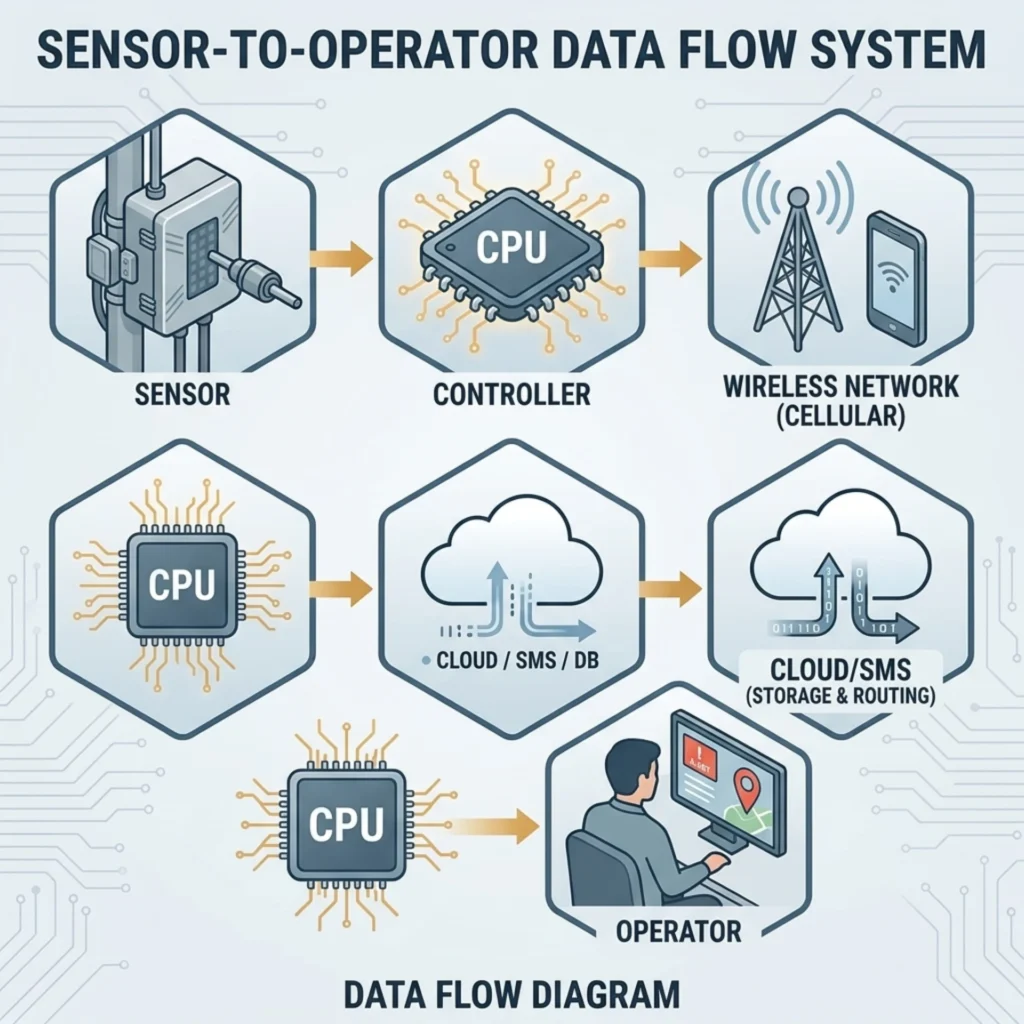
This enables real-time notification regardless of the transformer’s location. Operators receive alerts within seconds of an event, eliminating the delay between theft occurrence and awareness.
6. Implement GSM, 4G or NB-IoT Communication
The choice of communication network depends on the site’s coverage and power constraints:
- GSM: Widely available, suitable for areas with basic mobile coverage
- 4G Cat.1: Higher data capacity, suitable for richer alarm information
- NB-IoT: Low-power consumption, ideal for battery-operated sites
Remote transformer monitoring requires reliable communication. In areas with limited coverage, multiple network options allow the monitoring system to adapt to local conditions.
7. Monitor Power Status and Loss
Power monitoring adds an important dimension to transformer theft protection. The system can detect:
- Sudden power loss indicating intentional disconnection
- Phase loss or unbalanced voltage
- Abnormal voltage conditions
Power loss alone does not necessarily mean theft. However, when power loss occurs together with vibration, tilt or cable cutting, it provides a stronger indication of a potential theft event.
8. Combine Multiple Detection Methods
No single protection method is sufficient for remote transformers. The most effective approach combines physical security, sensor detection, local alarms and remote notification into a layered transformer security system.
| Solution | Vibration | Tilt | Cable Cut | Power Loss | Remote Alert |
|---|---|---|---|---|---|
| Physical Lock | ✗ | ✗ | ✗ | ✗ | ✗ |
| Siren Only | △ | △ | ✗ | ✗ | ✗ |
| Single Sensor | ✓ | ✗ | ✗ | ✗ | △ |
| Multi-Sensor Monitoring | ✓ | ✓ | ✓ | ✓ | ✓ |
Multi-layer protection = Physical protection + Sensor detection + Local alarm + Remote notification
Why Is Remote Transformer Monitoring Important for Theft Prevention?
Remote monitoring transforms the response model. Instead of discovering a theft only after power is lost, operators receive alerts at the moment an abnormal event occurs.
A monitoring-enabled workflow looks like this:
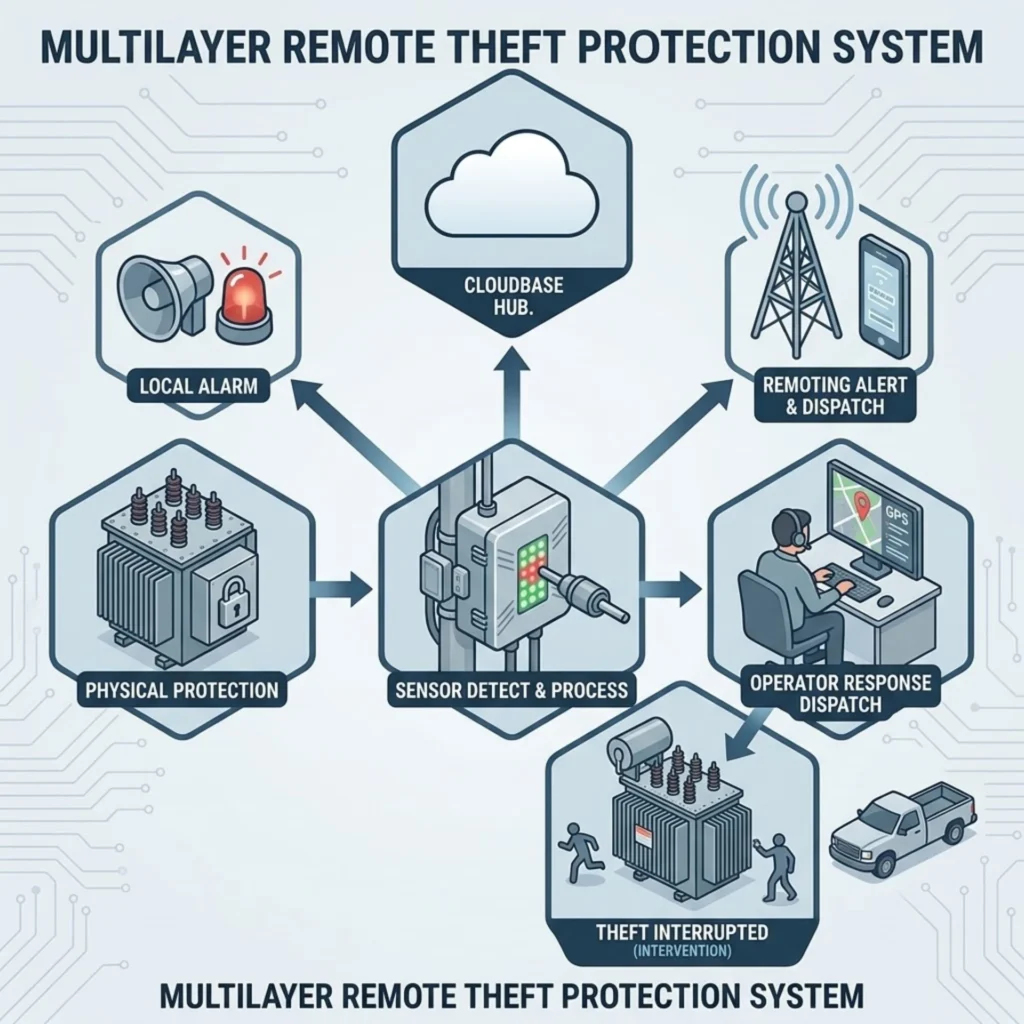
The key difference is the ability to interrupt the theft before the equipment is removed or destroyed.
GSM and 4G Remote Transformer Monitoring
Cellular networks provide the most practical communication path for remote sites. The monitoring system uses GSM or 4G to transmit alarm data from the transformer location to the operator’s control centre or mobile phone.
NB-IoT for Low-Power Transformer Security
NB-IoT offers a low-power alternative for sites where battery life is critical. This technology allows the monitoring device to operate for extended periods without mains power, making it suitable for transformers in completely off-grid locations.
SMS Alarm Notifications
SMS is the simplest and most widely supported alert method. Alarm messages can be sent to multiple operator phones simultaneously, ensuring that the alarm reaches someone regardless of shift schedules or duty rotations.
Cloud-Based Transformer Monitoring
Cloud platforms provide centralised visibility across multiple sites. Operators can view the status of all monitored transformers, review historical alarm records, and manage multiple devices from a single dashboard.
| Method | Local Alarm | Remote Alert | Suitable for Remote Sites |
|---|---|---|---|
| Lock/Fence | ✓ | ✗ | Medium |
| Siren | ✓ | ✗ | Medium |
| SMS Monitoring | ✓ | ✓ | High |
| Cloud Monitoring | ✓ | ✓ | High |
| Multi-sensor Monitoring | ✓ | ✓ | Very High |
Can Power Loss Detection Help Prevent Transformer Theft?
Power monitoring provides a valuable additional layer of detection. The system continuously monitors the three-phase supply to the transformer and identifies anomalies.
Detecting Sudden Power Loss
A sudden loss of power may indicate that thieves have disconnected the transformer to work safely. The monitoring system detects this event and reports it.
Detecting Phase Loss
Phase loss can indicate partial disconnection or cable damage. In the context of theft, it may indicate that one or more phase conductors have been cut.
Detecting Abnormal Voltage
Voltage outside normal ranges can indicate tampering with the supply circuit.
Combining Power Monitoring with Physical Sensors
Power status is most useful when combined with physical sensor data. A power loss event on its own may be caused by grid fault. But power loss accompanied by vibration and tilt provides a much stronger indication of a theft attempt in progress. This multi-parameter approach reduces false alarms and improves detection reliability.
Why Multi-Sensor Transformer Theft Protection Is More Effective
The limitation of single-sensor systems is their inability to cross-validate events. A vibration reading alone could be caused by an animal, wind, or legitimate maintenance work. When multiple sensors confirm a pattern—vibration plus tilt plus cable cut—the system can classify the event with much higher confidence.
Multi-layer protection = Physical protection + Sensor detection + Local alarm + Remote notification
This layered approach addresses the three key weaknesses of traditional security: lack of detection, lack of alerting, and lack of remote visibility. For EPC contractors designing new installations, integrating these layers from the outset is more cost-effective than retrofitting them later.
How to Prevent Transformer Theft in Rural and Remote Areas
Rural and remote networks require protection strategies that account for their specific conditions.
Agricultural Distribution Transformers
Risk: Transformers are located in open fields, far from communities. Theft can go unnoticed for days. Recommended Protection: Multi-sensor monitoring with solar or battery power and SMS alerting.
Mining and Oilfield Transformers
Risk: Valuable equipment in remote, harsh environments. Downtime is extremely expensive. Recommended Protection: Rugged monitoring devices with vibration, tilt, and cable detection plus cloud monitoring.
Construction Site Transformers
Risk: Temporary installations with no permanent security. Equipment moves frequently. Recommended Protection: Portable monitoring systems with quick deployment and GPS location tracking.
Remote Pole-Mounted Transformers
Risk: Easily accessible, difficult to physically secure. Recommended Protection: Tamper detection, tilt sensors, and local alarms to deter climbing or access attempts.
Unattended Substations
Risk: Multiple assets at a single location, but no on-site staff. Recommended Protection: Comprehensive monitoring covering all transformers and switchgear, with centralized cloud alerting.
| Environment | Main Risk | Recommended Protection |
|---|---|---|
| Rural area | Theft / vandalism | Sensors + SMS alarm |
| Mining site | Cable cutting | Cable detection + vibration |
| Construction site | Tampering | Tilt + vibration + GPS |
| Unattended substation | Delayed response | Remote monitoring + cloud alerting |
Physical Security vs Remote Transformer Monitoring
Physical security and remote monitoring serve different but complementary purposes. Physical security makes theft more difficult. Remote monitoring makes theft detectable.
| Protection Method | Prevents Access | Detects Theft | Sends Remote Alarm | Best Use |
|---|---|---|---|---|
| Fence | ✓ | ✗ | ✗ | Site protection |
| Security Cage | ✓ | ✗ | ✗ | Transformer enclosure |
| Anti-Theft Bolt | ✓ | △ | ✗ | Hardware protection |
| Siren | ✓ | ✓ | ✗ | Local deterrence |
| Remote Monitoring | ✗ | ✓ | ✓ | Unattended sites |
| Multi-Layer System | ✓ | ✓ | ✓ | High-risk locations |
The most effective strategy is not choosing between physical security and monitoring, but combining them into a layered transformer security system.
How Does Remote Transformer Theft Monitoring Work?
A complete remote monitoring system follows a sequence of events from detection to response:
Step 1 — Detect Abnormal Activity: Sensors continuously monitor vibration, tilt, cable continuity, power status, and enclosure tampering. An event occurs when any parameter exceeds its normal operating range.
Step 2 — Analyze the Alarm Condition: The controller evaluates sensor inputs simultaneously. Multiple events occurring in combination are flagged with higher priority.
Step 3 — Trigger Local Alarm: The system activates the on-site siren and flashing lights to deter the thieves and draw attention.
Step 4 — Send Remote Notification: Alarm information is transmitted via GSM, 4G, or NB-IoT to the cloud platform and SMS recipients. The message includes event type, timestamp, and location data.
Step 5 — Operator Verifies the Event: The operator reviews the alarm information and assesses the situation. Geolocation helps confirm the affected site.
Step 6 — Dispatch Security or Maintenance Personnel: A response team is sent to the site to secure the equipment, assess damage, and initiate repair if needed.
This sequence replaces the traditional reactive model with a proactive approach that can interrupt theft attempts before equipment is lost.
What Should Be Monitored to Prevent Transformer Theft?
A comprehensive monitoring approach covers both physical and electrical parameters:
Transformer Vibration
Vibration sensors detect impact, drilling, or other mechanical attacks. Any vibration exceeding preset thresholds triggers an alarm.
Transformer Tilt or Movement
Tilt sensors detect whether the transformer is being lifted, dragged, or otherwise displaced from its normal position.
Cable Cutting
Cable monitoring detects loss of continuity in the transformer’s incoming and outgoing cables.
Power Loss
Power monitoring identifies sudden loss of supply, which may indicate intentional disconnection.
Phase Loss
Phase-loss detection identifies partial cable damage or disconnection.
Unauthorized Access
Tamper sensors detect enclosure doors being opened or security bolts being removed.
GPS Location
GPS provides precise location data for each monitored transformer, enabling accurate dispatch.
Optional Image or Video Verification
Some systems offer image capture capability to provide visual confirmation of the event.
How to Choose a Transformer Theft Prevention Solution
EPC contractors and project engineers should consider the following factors when selecting a solution:
Consider the Transformer Location: Is the transformer rural, remote, urban, or industrial? The location determines the appropriate protection level.
Evaluate Communication Network Availability: Check local coverage for GSM, 4G, and NB-IoT. Choose a solution that supports the available network.
Check Sensor Types: Ensure the solution includes vibration, tilt, cable, power, and tamper detection.
Check Alarm Response Time: The system should provide immediate notification when an abnormal event is detected.
Evaluate Backup Power: For remote sites without reliable mains power, the monitoring device must have long-term battery operation (3–5 years is achievable).
Check Outdoor Protection Rating: The device must withstand rain, dust, UV exposure, and temperature extremes. IP55 or higher is recommended.
Consider Cloud and SMS Monitoring: The solution should offer both SMS alerts and cloud-based visibility for multiple devices.
Check Customization Requirements: Different sites may require different sensor configurations or communication methods. The solution should be adaptable.
Transformer Theft Prevention Checklist
- [ ] Install physical barriers (cages, enclosures, fencing)
- [ ] Use anti-theft bolts and tamper-resistant hardware
- [ ] Install vibration detection
- [ ] Install tilt detection
- [ ] Monitor cable cutting
- [ ] Monitor power loss and phase loss
- [ ] Enable local alarms (siren + warning lights)
- [ ] Enable SMS and remote alerts
- [ ] Use backup power for remote sites
- [ ] Connect to cloud monitoring platform
- [ ] Establish emergency response procedures
- [ ] Regularly inspect remote transformers
Frequently Asked Questions About Transformer Theft Prevention
How can I prevent transformer theft?
Preventing transformer theft requires a layered approach combining physical security (locks, cages, anti-theft bolts), tamper detection sensors (vibration, tilt, cable, power), local alarms, and remote monitoring with SMS or cloud alerting.
What is the best way to prevent transformer theft in remote areas?
For remote areas, the most practical solution is a low-power monitoring device with long battery life, local siren deterrence, and GSM/4G/NB-IoT communication for remote alerts—since regular patrols cannot provide timely coverage.
How can remote monitoring prevent transformer theft?
Remote monitoring detects abnormal events at the moment they occur and sends alerts to operators instantly. This eliminates the delay between theft and discovery, allowing response to be dispatched before the equipment is removed.
Can vibration sensors detect transformer theft?
Yes. Vibration sensors detect hammering, drilling, and mechanical impact—activities that typically precede theft attempts. Any vibration exceeding preset thresholds triggers an alarm.
Can a transformer monitor detect cable cutting?
Yes. Cable continuity monitoring detects sudden open-circuit conditions, indicating cables have been cut.
How does a transformer theft alarm work?
A transformer theft alarm system uses sensors to detect abnormal conditions (vibration, tilt, cable cutting, power loss, tampering). When an event is detected, it activates a local siren and/or warning light, while also sending remote notifications via wireless communication.
What is the difference between transformer theft prevention and theft detection?
Theft prevention refers to measures that make theft harder to accomplish (locks, cages, anti-theft bolts). Theft detection refers to measures that identify when a theft attempt is in progress (sensors, alarms, remote monitoring). Effective security combines both.
How can utilities protect unattended transformers?
Unattended transformers require automated protection: sensors detect abnormal events, local alarms provide on-site deterrence, and remote monitoring ensures operators are notified even when no one is physically present at the location.
A Layered Approach Is the Best Way to Prevent Transformer Theft
The problem of remote transformer theft does not have a single-point solution. Physical barriers alone cannot stop determined thieves who operate out of sight. Inspection alone cannot cover the vast distances of rural distribution networks. Local alarms alone cannot alert operators who are miles away.
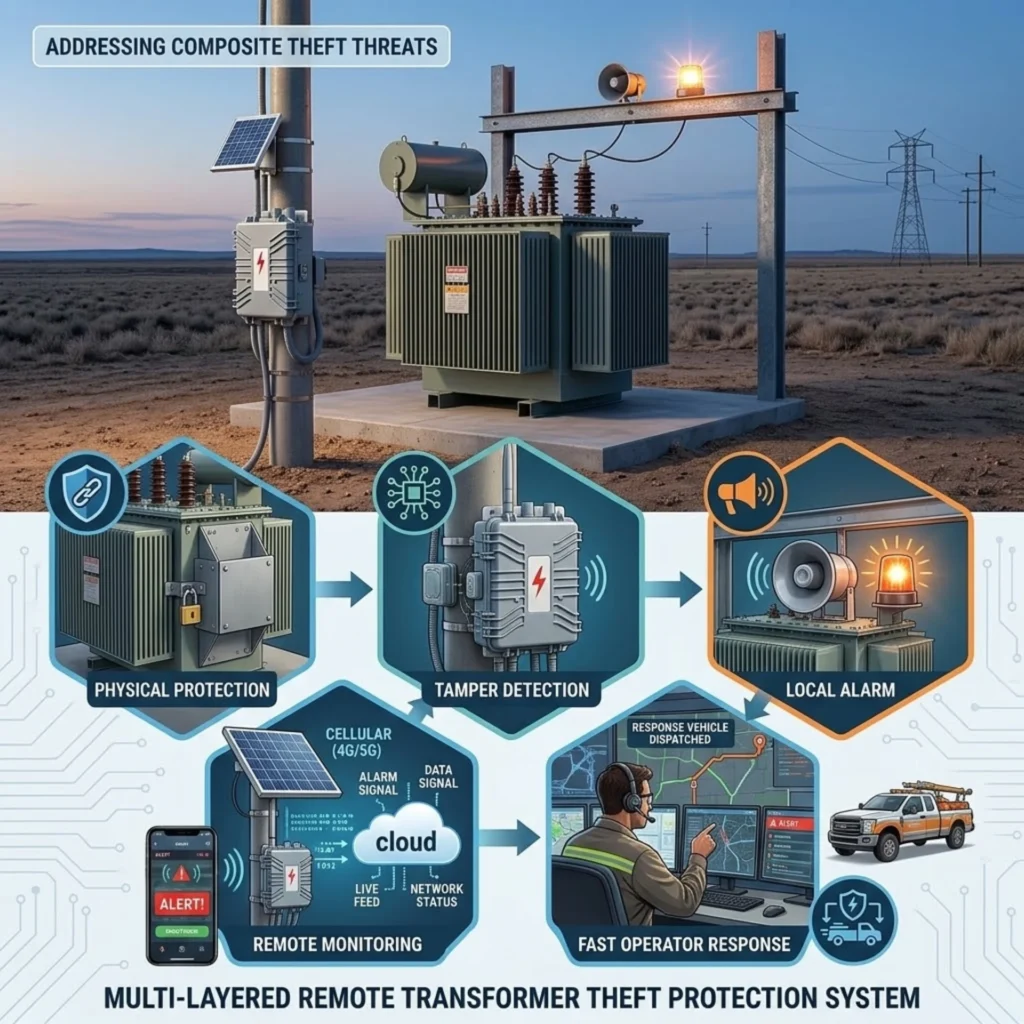
Each layer addresses a weakness in the previous one. Physical protection deters casual theft. Tamper detection identifies attacks that physical barriers cannot stop. Local alarms disrupt the thief’s operation. Remote monitoring ensures the alarm reaches someone who can respond. Fast response stops the theft before the equipment is lost.
For remote and unattended distribution networks, a comprehensive solution that provides vibration, tilt, cable-cutting, and power-loss detection, combined with local and remote alarms, offers the most practical and effective means to prevent transformer theft.
To learn more about integrated solutions for transformer protection, visit our Transformer Anti-Theft Monitoring Device product page.
References
- Y. Ji et al., “Intelligent diagnosis method for electricity theft behavior in distribution network based on three-layer edge computing model,” Energy Reports, 2024.
- “How outdated infrastructure, weak security and corruption are fueling power equipment theft in Zimbabwe,” ZAWYA, December 2025.
- “Copper wires stolen from transformers in Ampara,” DailyNews (Sri Lanka), August 2026.
- “Ludhiana: Over ₹10 crore lost to transformer thefts in a yr, reveals PSPCL report,” Hindustan Times, June 2026.
- “Gang steals 440 kVA transformer, cuts power to 300 homes in Lucknow’s Shivpuri area,” The Times of India, February 2026.
- “Transformer copper thefts: LESA to install cameras, intensify night patrols,” Hindustan Times, February 2026.
- “Transformer thefts cripples supply in Ludhiana circles,” Hindustan Times, April 2026.
- “CX-032946: EAL Substation Fence and Transformer Hardening Project,” U.S. Department of Energy, January 2025.
- “Thieves bring in crane, try to snatch 700kg transformer,” The Indian Express, September 2013.
- “Wireless sensor system targets cable-theft disruptions at high-risk substations,” Energize, November 2025.
- M. F. Khan, “Aggregated Wireless Sensor System for High-Risk Distribution Substations,” CIGRE Southern Africa Regional Conference, October 2025.