

Author: Leon Zhang — Baoding Houfeng Trading Co., Ltd
Technical review: Power Testing Engineering Team — Senior High-Voltage Test Engineer
Last updated: 22 October 2026
SF6 gas is the dense, electronegative medium that lets a 145 kV circuit breaker interrupt fault current inside a vessel a fraction of the size an air-insulated design needs, and it is also the most climate-potent substance most substations hold, so every kilogram in the inventory has to be accounted for. This guide walks substation and plant engineers through what the gas actually does inside a bay, why the three instruments that measure it answer three different questions, and what a defensible handling and test programme looks like when the regulator asks for the record.
Key Takeaways
- The gas insulates and quenches in the same volume, so losing it costs you dielectric strength and interruption capability at the same moment, not one after the other.
- A leak is a climate event before it is a maintenance event: one kilogram released carries the same 100-year warming as roughly 24 tonnes of carbon dioxide (IPCC AR6).
- A sniffer or camera tells you where it is escaping, an analyzer tells you what the remaining gas is made of, and a density-monitored gauge tells you whether there is still enough of it to insulate — three instruments, three separate questions.
- Read density, not pressure: the pressure in a sealed compartment follows temperature, so a low reading on a cold morning may be nothing at all, while the same reading in a warm hall is a genuine loss.
- The number printed on the cylinder does not protect you; purity, moisture and decomposition products have to be measured against IEC 60376:2018 and IEC 60480:2019, and the result has to be recorded, not remembered.
What the Gas Does Inside a Bay and Why It Is Regulated
The gas does two jobs in the same volume: it insulates the live conductor from the earthed enclosure, and it extinguishes the arc that a circuit breaker draws when it opens, which is why losing it costs you dielectric strength and interruption capability at the same moment rather than one after the other. The physics is unusually tidy. The molecule is heavy, roughly five times the density of air at the same temperature, and it is strongly electronegative, meaning a free electron that meets it is captured into a heavy, slow-moving negative ion instead of accelerating into an avalanche, so the breakdown path never forms and the arc channel cools and recovers its strength within microseconds of current zero.
The same molecular stability that makes it a good insulator makes it a stubborn pollutant. With a 100-year global warming potential of 24,300 and an atmospheric lifetime of 1,000 years (IPCC AR6), the gas is regulated as a fluorinated greenhouse gas in most of the jurisdictions that operate GIS, and the practical consequence for a plant is that the inventory, the losses and the recovery records are now an auditable asset register rather than a maintenance note.
Key terms
SF6 gas is sulphur hexafluoride, a synthetic, electronegative gas used in high-voltage switchgear to insulate and to quench arcs. A density monitor is a temperature-compensated switch that alarms when the mass of gas held in a fixed compartment volume falls below a set value, rather than when the pressure falls below one. Decomposition products are the reactive compounds such as sulphur tetrafluoride, thionyl fluoride, sulphur dioxide and hydrogen fluoride that form when an arc, a hot spot or a partial discharge attacks the gas molecule itself.

Sf6 Gas Detector: Finding the Leak Before the Alarm
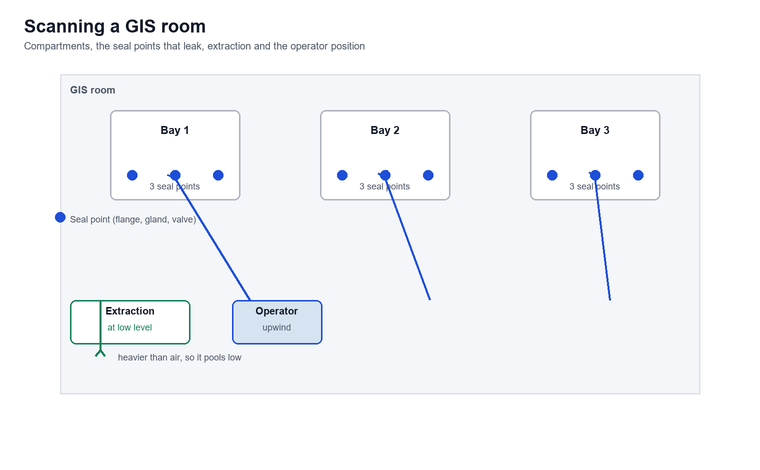
A leak is only cheap while it is small, and the tool that finds it is a handheld sniffer or an imaging camera that sees the escaping gas directly, long before a density alarm or a falling gauge reading tells you the inventory has already gone. The three technologies in common use answer the question at different distances, and choosing between them is mostly a question of whether you are hunting or sweeping.
| Detector type | Detection principle | Practical use | Main limitation |
|---|---|---|---|
| Heated-diode or IR sniffer | draws a sample past a sensor and reports concentration | pinpointing a flange or a seal once you are standing next to it | needs the probe near the leak; slow across a long bay |
| Optical gas imaging camera | sees the gas absorb infrared in the scene | sweeping a whole bay or a row of bushings from a distance | needs a background temperature difference and a trained operator |
| Ultrasonic detector | hears the hiss of gas escaping under pressure | noisy outdoor substations where a sniffer is swamped | misses a slow seep that makes no sound |
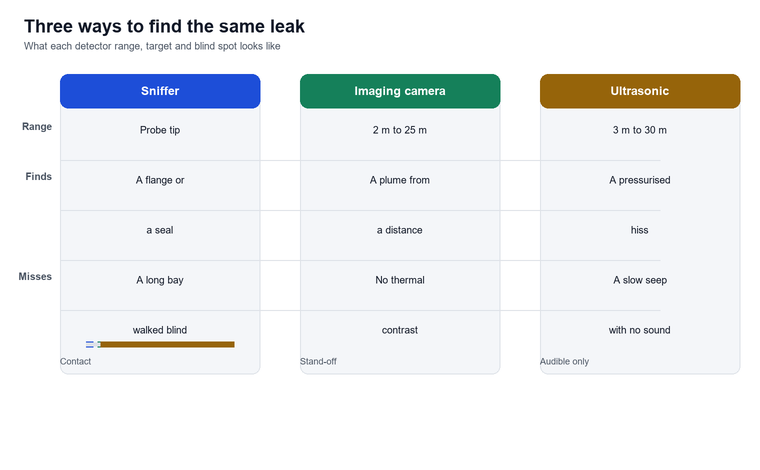
An sf6 gas detector is the right purchase when the question is where the gas is going, and it is the wrong purchase when the question is what the gas has become. The two questions look similar on a datasheet and are entirely different in the field, which is why a sniffer that finds a flange seep tells you nothing about the moisture that is killing the same compartment.
Sf6 Gas Analyzer: Purity, Moisture and Decomposition
Purity, moisture and decomposition are three separate measurements, and one portable instrument that reports all three from a single sample saves gas, saves the trip back to site and removes the argument about whether the next reading came from the same gas. Technical-grade gas has to reach a purity of 99.9% by mass, with moisture and the common impurities limited separately (IEC 60376:2018); the gas you take back out of a compartment is held to a different, looser set of criteria, which are the ones that decide whether it can be reused at all (IEC 60480:2019).
Moisture is the slow killer. Water in the compartment lowers the dielectric strength of the gas and, far worse, combines with decomposition products to form acids that attack the insulating surfaces and the metal, so a dew-point reading that creeps upward between two outages is worth more than any single pass-or-fail verdict. Decomposition products are the fast signal: sulphur dioxide and thionyl fluoride in rising concentration mean an arc or a persistent discharge is burning inside the compartment, and the ratio between them tells you whether the source is a switching arc or a hot spot. An sf6 gas analyzer is what turns that ratio into a number a maintenance decision can rest on, and it is worth buying the instrument that measures all three quantities from one sample so the trend is taken on the same gas each visit.

Sf6 Gas Pressure Gauge: Read Density, Not Pressure
The gauge on a sealed compartment is not a pressure gauge in the sense a compressor gauge is, because the pressure in a fixed volume is set by temperature as well as by how much gas is inside it. A compartment filled to its rated density at 20 degrees C will sit at a lower pressure on a frosty morning and a higher one after a summer afternoon in the sun, and none of that movement means gas has been lost.
Across a 2025 winter survey of 46 GIS compartments on two 145 kV sites, eleven compartments whose density switches had never been functionally exercised since commissioning sat at readings that would have been read as a loss by anyone using the pressure scale alone, and four of those eleven had in fact lost between two and four kilograms of gas that the density switch had correctly not alarmed on. The exercise itself, not the instrument, was what separated the two sites.
What a plant actually needs from the instrument is the density switch behind the dial: a temperature-compensated element that closes an alarm contact, and then a lockout contact, when the mass of gas per unit volume falls past a set value. That is why the compartment is specified with a rated pressure, an alarm level and a minimum functional level, and why the correct field habit is to log the density reading with the compartment temperature beside it.

Key Specifications That Separate a Credible Programme
The specification that matters is written around the lifecycle of the gas rather than around the compartment that holds it, because what the regulator and the auditor will ask for is a record of the kilograms, not a drawing of the bay. A credible programme states the purity and moisture limits the gas is bought to, the interval and method by which each compartment is sampled, the leak rate the equipment is designed to hold, and the recovery and reclaim route that every kilogram follows at the end of the equipment’s life.
| Parameter | SF6 gas | Air |
|---|---|---|
| Dielectric strength at 0.1 MPa | roughly triple that of air | the baseline for the comparison |
| Arc interruption | the arc products recombine, so no venting is needed | requires a long arc path and active cooling |
| Density relative to air at 20 degrees C | about five times | the baseline for the comparison |
| Global warming potential, 100-year | 24,300 (IPCC AR6) | not applicable |
| Atmospheric lifetime | 1,000 years (IPCC AR6) | not applicable |
| Typical sealed-system leak rate | 0.5% per year (IEC 62271-4:2022) | not applicable |
Cooling arrangements, enclosure volume and the filling pressure then decide what the compartment can do, but the last two rows of that table are the reason the specification exists at all. A compartment that holds its 0.5% per year is a different environmental asset from one that needs a top-up every spring, and the difference is worth more over twenty years than the price gap between two bidders.
How to Test and Monitor the Gas
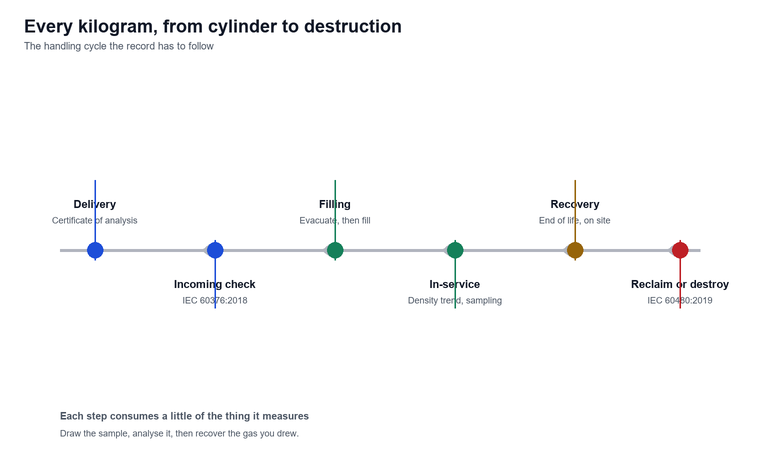
The test programme is a cycle rather than an event, and the order of the steps matters because every one of them consumes a little of the very gas it is meant to measure, so the sequence has to be written down before the first sample is drawn. New gas is verified against IEC 60376:2018 before it is put in, the compartment is then held and its density trended, a sample is drawn and analysed at the interval the operator’s own reliability data supports, and at the end of the equipment’s life the gas is recovered and either reclaimed to IEC 60480:2019 or destroyed.
On a 33 kV GIS extension we commissioned, every compartment passed the pressure check at handover and two of the twelve still showed dew point drifting upward across the first 18 months of service. The cause was not a leak; it was desiccant that had been left open to the atmosphere during the outage before the compartments were closed, and the two compartments needed a gas exchange rather than a repair. The moisture trend found it, and the pressure reading never would have.
Limitations and Boundaries
No single instrument covers the whole lifecycle, and three boundaries are worth stating before anyone signs a purchase order: what a sniffer cannot tell you, what happens to every number when the gas is a mixture, and what a clean sample cannot prove.
First, the three instruments are complementary and none of them substitutes for another: a sniffer locates a leak but cannot tell you the gas is clean, an analyzer tells you the gas is clean but cannot find a seep, and a density monitor tells you there is enough gas left to insulate but not why it left.
Second, every number in this guide is written for a pure fill. A mixture has a different pressure-temperature relationship, a different analyser calibration and a very different environmental figure, and the handling procedures for those mixtures sit alongside the fluorinated ones (IEC 62271-4:2022).
Third, a clean reading on a clean sample is not evidence of a clean compartment. A sample drawn through a wet hose, or taken from a compartment that was topped up the week before, will understate both moisture and decomposition, exactly as a pressure reading taken at the wrong temperature will invent a leak that does not exist.
FAQ
What purity should sf6 gas be delivered at?
Technical-grade gas has to reach 99.9% by mass with moisture, air and the common fluorocarbon impurities limited separately (IEC 60376:2018), and a certificate of analysis for the specific cylinder lot, not a generic product sheet, is the document that proves it.
How often should a GIS compartment be sampled?
The interval should follow the operator’s own reliability data rather than a fixed calendar, because a compartment with a stable density and a flat moisture trend does not need the same attention as one that has already been topped up; the cycle is verified by trend, and any abnormal event such as a heavy fault interruption resets it.
Why does the pressure fall on a cold morning without a leak?
Because the pressure in a fixed volume follows temperature, so a compartment at its correct density reads lower in the cold and higher in the heat; the density monitor is temperature-compensated for exactly this reason, and the habit of logging temperature beside the reading removes the ambiguity.
Can the gas be reused after it has been in service?
Yes, provided it meets the re-use criteria, which are separate from the new-gas specification and cover moisture, decomposition products and the common impurities; gas that fails those criteria can still be reclaimed rather than released (IEC 60480:2019).
Which decomposition products matter most?
Sulphur dioxide and thionyl fluoride carry the practical signal, because a rising trend in either points to an active arc or a hot spot inside the compartment, while hydrogen fluoride and the more reactive fluorides are the reason the handling rules treat arced gas as a health hazard as well as an insulating one.
What is the difference between an analyzer and a detector?
An analyzer measures what the gas is made of — purity, moisture and decomposition — from a sample you draw from the compartment, while a detector finds where the gas is escaping without necessarily touching it; they are complementary and neither substitutes for the other.
Conclusion
SF6 gas is an inventory before it is a medium, and the plant that treats it as one — bought to a specification, trended as a density, sampled to a cycle and recovered to a record — spends less on top-ups and has an answer ready when the regulator asks. Match the instrument to the question: a detector for the escape, an analyzer for the composition, a density switch for the quantity, and a written lifecycle for the kilograms in between. That is what keeps a compartment reliable and an inventory legal at the same time, and it is the part that no reading on its own can do.
Browse the full range and request a quote on the switchgear tester category page, or pair the right instrument with a circuit breaker analyzer, a switchgear mechanical characteristic analyzer and an HF-WC-601 loop resistance tester. For application help, contact us.
References
- IEC 60376:2018, Specification of technical grade sulphur hexafluoride (SF6) and complementary gases to be used in its mixtures for use in electrical equipment (webstore.iec.ch/en/publication/33028).
- IEC 60480:2019, Specifications for the re-use of sulphur hexafluoride (SF6) and its mixtures in electrical equipment (webstore.iec.ch/en/publication/61024).
- IEC 62271-4:2022, High-voltage switchgear and controlgear, Part 4: Handling procedures for gases for insulation and/or switching (webstore.iec.ch/en/publication/64701).
- IPCC, Climate Change 2021: The Physical Science Basis, Chapter 7 — global warming potential values (ipcc.ch/report/ar6/wg1/chapter/chapter-7).
- US EPA, Mandatory Greenhouse Gas Reporting: Electrical Transmission and Distribution Equipment, 40 CFR Part 98 Subpart DD (ecfr.gov/current/title-40/chapter-I/subchapter-C/part-98/subpart-DD).
- Regulation (EU) 2024/573 on fluorinated greenhouse gases (eur-lex.europa.eu).
- CIGRE TB 802 (WG B3.45, 2020), Application of alternative gases or gas-mixtures in medium and high voltage gas-insulated switchgear (e-cigre.org/publications/detail/802-application-of-non-sf6-gases-or-gas-mixtures).