

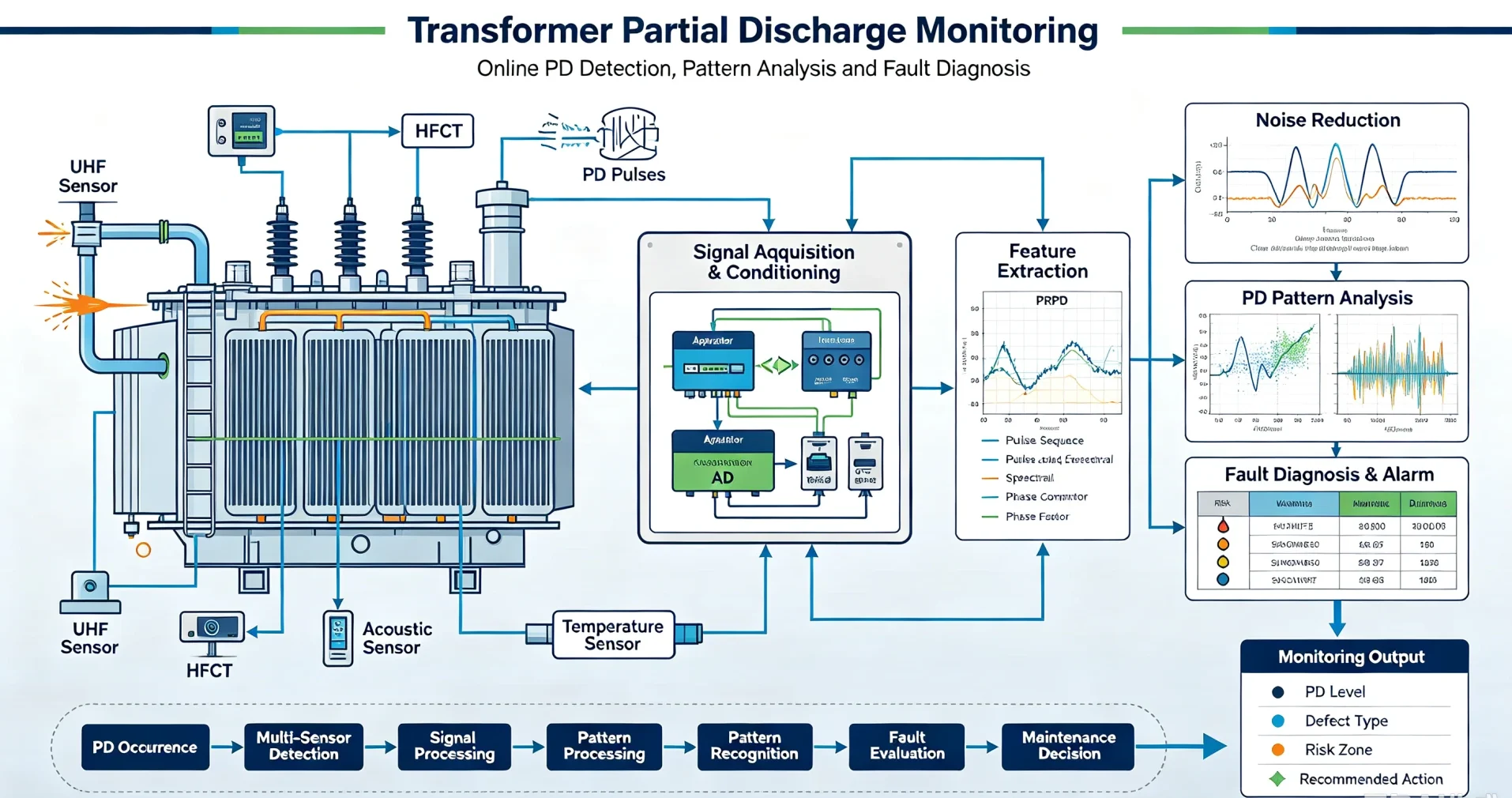
Transformer partial discharge monitoring is a condition-monitoring method used to detect, analyze, and track localized insulation discharge activity in power transformers.
By monitoring PD signals and their changes over time, engineers can identify developing insulation problems and assess transformer insulation condition before a major failure occurs.
This guide explains what transformer partial discharge monitoring is, how the monitoring process works, the main detection methods, what information PD monitoring provides, and where online monitoring is typically applied.
What Is Transformer Partial Discharge Monitoring?
What Is Partial Discharge in a Transformer?
Partial discharge refers to localized dielectric breakdown within transformer insulation (oil, paper, pressboard, or composite insulation) that does not completely bridge the high-voltage and ground electrodes. Caused by uneven electric field distribution, insulation aging, manufacturing defects, or mechanical loosening, PD generates tiny, intermittent discharge pulses. Unlike full insulation breakdown, partial discharge does not trigger immediate transformer failure. However, continuous cumulative discharge erodes insulation materials, accelerates aging, and eventually leads to permanent insulation damage and equipment failure per IEC 60270:2025 and IEEE C57.113-2023 industry standards.
Why Is Partial Discharge Important for Transformer Insulation?
Transformer insulation is the core barrier ensuring stable operation of high-voltage power equipment. Partial discharge is the most intuitive early warning signal of insulation degradation. Long-term PD activity causes local electrical stress concentration, carbonization of insulating paper, oil decomposition, and insulation void expansion. These hidden defects gradually weaken insulation performance, reduce transformer operational reliability, and greatly increase the risk of flashover and breakdown under overload, overvoltage, or harsh operating conditions. Timely PD monitoring is the key to grasping the health status of transformer insulation systems.
Transformer PD Monitoring vs Transformer Insulation Monitoring
Many industry practitioners confuse PD monitoring with full-range transformer insulation monitoring. In fact, transformer partial discharge monitoring is a critical branch of insulation condition monitoring, not a substitute.
Complete transformer insulation diagnosis also includes insulation resistance testing, dielectric loss measurement, and DGA gas analysis. PD monitoring focuses on real-time capture of dynamic insulation discharge defects, which complements static insulation parameter detection and multi-dimensional fault diagnosis, forming a comprehensive transformer health evaluation system.
For a more detailed explanation of why PD monitoring matters for transformer insulation, see our guide to the importance of partial discharge monitoring in transformers.
Why Monitor Partial Discharge in Power Transformers?
Early Detection of Insulation Problems
Partial discharge is one of the earliest signs of insulation degradation in transformers, often appearing long before visible damage or electrical failure. Early detection allows operators to address problems before they develop into serious faults, avoiding widespread outages and costly repairs. Online monitoring provides continuous visibility that periodic offline testing cannot offer.
Continuous Tracking of Developing Defects
Partial discharge often develops gradually over time, changing in intensity and pattern. Continuous monitoring allows operators to track these changes, distinguish stable low-level activity from worsening discharge, and make better judgments about urgency and maintenance timing.
Support Condition-Based Maintenance
PD monitoring supports a shift from fixed-schedule maintenance to condition-based maintenance by providing real-time data on insulation health. Maintenance activities can be prioritized based on actual discharge activity and trend, helping allocate resources more efficiently and reduce unnecessary interventions.
Monitoring of Critical Power Transformers
For urban-core substation transformers, large wind and PV step-up units, and aging transformers, power-supply reliability is vital. Continuous 24/7 PD monitoring provides online condition awareness of key assets and supports stable grid operation without relying solely on periodic inspections or offline tests.
Transformer PD Monitoring vs Transformer Insulation Monitoring
Transformer PD monitoring focuses specifically on partial discharge activity as an indicator of insulation condition. It is a critical branch of insulation condition monitoring, not a substitute for it.
Insulation condition can also be assessed through other methods such as insulation resistance testing, dielectric loss measurement, and dissolved gas analysis (DGA). Each method provides a different view of transformer health. PD monitoring adds continuous, online visibility into discharge activity, while these complementary methods support a broader insulation assessment.
How Does Transformer Partial Discharge Monitoring Work?
The complete workflow of transformer PD monitoring follows a closed-loop logic from signal capture to maintenance decision-making, covering sensor acquisition, signal processing, data analysis, and fault early warning. The standard technical flow is as follows:
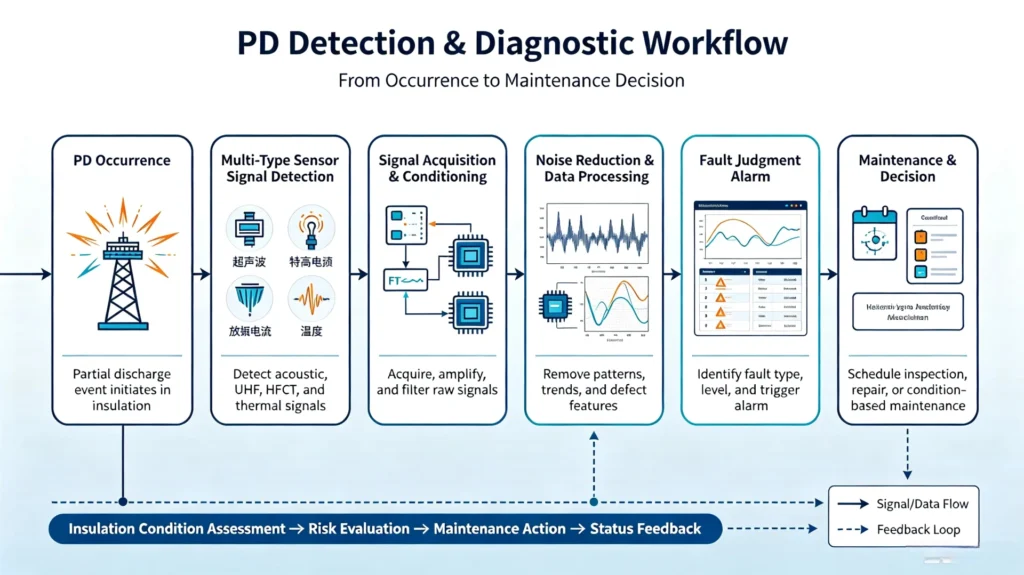
PD Occurrence → Multi-Type Sensor Signal Detection → Signal Acquisition & Conditioning → Noise Reduction & Data Processing → PD Pattern Analysis → Fault Judgment & Alarm → Maintenance Decision
Step 1: Detect Partial Discharge Signals
When partial discharge occurs inside a transformer, it produces three measurable physical signals: high-frequency electromagnetic waves, high-frequency grounding current pulses, and acoustic emission signals. Different detection technologies capture corresponding characteristic signals to realize PD identification.
Step 2: Acquire and Condition the PD Signal
Professional PD sensors (UHF sensors, HFCT sensors, ultrasonic sensors) collect original discharge signals. The system performs signal amplification, impedance matching, and preliminary filtering to eliminate invalid interference signals and retain effective PD characteristic signals, ensuring data authenticity and accuracy.
Step 3: Process and Analyze PD Data
The system performs secondary noise reduction and filtering on the collected signals to filter out on-site electromagnetic interference, mechanical vibration, and power frequency interference. It extracts core characteristic parameters including discharge magnitude, pulse repetition rate, and phase distribution characteristics of discharge pulses.
Step 4: Identify PD Patterns
Based on professional analysis algorithms, the system identifies PD types through PRPD (Phase-Resolved Partial Discharge) patterns and PRPS pulse sequence analysis. Combined with historical data trend comparison, it distinguishes internal discharge, surface discharge, particle discharge, and other fault types, realizing qualitative fault judgment.
Step 5: Generate Alarms and Condition Information
The system compares real-time PD parameters with industry standard thresholds and equipment historical baseline data. When abnormal discharge activity or continuous rising discharge trends are detected, it automatically triggers graded alarms and outputs visual transformer insulation condition reports to support operation and maintenance decision-making.
For a detailed explanation of how an online partial discharge monitoring system for transformers acquires, processes and analyzes PD signals, see our online monitoring guide.
Transformer Partial Discharge Detection Methods
Different transformer partial discharge detection methods capture different physical characteristics of PD signals. The selection of detection schemes depends on transformer structure, on-site installation conditions, electromagnetic noise environment, and monitoring objectives. The four mainstream industrial detection technologies are as follows:
| Technology | Principle | Advantages | Limitations | Applications |
|---|---|---|---|---|
| UHF | Captures electromagnetic waves (300MHz–3GHz) from PD | Strong anti-interference, high sensitivity, accurate positioning | Requires reserved positions; weak for low-frequency discharge | New transformers, HV main transformers |
| HFCT | Clamps HF current sensors on grounding conductors | Simple installation, no need to open transformer, retrofit-friendly | Susceptible to grounding loop interference; no positioning | Operating transformers, retrofit projects |
| Ultrasonic | Captures acoustic signals through oil and tank wall | Non-invasive, no impact on operation, low cost | Signal attenuation, noise interference, low sensitivity for deep discharge | Auxiliary monitoring, quick fault screening |
| Acoustic Emission | Captures elastic waves from insulation cracks and discharge impact | Non-destructive, useful for auxiliary verification | Not suitable as standalone monitoring method | Auxiliary PD fault verification |
UHF vs HFCT vs Ultrasonic Transformer PD Detection
UHF, HFCT and ultrasonic methods have different signal characteristics, installation requirements and noise performance. The appropriate method depends on transformer design, installation conditions and monitoring objectives.
For a detailed comparison, see: Transformer Partial Discharge Detection: UHF vs HFCT vs Ultrasonic.
What Can Transformer Partial Discharge Monitoring Detect?
PD monitoring provides intuitive diagnostic evidence for transformer insulation faults. It can effectively identify multiple typical developing insulation defects, but it needs to be combined with DGA, insulation resistance, and other data for comprehensive judgment to avoid single-data misjudgment.
Internal Discharge
Caused by internal insulation voids, bubbles, or paper layer defects, it is the most common hidden danger of transformer insulation failure. Long-term internal discharge will erode insulating paper and accelerate insulation aging.
Surface Discharge
Occurs on the surface of insulating paper and bushings, caused by surface dirt, damp insulation, or uneven electric field. It easily develops into creeping discharge and causes insulation flashover.
Corona-Type Discharge
Generated by sharp metal burrs or uneven electric field of high-voltage conductors, it is common in new equipment or equipment with poor assembly process, which will gradually damage surrounding insulation.
Floating Electrode or Particle-Related Discharge
Caused by suspended metal particles, loose metal parts, or floating potential components inside the transformer. Discharge activity is unstable and easy to mutate into severe faults under operating voltage fluctuations.
Developing Insulation Defects
PD monitoring can track the continuous deterioration trend of insulation defects, accurately capture abnormal discharge growth caused by aging, dampness, and mechanical damage, and realize early warning of latent faults.
What Information Does Transformer PD Monitoring Provide?
- PD activity – whether partial discharge is present and active
- PD magnitude – the intensity of detected discharge signals
- PRPD pattern – phase-resolved partial discharge pattern for identifying discharge characteristics
- Trend – how PD activity changes over time
- Alarm – notification when PD levels exceed configured thresholds
- Historical data – recorded events and measurements for analysis and comparison
A complete PD monitoring system combines these data with sensor acquisition, processing and communication components.
For more details, see our Transformer Partial Discharge Monitoring System.
Online vs Offline Transformer PD Monitoring
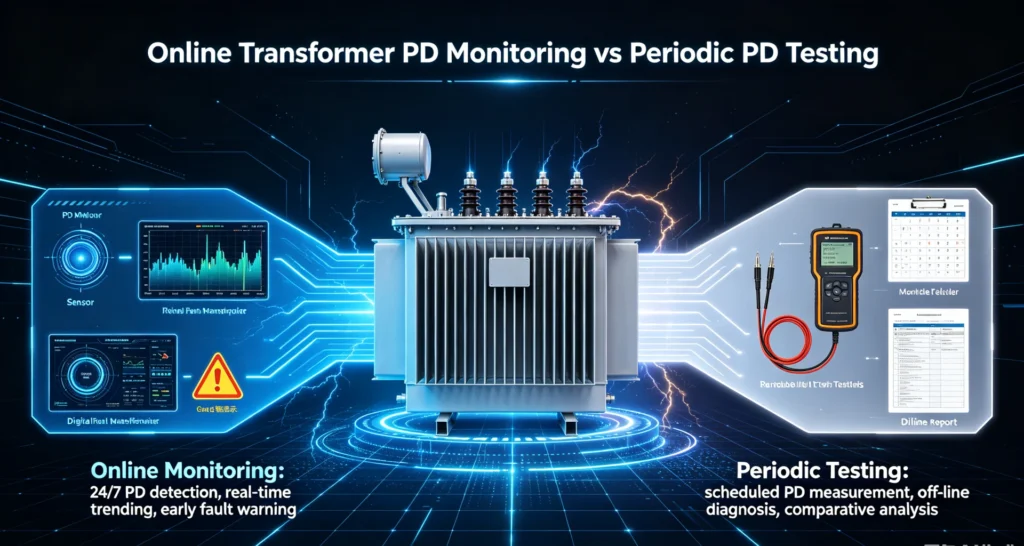
Online monitoring operates on energized transformers and supports continuous condition monitoring, while offline PD testing is normally performed during planned outages under controlled test conditions.
| Item | Online Monitoring | Offline Testing |
|---|---|---|
| Transformer status | In service | Out of service |
| Frequency | Continuous | Periodic |
| Main purpose | Condition monitoring | Testing/diagnosis |
For a detailed comparison, see Online vs Offline Partial Discharge Testing for Transformers.
Applications of Transformer Partial Discharge Monitoring
Substation Power Transformers
Partial discharge monitoring for power transformers in substations provides continuous online visibility into insulation condition. It helps operators detect developing defects early and supports reliable operation of critical substation assets.
Generator Step-Up Transformers
Generator step-up transformers operate under high electrical and thermal stress. PD monitoring helps track insulation health and identify abnormal discharge activity before it affects generation availability.
Aging Transformers
For transformers approaching or exceeding design life, PD monitoring provides valuable trend data on insulation degradation. This supports decisions on continued operation, maintenance, or replacement.
Critical Grid Assets
Transformers serving urban cores, key load centers, or strategic network nodes require continuous condition awareness. PD monitoring helps reduce the risk of unexpected failure and supports stable grid operation.
Industrial Power Transformers
Industrial facilities rely on power transformers for continuous production. PD monitoring helps maintenance teams detect insulation problems early and avoid unplanned downtime.
When Is Online PD Monitoring Appropriate?
Online PD monitoring is not required for all ordinary distribution transformers. It is recommended to deploy a transformer partial discharge online monitoring device in the following scenarios:
- Transformers serving core power supply areas with high power supply reliability requirements
- Aging transformers with more than 10 years of operating history
- Equipment with historical insulation abnormalities and partial discharge hidden dangers
- Transformers operating in harsh environments (high temperature, high humidity, heavy pollution)
- Key equipment whose failure will cause large-scale power outages and economic losses
- Power plant step-up transformers and main transformers of high-voltage substations
For the above critical equipment, professional online monitoring devices can realize uninterrupted PD status perception during transformer operation, completely solving the problem of missed detection of latent faults in periodic offline testing.
Key Considerations for Transformer PD Monitoring
- Transformer type and voltage level – determines suitable sensor types and monitoring configuration
- Monitoring objective – early detection, fault diagnosis, or long-term trend analysis
- Sensor installation conditions – availability of reserved interfaces, grounding access, or tank wall mounting points
- Operating environment and noise – site interference level affects sensor selection and sensitivity settings
- Online or offline requirement – continuous online monitoring versus periodic offline testing
For a detailed device and solution selection framework, see How to Choose a PD Monitoring Device for Power Transformer.
ransformer Partial Discharge Monitoring Devices
Transformer PD monitoring devices combine sensors, signal acquisition, processing and analysis functions to support continuous monitoring of transformer insulation condition. Device configurations vary according to transformer design, sensor installation conditions and monitoring requirements.
View our Transformer Partial Discharge Online Monitoring Device
Frequently Asked Questions
Q1. What is transformer partial discharge monitoring?
Transformer partial discharge monitoring is the continuous or periodic measurement of partial discharge activity inside a transformer. It uses sensors to detect discharge signals, analyze their characteristics, and provide information on insulation condition. Online systems allow operators to track PD activity without taking the transformer out of service.
Q2. Why is partial discharge monitoring important for transformers?
Partial discharge is an early sign of insulation degradation. If left undetected, it can develop into serious faults, unplanned outages, and costly repairs. PD monitoring helps operators detect problems early, track their development, and take maintenance action before the situation escalates, supporting reliable transformer operation.
Q3. How is partial discharge detected in a transformer?
Partial discharge generates electromagnetic waves, high-frequency current pulses, and acoustic signals. These can be detected using UHF sensors, HFCT sensors, and ultrasonic sensors. The detected signals are processed and analyzed to identify discharge activity, magnitude, pattern, and trend.
Q4. What sensors are used for transformer PD monitoring?
Common sensors include UHF sensors for electromagnetic signals, HFCT sensors for high-frequency current pulses on grounding conductors, and ultrasonic sensors for acoustic signals through the tank wall. The appropriate sensor type depends on transformer structure, installation conditions, and monitoring objectives.
Q5. Can transformer partial discharge be monitored online?
Yes. Online PD monitoring allows continuous measurement while the transformer remains energized. It provides real-time visibility into insulation condition, supports early fault detection, and enables trend analysis over time without requiring a shutdown or offline test.
Q6. What is the difference between online and offline PD testing?
Online PD monitoring operates continuously while the transformer is in service, providing real-time data and trend information. Offline PD testing is performed during a shutdown, often as part of commissioning or periodic maintenance. Online monitoring offers ongoing visibility; offline testing provides a snapshot under controlled conditions.
Q7. What types of transformer insulation problems can PD monitoring indicate?
PD monitoring can indicate insulation defects such as voids, cracks, surface contamination, and degradation in solid or liquid insulation. It can also help identify abnormal discharge activity related to aging, moisture, or mechanical damage. Final fault type normally requires further analysis and verification.
Conclusion
Transformer partial discharge monitoring is an essential technical means for assessing insulation condition in power transformers. It detects discharge-generated signals through UHF, HFCT, or ultrasonic sensors, and analyzes PD activity, magnitude, PRPD patterns, and trends to identify developing insulation problems. It is widely used for substation power transformers, generator step-up units, aging assets, and other critical grid equipment. Because partial discharge often develops gradually, continuous online monitoring provides visibility that periodic offline testing cannot offer—helping operators detect problems earlier, track their development, and support condition-based maintenance decisions. For a complete online monitoring solution, please refer to our related product page.
Technical References & Data Sources
- IEC 60270:2025, High-voltage test techniques – Charge-based measurement of partial discharges
- IEEE C57.113-2023, Recommended Practice for Partial Discharge Measurement in Liquid-Filled Power Transformers and Shunt Reactors
- IEEE C57.143, Guide for the Application of Monitoring Equipment to Liquid-Immersed Transformers and Components
- IEC 60076-3:2013, Power transformers – Part 3: Insulation levels, dielectric tests and external clearances in air