

Transformer Partial Discharge Testing: Online vs Offline
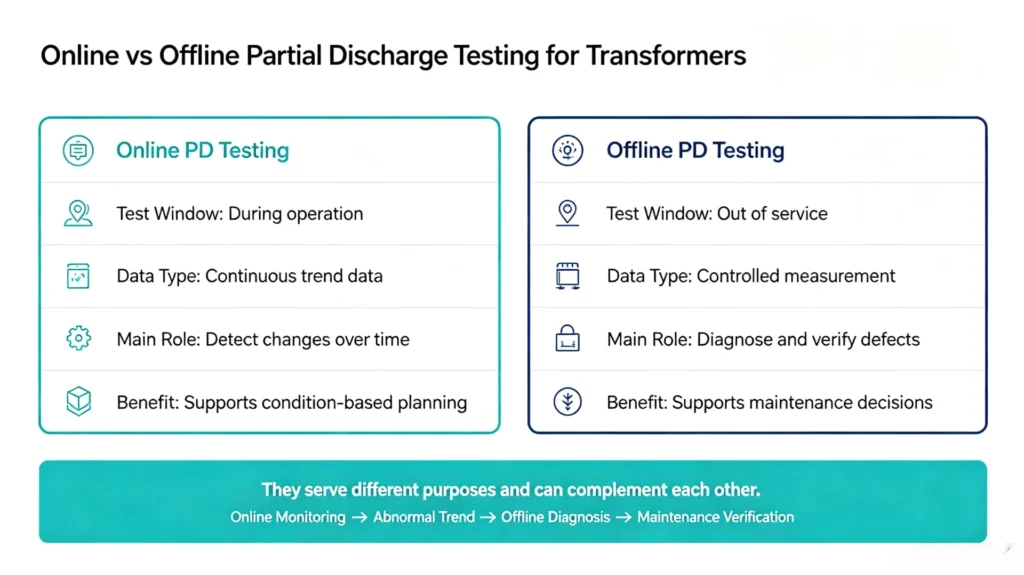
Transformer partial discharge testing can be performed under different operating conditions. Online testing evaluates PD activity while the transformer is in service, whereas offline testing is performed with the transformer de-energized under controlled test conditions.
The two approaches provide different types of information and serve different engineering purposes. Online testing reflects PD behavior under real operating conditions, including load, temperature and system interference. Offline testing provides a controlled environment with reduced external noise and defined test voltages, which can make measurement and interpretation more straightforward.
This guide, Online vs Offline Partial Discharge Testing for Transformers, compares their operating conditions, measurement characteristics, advantages, limitations and typical applications, and explains when the two methods can be used together.
What Is Transformer Partial Discharge Testing?
Partial discharge testing evaluates localized electrical discharge activity associated with transformer insulation. It is used to detect, measure and analyze PD signals that may indicate insulation degradation or abnormal discharge behavior.
Online and offline testing differ mainly in transformer operating state, measurement environment, data characteristics and diagnostic purpose. Online testing is performed while the transformer is energized and reflects PD activity under real service conditions. Offline testing is performed with the transformer de-energized, under controlled test voltages and a quieter measurement environment.
Both approaches provide useful information for insulation condition assessment, but they are suited to different situations and can complement each other when used together.
What Is Online Partial Discharge Testing for Transformers?
Online partial discharge testing is performed while the transformer remains energized. It provides continuous or repeated PD data under actual operating conditions. Its main advantages are that no planned transformer shutdown is required for the monitoring activity, where the installation permits; it delivers long-term trend data; it reflects actual load and environmental conditions; and it is useful for critical assets. Its main limitations are field interference, interpretation complexity, and measurement conditions that differ from standardized offline testing.
For a detailed explanation of how online transformer PD monitoring works, see How Does an Online Partial Discharge Monitoring System for Transformers Work?.
结构: What Is Offline Partial Discharge Testing for Transformers? How It Works 简单流程: Transformer Shutdown → Isolation → Test Setup → Applied Test Voltage → PD Measurement → Analysis → Report When Is It Used? 重点: factory acceptance testing commissioning post-maintenance verification detailed diagnostic testing Main Strengths controlled test conditions standardized measurement quantitative assessment where applicable useful for acceptance and detailed diagnosis参考生成一段话
What Is Offline Partial Discharge Testing for Transformers?
Offline partial discharge testing is performed with the transformer de-energized, under controlled test conditions. It allows PD activity to be measured in a defined environment with reduced external interference and known test voltages.
How It Works
The typical process follows a structured sequence: transformer shutdown → isolation → test setup → applied test voltage → PD measurement → analysis → report. Because the transformer is disconnected from the system, parameters such as voltage level and measurement configuration can be controlled more precisely than during online operation.
When Is It Used?
Offline PD testing is commonly used for factory acceptance testing, commissioning, post-maintenance verification and detailed diagnostic testing.
Main Strengths
Its main strengths are controlled test conditions, standardized measurement procedures, quantitative assessment where applicable, and suitability for acceptance testing and detailed diagnosis. Offline testing provides a well-defined measurement environment that supports consistent comparison with standards and baseline data. Its main limitation is that the transformer must be taken out of service, so it cannot reflect PD behavior under real load and operating conditions.
Online vs Offline Partial Discharge Testing: Key Differences
| Factor | Online PD Testing | Offline PD Testing |
|---|---|---|
| Transformer status | Energized / in service | De-energized |
| Test environment | Actual operating environment | Controlled test conditions |
| Data type | Long-term / trend data | Test-point / diagnostic data |
| Outage | Usually avoids planned outage for monitoring | Requires shutdown and isolation |
| Interference | More exposed to site interference | More controllable |
| Main purpose | Condition monitoring and trend tracking | Detailed testing, verification and diagnosis |
| Typical use | In-service critical assets | FAT, commissioning, maintenance and detailed diagnosis |
Advantages and Limitations of Online PD Testing
Advantages
- Monitoring during service
- Long-term trend tracking
- No routine outage for the monitoring activity
- Actual operating condition data
- Useful for critical transformers
Limitations
- Affected by field interference
- Measurement interpretation can be more complex
- Installation may require permanent sensors
- Data may not be directly equivalent to standardized offline measurements
Advantages and Limitations of Offline PD Testing
Advantages
- Controlled test conditions
- Standardized test procedures
- Detailed diagnostic assessment
- Suitable for FAT and commissioning
Limitations
- Requires shutdown
- Point-in-time information
- Higher testing preparation requirements
- Does not continuously observe the transformer between tests
How Do Online and Offline PD Testing Differ in Measurement Conditions?
Online and offline PD testing are not identical measurement approaches because they operate under different conditions. This affects what each method can measure, how the data should be interpreted and what the results are suitable for.
Measurement Environment
Online testing is performed in the actual substation environment, with the transformer energized and connected to the system. Offline testing is performed in a controlled test environment, with the transformer de-energized and isolated.
Data Characteristics
Online data is primarily trend-oriented. It reflects how PD activity changes over time under real load, temperature and operating conditions. Offline data is more standardized and diagnostic in nature, collected under defined test voltages and measurement configurations.
Interference
Online testing is more exposed to field noise, including switching interference, RFI and signals from other equipment. Offline testing offers more controllable conditions, which generally makes interference management easier.
Application
Online testing is suited to in-service monitoring and long-term condition tracking. Offline testing is suited to acceptance testing, commissioning and detailed diagnostic investigation.
Because of these differences, the two methods should be seen as complementary rather than directly interchangeable. Each provides information the other cannot fully replace.
When Is Online Partial Discharge Testing Appropriate?
Critical Grid and Industrial Transformers
Online PD testing is appropriate for critical grid and industrial transformers where an unplanned outage would have significant operational or financial consequences. For these assets, continuous or repeated monitoring provides ongoing information about insulation condition without requiring the transformer to be taken out of service. It supports condition-based maintenance decisions and helps identify changes in PD activity before they develop into more serious issues.
Transformers Difficult to Take Offline
Some transformers are difficult or costly to take offline because of system configuration, load requirements or limited redundancy. For these units, online PD testing allows insulation condition to be monitored while the transformer remains in service. Where permanent sensors can be installed, this avoids the need for a planned shutdown solely for monitoring purposes and provides data under real operating conditions.
Transformers With Suspected Insulation Abnormalities
When insulation abnormalities are suspected, online PD testing can provide additional information about discharge activity under actual load and operating conditions. It is particularly useful when offline testing is not immediately possible or when the concern is how PD behavior changes over time. Online data can support further investigation and help determine whether offline diagnostic testing or other actions are warranted.
Aging Transformers
For aging transformers, insulation degradation becomes more likely over time. Online PD testing supports long-term trend tracking and helps users observe how PD activity evolves under real service conditions. This makes it useful for assets approaching the later stages of their service life, where continuous condition information can support maintenance planning and replacement decisions.
When Is Offline Partial Discharge Testing More Suitable?
Factory Acceptance Testing
Offline PD testing is standard practice for factory acceptance testing (FAT). It is performed under controlled conditions with defined test voltages, allowing insulation quality to be verified before shipment. The results provide a documented baseline for later comparison during commissioning or after maintenance.
On-Site Commissioning
Offline testing is well suited to on-site commissioning, where the transformer is tested before being placed into service. It helps confirm that insulation condition has not been affected by transport, installation or assembly. For EPC projects, commissioning results support handover documentation and future condition assessment.
Post-Maintenance Verification
After major maintenance, such as bushing replacement, oil processing or internal inspection, offline PD testing can verify that insulation condition is acceptable before re-energization. It provides a defined measurement environment for comparison with previous results.
Detailed Diagnostic Testing
When deeper investigation is required, offline testing offers controlled test voltages and a quieter measurement environment. This makes it suitable for in-depth diagnostic assessment, including cases where online data has indicated abnormal PD activity and further confirmation is needed.
For EPC engineers, these four applications are closely tied to project milestones — FAT, commissioning, handover and maintenance — which is why offline PD testing remains a standard requirement in many transformer projects.
Can Online and Offline PD Testing Be Used Together?
Yes. Online and offline PD testing are complementary methods, and in many transformer projects they are used together across the asset lifecycle.
A typical combined workflow looks like this:
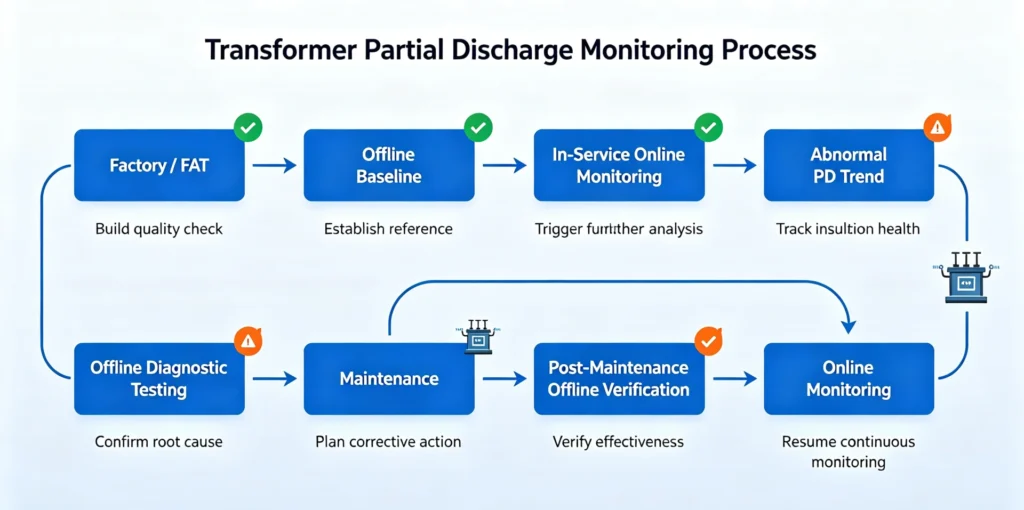
Each stage has a distinct role:
- Factory / FAT — establishes the initial insulation quality reference under controlled conditions.
- Offline Baseline — documents a defined starting point for future comparison.
- In-Service Online Monitoring — tracks PD activity under real load and operating conditions over time.
- Abnormal PD Trend — indicates a change that may require further investigation.
- Offline Diagnostic Testing — provides controlled conditions for deeper analysis and confirmation.
- Maintenance — addresses the identified issue.
- Post-Maintenance Offline Verification — confirms insulation condition before re-energization.
- Online Monitoring — resumes long-term trend tracking after the transformer returns to service.
This lifecycle approach combines the strengths of both methods. Offline testing provides controlled, standardized and diagnostic information at key milestones. Online monitoring provides continuous, trend-oriented data under actual operating conditions. Together, they support more informed insulation condition assessment than either method alone.
Frequently Asked Questions
1. What is the difference between online and offline partial discharge testing?
Online PD testing is performed while the transformer is energized, reflecting real operating conditions. Offline PD testing is performed with the transformer de-energized, under controlled test conditions.
2. Can partial discharge be tested while a transformer is energized?
Yes. Online PD testing is designed for this purpose and allows PD activity to be monitored while the transformer remains in service.
3. What are the advantages of online transformer PD testing?
Online testing provides long-term trend data, reflects actual load and environmental conditions, and does not require a routine outage for the monitoring activity, where the installation permits.
4. What are the advantages of offline transformer PD testing?
Offline testing provides controlled test conditions, standardized measurement procedures and more detailed diagnostic information, making it suitable for FAT, commissioning and post-maintenance verification.
5. Can online PD testing replace offline PD testing?
No. They serve different purposes and are often complementary rather than interchangeable. Online testing supports continuous monitoring, while offline testing provides controlled, standardized diagnostic data at key milestones.
6. When should a transformer undergo offline partial discharge testing?
Offline PD testing is typically used for factory acceptance testing, on-site commissioning, post-maintenance verification and detailed diagnostic testing.
Conclusion
Online and offline partial discharge testing serve different purposes. Online testing is suited to in-service monitoring and trend tracking, providing PD data under actual load and operating conditions. Offline testing is suited to controlled testing, acceptance and detailed diagnosis, with defined test voltages and a quieter measurement environment.
Together, the two methods can complement each other throughout the transformer life cycle — from factory acceptance and commissioning to long-term monitoring, maintenance and post-maintenance verification.
For applications requiring continuous transformer PD monitoring, see our Transformer Partial Discharge Online Monitoring Device.
Technical References & Data Sources
- IEEE C57.113-2023, IEEE Recommended Practice for Partial Discharge Measurement in Liquid-Filled Power Transformers and Shunt Reactors
- IEC 60270:2015, High-voltage test techniques – Partial discharge measurements
- IEEE C57.152-2013, Guide for Diagnostic Field Testing of Fluid-Filled Power Transformers, Regulators, and Reactors
- IEC 60076-3:2013, Power transformers – Part 3: Insulation levels, dielectric tests and external clearances in air
- IEEE Power & Energy Society Transformer Committee Field Test Specification (2024)
[…] Online vs Offline Transformer PD Testing […]
[…] For a detailed comparison of online and offline transformer PD testing, see Online Partial Discharge Testing for Transformers. […]
[…] For a detailed comparison, see Online vs Offline Partial Discharge Testing for Transformers. […]