

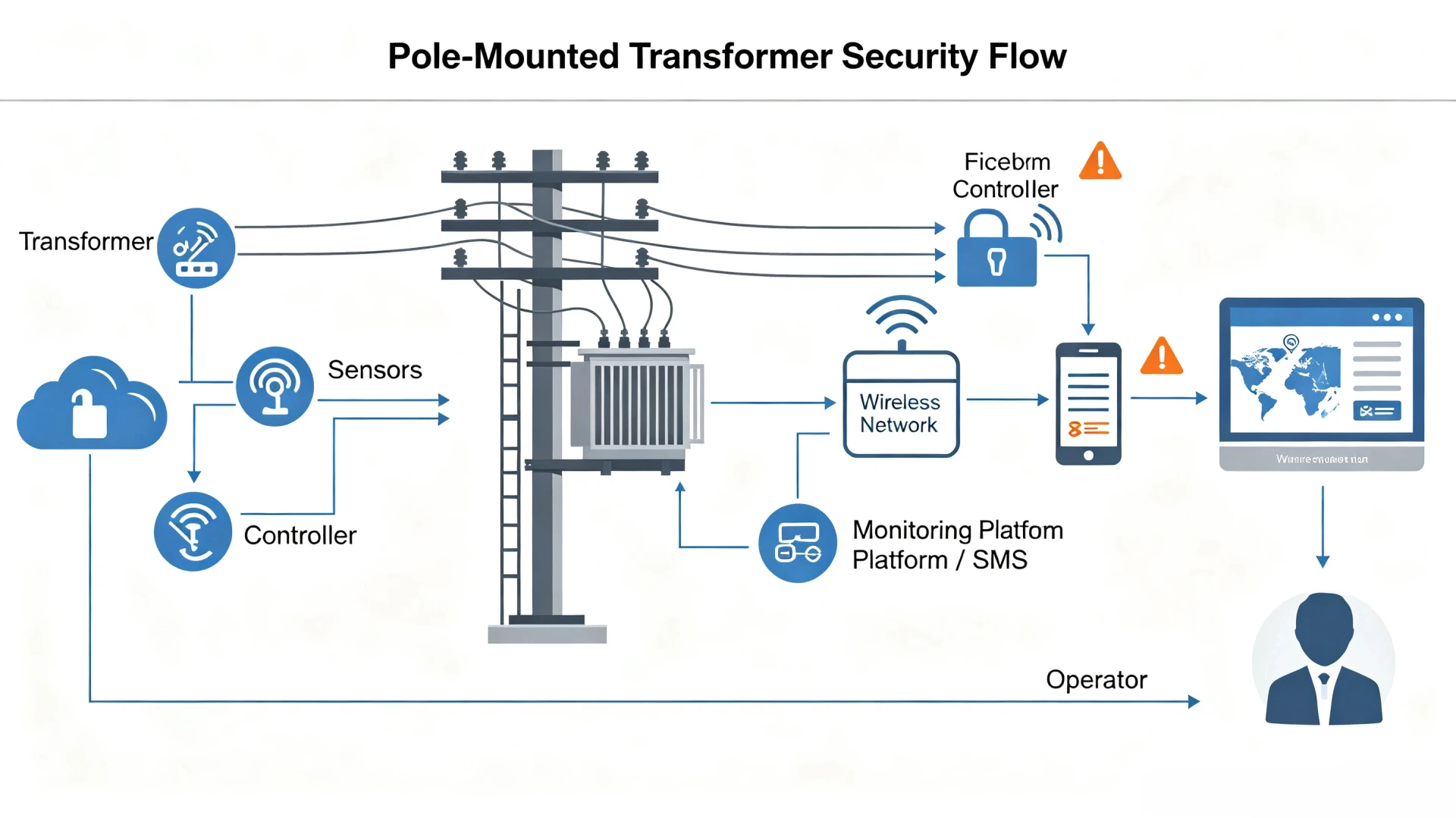
Pole-mounted transformers are common in rural distribution networks, agricultural areas, and other locations where equipment has to be installed away from permanent staff.
That makes them useful for utilities, but it also creates a security problem. A transformer mounted beside a road, farm, or remote feeder can be physically accessible for hours or days without anyone noticing unusual activity.
A lock or steel enclosure can make theft more difficult, but it cannot tell a utility operator that somebody is working on the transformer. For remote installations, that missing link between physical security and early detection is often the biggest weakness.
A practical pole‑mounted transformer security strategy to Protect Pole‑Mounted Transformers From Theft normally combines physical protection, tamper detection, local alarms, remote communication, and a clear response procedure.
Why Are Pole-Mounted Transformers Vulnerable to Theft?
The location of the transformer is often a bigger security issue than the transformer itself.
A pole-mounted unit may be installed:
- Along rural roads
- Near agricultural land
- In sparsely populated areas
- On long distribution feeders
- At sites without permanent personnel
- In areas where cellular communication is available but physical access is difficult
The problem becomes more serious when a utility operates hundreds or thousands of distribution transformers.
Regular patrols can help, but checking every transformer frequently is expensive. More importantly, a patrol only tells the operator what happened when someone visited the site. It does not provide continuous information between inspections.
There is also a second problem: transformer theft can initially look like an ordinary power interruption. If the first indication is a customer calling about an outage, valuable time may already have been lost.
For this reason, pole mounted transformer security should focus on three questions:
- Can unauthorized access be made more difficult?
- Can the system recognize a theft attempt?
- Can the utility know about the event while it is happening?
What Is Pole Mounted Transformer Security?
Pole mounted transformer security refers to the combination of measures used to prevent unauthorized access, detect tampering or movement, and notify operators when a transformer may be under attack.
It is broader than simply installing a lock or security cage.
A typical protection arrangement can include:
| Security Layer | Main Purpose |
|---|---|
| Security hardware | Make physical access more difficult |
| Anti-theft bolts | Slow unauthorized removal |
| Tamper sensors | Detect opening or interference |
| Vibration detection | Identify impact or mechanical activity |
| Tilt detection | Identify movement or displacement |
| Cable monitoring | Detect cable cutting |
| Power monitoring | Identify unexpected power loss |
| Local alarm | Draw attention to an event |
| 4G/NB-IoT communication | Send alarm information remotely |
| Monitoring platform | Manage alarms from multiple sites |
Not every transformer needs every layer. The appropriate combination depends on the location, theft history, accessibility, communication coverage, and value of the equipment.
7 Practical Ways to Improve Pole Mounted Transformer Security
1. Start With Physical Protection
Physical protection is still the first line of defense.
Depending on the installation, utilities may use steel security cages, lockable enclosures, protective fencing, anti-theft bolts, or tamper-resistant fasteners.
The purpose is not necessarily to make the transformer impossible to remove. That is rarely realistic.
Instead, physical protection increases the amount of time and effort required to reach the transformer, cable connections, covers, and other vulnerable parts.
For pole-mounted installations, particular attention should be paid to:
- Transformer mounting points
- Cable connections
- Access covers
- Bolted components
- Lower sections that can be reached from the ground
- Any structure that allows climbing or lifting equipment to be used
Physical security is useful, but it has an obvious limitation: it does not tell the utility that somebody is attempting to breach it.
That is where detection becomes important.
2. Use Tamper Detection at Vulnerable Points
A tamper sensor can be installed on an enclosure, access panel, mounting structure, or other point where unauthorized access is likely to occur.
Depending on the equipment, the system may detect:
- Opening of an enclosure
- Mechanical impact
- Abnormal movement
- Removal attempts
- Unauthorized access to protected components
This is particularly useful for unattended transformers because the sensor does not depend on a person being nearby.
Instead of waiting for an outage report, the utility can receive an alarm when the physical condition of the transformer changes.
3. Add Vibration Detection
Vibration is useful for detecting mechanical activity around the transformer.
Drilling, striking, cutting, climbing, or attempting to move the transformer can produce abnormal vibration. A vibration sensor can therefore provide an early indication of suspicious activity.
However, vibration should not normally be treated as an independent confirmation of theft.
Wind, animals, nearby vehicles, maintenance work, or other environmental factors can also produce mechanical vibration.
For this reason, a better approach is to evaluate vibration together with other signals.
For example:
Vibration only → investigate
Vibration + tilt → higher confidence
Vibration + tilt + cable/power event → urgent alarm
The exact alarm logic should be adjusted to the installation rather than using the same threshold at every site.
4. Monitor Transformer Tilt and Movement
A transformer being lifted, dragged, or removed from its normal position is a significant event.
A tilt or movement sensor can detect changes in the physical position of the protected equipment.
This is especially relevant to pole-mounted transformer security because the transformer is elevated and mechanically fixed to a supporting structure. An abnormal change in its position can provide useful evidence of an attempted removal.
Tilt detection is also valuable when combined with vibration.
A short vibration event by itself may be caused by the environment. A sudden change in tilt at the same time is much harder to explain as normal operating activity.
5. Detect Cable Cutting and Sudden Power Loss
The transformer itself is not always the first target.
In some theft attempts, cables or connections may be cut before the transformer is removed. Monitoring cable continuity can therefore add another layer of protection.
Power monitoring provides a second useful signal.
A sudden loss of transformer power can be caused by many things:
- Distribution faults
- Planned maintenance
- Upstream breaker operation
- Cable damage
- Intentional disconnection
- Transformer theft
Therefore, power loss alone should not automatically be classified as theft.
Its value increases when it occurs together with another abnormal condition.
For example, a power interruption combined with transformer movement is much more suspicious than a power interruption by itself.
This type of event correlation is one of the practical advantages of a multi-sensor transformer security system.
6. Send Alarms Through 4G, GSM, or NB-IoT
A local alarm is useful only when somebody is close enough to hear it or see it.
That is not usually the case for rural or remote distribution transformers.
Remote communication allows the alarm generated at the transformer site to reach utility personnel without requiring someone to be physically present.
A basic communication path looks like this:
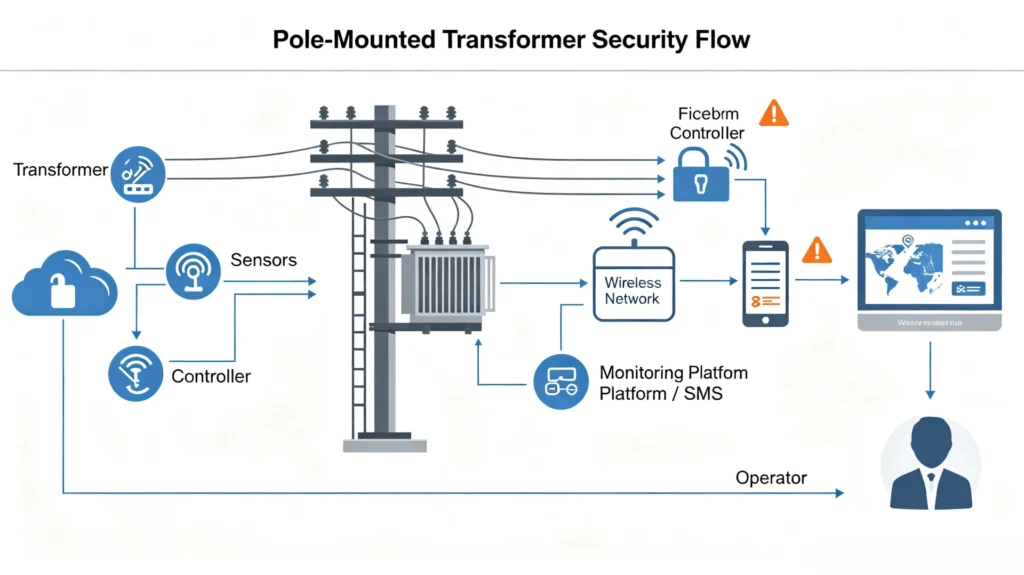
Different communication technologies can be appropriate for different installations.
GSM can be considered where basic alarm transmission is sufficient and network availability is reliable.
4G Cat.1 can support more frequent communication and richer monitoring data.
NB-IoT can be attractive for low-power remote monitoring applications, particularly where battery operation is important.
The key point is not simply choosing the newest communication technology. The network actually available at the transformer site matters more.
Before installation, utilities should check:
- Cellular signal strength
- Operator coverage
- SIM availability
- Data requirements
- Expected battery life
- Communication reliability during power loss
7. Connect Multiple Transformers to One Monitoring Platform
For a utility with a large number of pole-mounted transformers, individual alarms quickly become difficult to manage.
A central monitoring platform allows operators to see multiple sites from one interface.
Depending on the system, the platform may provide:
- Transformer status
- Active alarms
- Alarm history
- Communication status
- Battery information
- Sensor status
- Site identification
- Event records
SMS alerts can also be used for urgent events.
This changes the operating model from:
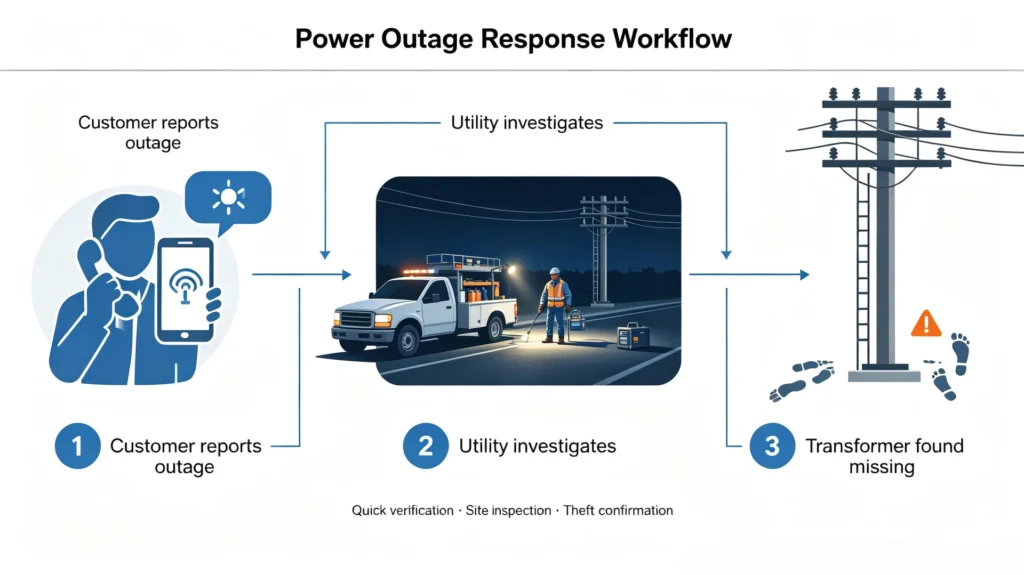
to:
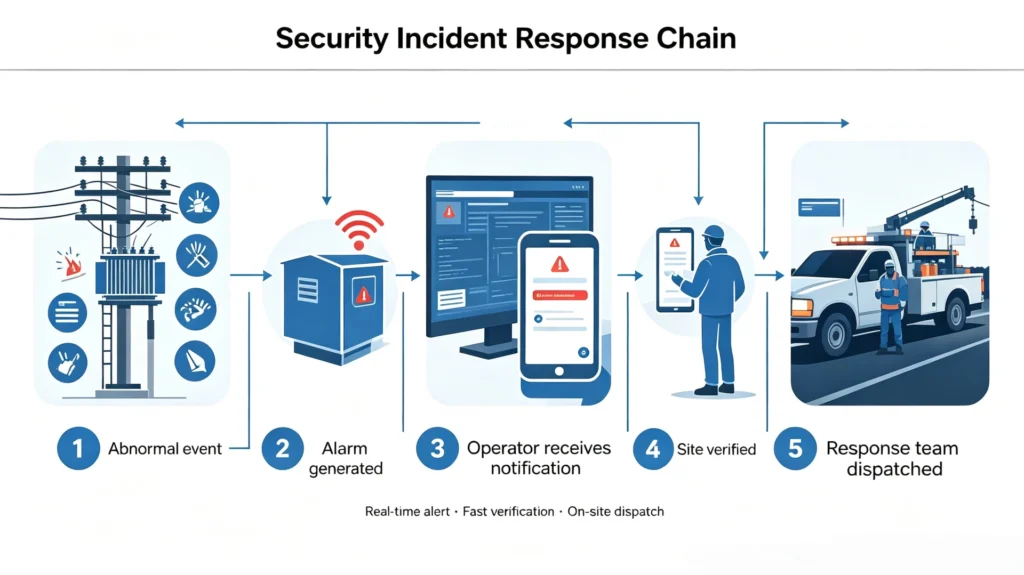
That difference can be significant when the protected transformer is located far from the nearest utility office.
How Does a Pole-Mounted Transformer Security System Work?
A typical system consists of several components working together.
Sensors
Sensors collect information about the physical condition of the transformer.
Common inputs include:
- Vibration
- Tilt
- Tampering
- Cable continuity
- Power status
- Enclosure opening
Monitoring Controller
The controller receives the sensor signals and evaluates whether the detected condition matches a configured alarm condition.
This is important because the controller does not simply need to detect movement. It needs to determine what happened and whether the event should generate an alarm.
Local Alarm
When a confirmed or configured event occurs, a siren or visual alarm can be activated at the site.
The local alarm can attract attention and may interrupt an attempted theft.
Wireless Communication
The controller sends the event to a remote monitoring system through the available cellular network.
Depending on the system design, this may use GSM, 4G, or NB-IoT.
Remote Monitoring
The operator receives the event and determines the appropriate response.
For a large utility, the event can also be stored in a central platform for later review.
Which Events Should a Pole-Mounted Transformer Security System Detect?
The detection requirements depend on the type of theft that is common in the area.
| Event | Possible Detection Method | Typical Response |
|---|---|---|
| Enclosure opened | Tamper / door sensor | Alarm |
| Mechanical attack | Vibration sensor | Verify event |
| Transformer movement | Tilt sensor | High-priority alarm |
| Cable cutting | Cable detection | Immediate alarm |
| Unexpected power loss | Power monitoring | Check grid condition |
| Multiple abnormal signals | Multi-sensor logic | Dispatch / investigate |
The important point is that not every alarm means theft.
A distribution transformer can experience legitimate outages, maintenance, weather-related events, or accidental damage.
A well-designed system should therefore give operators enough information to distinguish routine electrical events from suspicious physical activity.
How to Reduce False Alarms
False alarms are one of the practical issues that should be considered before deploying a transformer security system.
A sensor that is too sensitive may generate frequent alarms. If operators receive too many false alerts, they may eventually stop treating alarms as urgent.
Several measures can help.
Use More Than One Detection Signal
Instead of relying entirely on vibration, combine signals where appropriate.
For example:
Vibration + tilt + power loss
provides more information than vibration alone.
Set Thresholds According to the Site
A transformer beside a busy road may experience more vibration than one in an isolated agricultural area.
The same alarm threshold should not necessarily be applied to both.
Review Historical Events
Alarm records can help identify repeated false-trigger conditions and allow thresholds or alarm logic to be adjusted.
Separate Warning and Critical Alarms
Not every abnormal event requires the same response.
A single vibration event might generate a warning, while simultaneous movement and power loss could generate a critical alarm.
This approach can make the monitoring system more practical for utility control rooms.
Pole Mounted Transformer Security for Rural Distribution Networks
Rural transformers are often where remote security systems provide the greatest benefit.
A utility may have long feeders with transformers separated by several kilometers. Sending maintenance or security personnel to each site for frequent inspections is costly.
A remote monitoring system can provide basic information about each protected transformer without requiring a site visit.
For example:
| Site Condition | Recommended Protection |
|---|---|
| Low theft risk, supervised area | Physical security |
| Accessible transformer | Physical protection + tamper detection |
| Rural transformer | Tamper + vibration + tilt |
| Remote transformer | Multi-sensor + remote alarm |
| High-risk theft area | Physical protection + multi-sensor + 4G/NB-IoT + central monitoring |
This risk-based approach is generally more practical than installing the most expensive security package at every location.
Physical Protection vs Remote Monitoring
These two approaches should not be treated as competitors.
They solve different problems.
| Method | Main Benefit | Main Limitation |
|---|---|---|
| Security cage | Delays physical access | Does not report an attack |
| Anti-theft bolts | Makes removal harder | No remote alarm |
| Vibration sensor | Detects mechanical activity | Can be affected by environmental vibration |
| Tilt sensor | Detects displacement | Does not identify every type of tampering |
| Cable monitoring | Detects cable interruption | Requires suitable monitoring arrangement |
| Local siren | Immediate on-site warning | Limited value at isolated sites |
| Remote monitoring | Alerts operators remotely | Depends on power and communication |
| Multi-sensor system | Provides broader event information | Higher system complexity |
For a pole-mounted transformer in an isolated location, physical protection without remote detection leaves a significant gap.
On the other hand, remote monitoring without any physical deterrent means the system may detect an attack but do little to slow it down.
The strongest arrangement combines both.
How to Choose a Pole Mounted Transformer Security System
Before selecting equipment, evaluate the actual installation.
1. Assess the Location
Determine whether the transformer is:
- Urban or rural
- Supervised or unattended
- Easy to approach
- Close to a road
- Located in an area with previous theft incidents
2. Identify the Main Threat
The required sensors should match the likely attack.
If complete transformer removal is the primary concern, tilt and movement detection may be important.
If cable theft is common, cable monitoring deserves more attention.
If unauthorized access to an enclosure is the main issue, tamper detection should be included.
3. Check Cellular Coverage
Confirm which communication networks are actually available at the site.
A system designed for 4G communication is of limited value if the installation location has unreliable cellular coverage.
4. Consider Backup Power
A theft attempt may involve cutting the power supply.
If the security system depends entirely on the same power source being protected, the monitoring function may disappear at exactly the wrong moment.
For remote sites, backup battery capacity should therefore be evaluated as part of the system design.
5. Check Outdoor Environmental Conditions
Outdoor equipment may be exposed to:
- Rain
- Dust
- High humidity
- UV exposure
- Temperature changes
- Insects and animals
The enclosure and sensor design should be suitable for the actual installation environment.
Rather than applying one universal IP rating or temperature range, check the specifications of the selected equipment against the project requirements.
6. Consider Integration
For larger utilities, it may be useful to connect transformer security alarms with an existing SCADA, distribution management, or centralized monitoring platform.
This avoids creating a completely separate alarm workflow.
A Practical Protection Strategy for High-Risk Transformers
A high-risk remote transformer may require several layers working together:
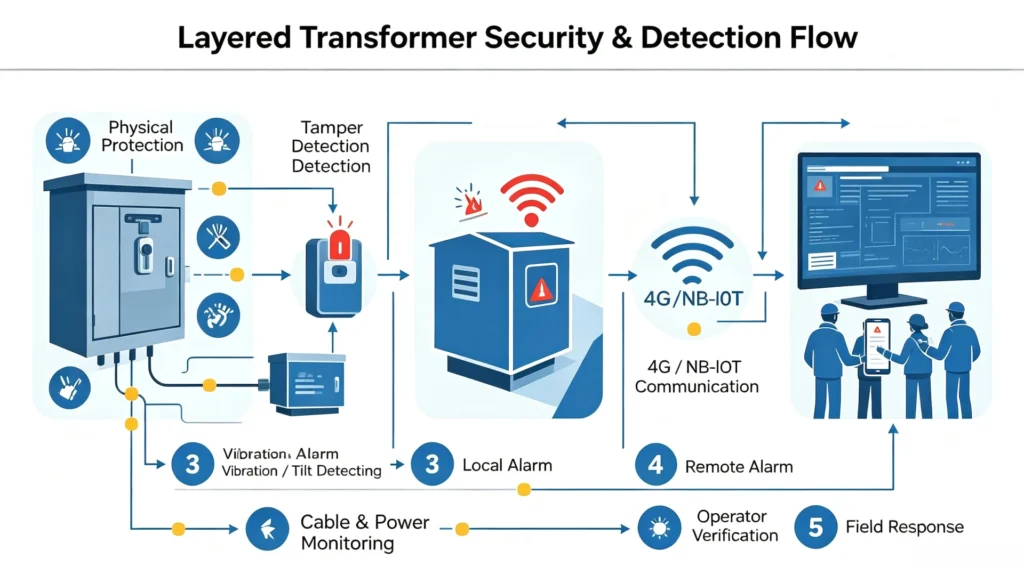
The purpose of this arrangement is not to make theft physically impossible.
Instead, each layer addresses a different part of the problem.
The cage slows access.
The sensors detect activity.
The local alarm creates an immediate deterrent.
The wireless connection tells someone who is not at the site.
The monitoring platform helps the utility determine what happened.
The response procedure turns the alarm into an actual security action.
Transformer Anti-Theft Protection Checklist
Before putting a pole-mounted transformer security system into service, utilities can check the following:
- Assess theft risk at the installation site
- Check physical access to the transformer
- Install suitable security hardware
- Protect vulnerable covers and connections
- Add tamper detection where required
- Evaluate vibration detection
- Evaluate tilt or movement detection
- Consider cable-cut detection
- Monitor unexpected power loss
- Install a local alarm where appropriate
- Confirm cellular communication coverage
- Select GSM, 4G, or NB-IoT according to the application
- Provide backup power for remote installations
- Configure alarm thresholds
- Test alarm transmission
- Establish an operator response procedure
- Review alarm history after deployment
Frequently Asked Questions
How can I protect a pole-mounted transformer from theft?
A practical approach combines physical protection with tamper detection and remote monitoring. Security cages and anti-theft hardware make unauthorized access more difficult, while vibration, tilt, cable, and power monitoring can help detect an active theft attempt.
What is the best security for a remote pole-mounted transformer?
There is no single solution for every site. For a remote, high-risk transformer, a combination of physical protection, multi-sensor detection, local alarm, cellular communication, and remote monitoring provides broader coverage than any one measure alone.
Can a transformer security system detect theft before the transformer is removed?
It can detect conditions associated with an attempted theft, such as abnormal vibration, movement, tampering, cable cutting, or sudden power loss. Whether the system can identify an event before complete removal depends on the sensor arrangement and alarm logic.
Can vibration sensors cause false alarms?
Yes. Wind, animals, nearby traffic, maintenance work, and other mechanical activity can produce vibration. This is why vibration is often more useful when combined with tilt, power, cable, or tamper signals.
Is remote monitoring necessary for rural transformers?
It is particularly useful when the transformer is unattended and far from utility personnel. A local siren may have little effect if nobody is nearby. Remote communication allows an alarm to reach an operator without waiting for a customer outage report.
Which communication technology is suitable for transformer anti-theft monitoring?
GSM, 4G, and NB-IoT can all be used depending on the project. The decision should consider network coverage, power consumption, data requirements, battery operation, and the communication infrastructure available at the transformer site.
Does physical protection replace remote monitoring?
No. A cage or anti-theft bolt can slow unauthorized access, but it normally cannot notify utility personnel. Remote monitoring adds the detection and communication layer needed for unattended installations.
Conclusion
Pole-mounted transformers are difficult to secure because many of them operate outdoors with little or no direct supervision.
The practical answer is not simply to install a stronger lock.
A more complete pole mounted transformer security strategy combines physical protection with sensors that can detect tampering, vibration, movement, cable cutting, and abnormal power conditions. For remote sites, GSM, 4G, or NB-IoT communication can then send the event to utility personnel for verification and response.
The exact combination should be based on the transformer location, theft risk, communication coverage, available power, and existing utility monitoring infrastructure.
For utilities managing a large number of unattended transformers, the goal is straightforward: make unauthorized access harder, detect suspicious activity earlier, and give operators enough information to respond before equipment is lost.
[…] Pole-Mounted Transformers […]