Leave your message

-
Leon Zhang sales consultant
-
Email: zxl635973785@gmail.com
-
Phone/WhatsApp/Wechat: +86 13655813266

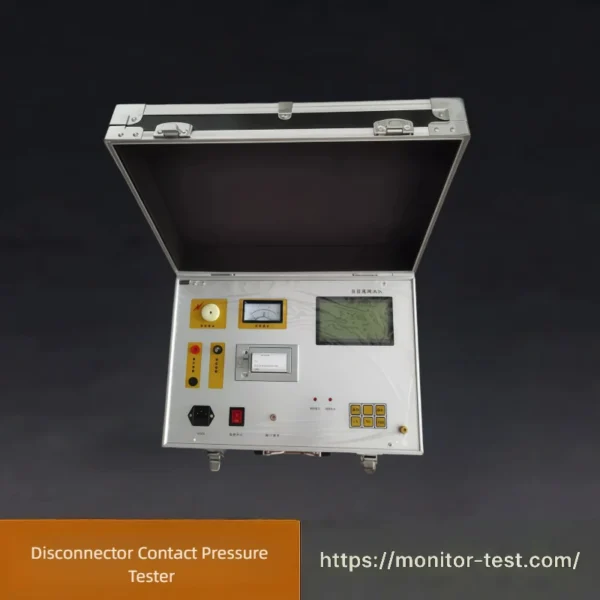
HF-WC-633 Disconnector Contact Pressure Tester
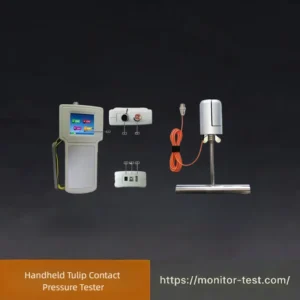
Disconnector Contact Pressure Tester accurately measures contact pressure of high-voltage disconnectors. It judges the contact engagement status, effectively preventing overheating failures caused by poor contact. It is widely used for on-site maintenance, acceptance inspection and fault diagnosis of power substations and transmission lines.
Send your requirements, we will quote for you within 12 hours
High-voltage switchgear is widely adopted in power systems. Outdoor disconnectors are exposed to atmospheric environments and vulnerable to climatic conditions, leading to harsh operating conditions and frequent mechanical or electrical faults. The contact surfaces are easily eroded by rainwater, dust and harmful gases, resulting in poor contact and overheating. The contact pressure springs may undergo thermal annealing, reducing contact pressure and triggering a vicious cycle of overheating, which can eventually burn out contacts and cause accidents.
During maintenance, technicians usually only replace obviously failed or broken springs. However, degraded springs without visible damage cannot be identified. During subsequent operation, uneven current distribution among contacts arises due to inconsistent pressure, which further causes poor contact and overheating. Thermal deterioration spreads across all contacts. In addition, many disconnectors feature adjustable contact pressure; insufficient or inconsistent pressure adjustment will lead to the same defects.
At present, most maintenance personnel judge conductor contact status only by measuring loop resistance. They assume maintenance is qualified once the loop resistance meets standards. In fact, the loop resistance consists of terminals, conductive tubes and contact resistance, featuring wide tolerance ranges. It merely proves the circuit is conductive and cannot directly reflect variations of contact resistance. Tests verify that loop resistance can remain qualified regardless of whether two or four pairs of contacts are engaged. Similarly, varying contact pressure barely changes loop resistance.
Relevant maintenance codes and standards specify contact pressure measurement. Spring balances are the traditionally recommended tool, yet they are inconvenient, inaccurate and unsafe for high-altitude field work. For certain disconnector structures such as shear-type switches, contact pressure cannot be measured by spring balances at all.
Main Technical Parameters
| Item | Specification |
|---|---|
| a. Power Input | AC 220V |
| b. Power Consumption | ≤20W |
| c. Measuring Range | Sensor A ≤980 N; Sensor B ≤2000 N |
| d. Measurement Error | ±1%N |
| e. Communication Interface | USB or RS232 serial port |
| f. Working Power Supply | 24V lithium battery; Charging power: AC220V±10%, 50Hz |
| g. Maximum Storage Capacity | 20,000 sets of disconnector test data |
| h. Operating Environment | Temperature: -10℃~40℃; Humidity ≤80%RH |
Main Functions
a. GH6106A Disconnector Contact Pressure Tester measures and stores contact pressure data for all types of disconnectors rated 100kV and below. Data can be compared with standard values and historical records to draw conclusions and guide maintenance operations.
b. Test data can be uploaded to a computer and automatically exported as WORD or EXCEL documents for statistics and analysis.
c. Test reports can be automatically generated when operated with supporting PC software.
b. Test data can be uploaded to a computer and automatically exported as WORD or EXCEL documents for statistics and analysis.
c. Test reports can be automatically generated when operated with supporting PC software.
FAQ for Disconnector Contact Pressure Tester
Q1: What is the main purpose of this tester?
A: It measures the contact pressure of high-voltage disconnectors, evaluating contact engagement status to avoid overheating faults caused by insufficient contact pressure.
Q2: Why cannot we only rely on loop resistance to judge contact conditions?
A: Loop resistance includes multiple parts such as conductive tubes and terminals. Qualified loop resistance does not guarantee normal contact pressure, so hidden contact defects cannot be detected accurately.
Q3: What measuring ranges do the sensors support?
A: Sensor A: ≤980N; Sensor B: ≤2000N, with measurement error within ±1%N.
Q4: What power supply modes are available for the instrument?
A: Built-in 24V lithium battery for field work; charging power supply: AC220V±10%, 50Hz. Input power consumption ≤20W.
Q5: How many groups of test data can the device store?
A: It can save up to 20,000 sets of disconnector test data.
Q6: Can test data be exported to a computer?
A: Yes. It supports USB and RS232 communication. Data can be uploaded and exported as Word and Excel reports via PC software.
Q7: Is it suitable for outdoor substation inspection?
A: Applicable for disconnectors of 100kV and below. It solves the drawbacks of traditional spring balances, which are unsafe and difficult to use at height.
Q8: What is the applicable ambient temperature range?
A: Operating temperature: -10℃ ~ 40℃, relative humidity ≤80%RH.
Reviews
There are no reviews yet.