

Author: Leon Zhang — Baoding Houfeng Trading Co., Ltd
Technical review: Power Testing Engineering Team — Senior Transformer Test Engineer
Last updated: 22 October 2026
A furnace transformer is the step-down unit that turns utility voltage into the few hundred volts and tens of kiloamps an electric arc furnace, a ladle refiner or a submerged-arc smelter needs to melt and refine metal, and it is one of the most heavily stressed transformers in any plant because the arc is an unstable, repeatedly short-circuiting load. This guide walks substation and plant engineers through the families of the equipment, the 24 V control cousin found in every HVAC system, the symptoms that warn a unit is failing, and what to demand from the supplier that builds it.
Key Takeaways
- The equipment is defined by the load it feeds: an arc furnace, a ladle refiner, a smelter or a building’s 24 V control circuit each needs a different design, and secondary voltage, current and cooling decide whether the answer is credible.
- The 24 V control transformer that powers a thermostat and gas valve is a small, isolated step-down device; when it fails the whole heating or cooling system goes silent even though the blower and burners are healthy.
- A failing unit announces itself long before it dies: a blank thermostat, a burning odor, a loud hum, repeated low-voltage fuse blows and voltage that collapses under load are the calls a technician learns to recognize.
- Buy the duty, not the nameplate: harmonic derating per IEEE C57.110-2018, short-circuit withstand per IEC 60076-5:2006 and an on-load tap changer sized for the heat cycle separate a furnace-grade unit from a general-purpose one.
- The reading is only trustworthy inside a disciplined maintenance routine; dissolved-gas analysis per IEEE C57.104-2019 and a documented factory acceptance test catch the failures that a nameplate never will.
What the Equipment Does and Why It Is Stressed
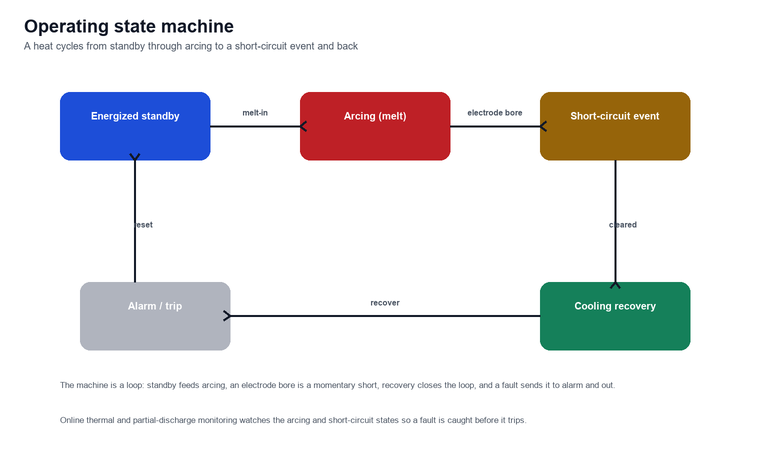
The core job of the device is to bridge two worlds that could not be further apart: a utility bus at 6 kV to 220 kV and a furnace electrode or secondary terminal at a few hundred volts carrying tens of kiloamps. A modern ultra-high-power arc unit commonly runs from 40 MVA on a small meltshop to over 150 MVA on a large furnace (IEC 60076-1:2011), and its secondary delivers roughly 200 V to 1,500 V at 30 kA to 120 kA per phase (IEC 60076-5:2006). Because the arc is a non-linear, unstable load, the same device swings from a near short circuit at melt-in to a steady refining arc within a single heat, and it short circuits every time an electrode bores into cold scrap.
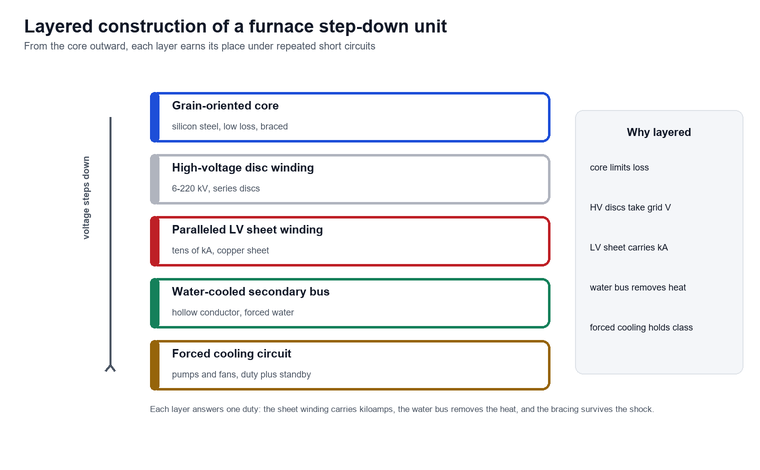
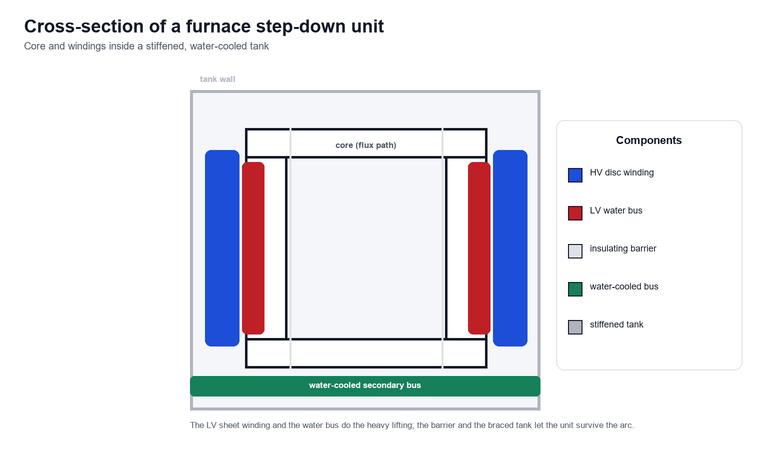
What separates a furnace transformer from a general-purpose transformer is not the core-and-coil idea but the bracing and the regulation. The low-voltage winding has very few turns yet must carry tens of kiloamps, so it is built from paralleled copper sheet or water-cooled hollow conductors rather than ordinary wire, and heavy clamp rings resist the radial forces that try to blow the coils apart on every electrode short. The on-load tap changer is the defining feature: it sets arc power by varying secondary voltage, often through thirty or more steps, so the operator can pour maximum power into cold scrap and then back off to a soft refining arc without interrupting the melt.
Key terms
A furnace transformer is a heavy-duty transformer that converts high grid voltage into the low voltage and very high current an electric arc furnace needs to melt metal. Short-circuit impedance is the percentage reactance that limits the surge current of an arc ignition, typically 8% to 14% on a furnace unit, higher than the 5% to 8% of a standard power transformer (IEEE C57.110-2018). Dissolved gas analysis is the laboratory reading of gases extracted from the insulating oil, and it is the most powerful diagnostic for an oil-immersed unit because each fault type produces a recognizable gas signature (IEEE C57.104-2019).
24v Furnace Transformer: The Low-Voltage Control Supply
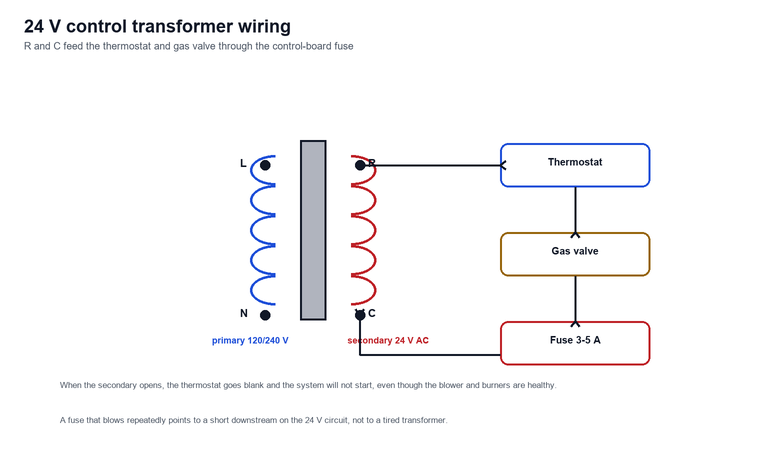
A 24 V control transformer is the small, isolated step-down device that almost every residential and commercial heating or cooling system depends on, and it has nothing to do with melting steel yet everything to do with whether the thermostat can call for heat. It converts the 120 V or 240 V house supply down to 24 V AC that powers the thermostat, the gas valve, the pressure switches and the relay coils that operate the blower and ignition, and it isolates those delicate controls from dangerous line voltage.
The component is unglamorous but critical: when it fails, the thermostat display goes blank and the furnace or air conditioner cannot start, even though the blower motor and burners are perfectly healthy. A healthy unit typically reads around 24 V AC to 28 V AC with no load, and it must stay above roughly 18 V AC once the system is calling for heat, because the control board’s 3 A or 5 A fuse will open and latch the system off if the secondary collapses. Most control transformers are rated in volt-amperes rather than watts, with 40 VA being the common replacement size, and their expected service life runs from 10 to 20 years before insulation breakdown overtakes them.
Symptoms of a Bad Furnace Transformer
A bad unit rarely fails without warning, and the warning signs are consistent enough that a technician learns to read them in minutes. The earliest and most common indicator is a thermostat that is dead or losing power intermittently, because the 24 V AC supply has disappeared; modern thermostats that need continuous low-voltage power will show a blank screen the moment the secondary opens. A second sign is the system starting and stopping mid-cycle, or the blower turning on and off unpredictably, which reflects unstable secondary voltage from a degrading winding.
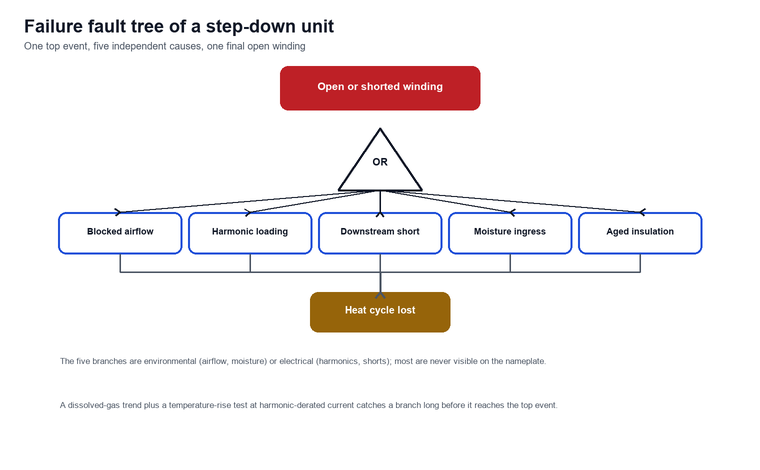
The later, more dangerous signs are thermal and audible. A burning smell near the air handler, a transformer that is visibly hot to the touch, or a loud hum and buzz that was not there before all point to internal insulation breakdown or a loose lamination; a hum is normal at low level, but a new, loud buzz usually precedes failure. The most definitive proof is a low-voltage fuse that blows repeatedly, because a shorted or overloaded secondary draws excess current until the protection opens. On a 90-ton packaged unit we serviced, the control board fuse had been replaced four times in a month before anyone checked the transformer; the real fault was a rubbed wire at the condenser that shorted the 24 V circuit, and the component had been taking the hit each time, running hot enough to scorch its mounting.
Choosing a Furnace Transformer Manufacturer
A credible supplier is only as good as the test report and the references behind the name, and the first question a specifier should ask is whether the supplier has actually built units for the same duty, because an arc-furnace or submerged-arc unit is a specialty product, not a catalog transformer. A credible supplier will state the harmonic derating method explicitly, confirm on-load tap-changer contact life under the actual distorted current rather than under a sinusoidal rating, and provide a factory acceptance test that includes a temperature-rise run at the harmonic-derated current, not just at rated sinusoidal current.
Certifications matter but do not substitute for evidence. Look for IEC 60076-1:2011 and IEC 60076-5:2006 compliance on the power side, IEEE C57.17-2012 for arc-furnace units, and a documented short-circuit withstand protocol that inspects the winding after the test rather than only after a single event. Equally important is the support structure: a manufacturer that can supply spare on-load tap-changer components, water-cooled bus fittings and a referenced list of installed units in your power class is worth more than a lower bid from a shop with no track record at your voltage and current.
Key Specifications That Separate Furnace-Grade Units
The specification sheet that matters is the one written around the heat cycle, not the one copied from a distribution transformer. Start with impedance: a furnace-grade unit runs 8% to 14% short-circuit reactance to limit the surge of arc ignition, and that single number protects both the winding and the electrode system (IEEE C57.110-2018). Then confirm the on-load tap changer range, which is typically plus or minus 20% to 30% in twenty to thirty-five steps, because the ability to trim arc voltage finely is what keeps specific energy per ton under control (IEEE C57.17-2012).
| Parameter | Furnace transformer | Distribution transformer |
|---|---|---|
| Short-circuit impedance | 8% to 14% | 5% to 8% |
| On-load tap range | plus or minus 20% to 30%, in 20 to 35 steps | off-circuit taps or a narrow OLTC |
| Secondary current | 30 kA to 120 kA per phase | a few hundred A to a few kA |
| Cooling | forced oil/air or oil/water, duty and standby | ONAN or ONAF |
| Winding bracing | re-tightenable clamps, rated for repeated shocks | standard clamping |
| Duty cycle | repeated arc short circuits | steady sinusoidal load |
Cooling is the next divider. A forced-oil, forced-air or forced-oil, forced-water system with duty and standby pumps and fans is the minimum appropriate choice for continuous furnace service, and the capacity must be proven by a temperature-rise test at the harmonic-derated current, not at sinusoidal rated current, so the hot-spot stays inside the insulation class. Finally, ask for magnetic shielding on the tank when secondary current exceeds roughly 20,000 A, specify water-cooled bushings above about 15,000 A, and require a re-tightenable clamping structure whose torque is verified at the factory acceptance test, because the mechanical duty is what actually ends a unit’s life.
How to Test and Monitor the Equipment
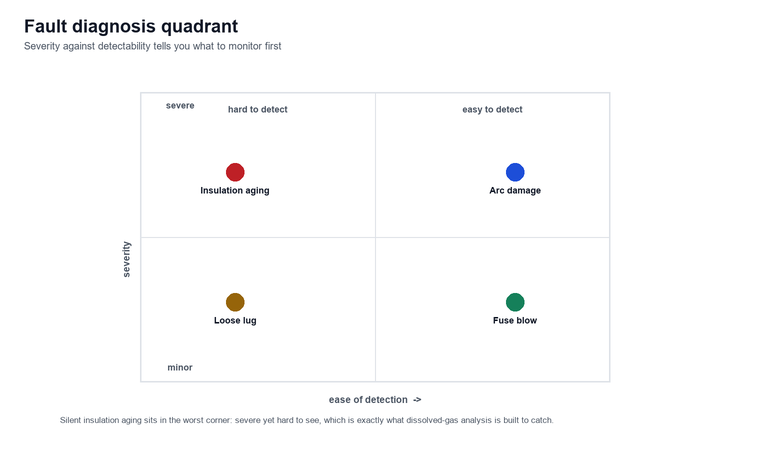
Condition-based monitoring, not a calendar interval, is the right framework for a unit that may accumulate in one year what a distribution transformer sees in ten, and the backbone of that framework is dissolved-gas analysis of the insulating oil. As paper and oil degrade under thermal and electrical stress they release gases whose identity and concentration point to the fault type: hydrogen and acetylene indicate discharge activity such as arcing, ethylene and ethane indicate oil thermal breakdown, and carbon monoxide and carbon dioxide indicate paper overheating (IEEE C57.104-2019). A rising trend is a far better warning than any single reading.
For the 24 V control cousin, the test is simpler but no less decisive: with power removed, a continuity check confirms the windings are intact, and with power restored a multimeter on the secondary terminals should show 24 V AC to 28 V AC no-load and stay above roughly 18 V AC under load. Across a 2024 service campaign covering 63 packaged HVAC units, the 24 V secondary read below 18 V AC under load on eleven units that had already tripped the control fuse at least once, and nine of those eleven showed insulation resistance under one megohm at the component, so the loaded-voltage test found roughly three times the weak units that a no-load reading alone would have cleared. A furnace-grade power unit adds online thermal and partial-discharge monitoring so the hot-spot and the bus connection are watched continuously rather than inspected at an outage.
Limitations and Boundaries
No single device does every furnace job well, and the boundaries are worth stating before procurement. A standard distribution transformer cannot survive the repeated secondary short circuits of an arc furnace, and a furnace-grade unit is the wrong choice for a clean sinusoidal load where its reinforced bracing and wide tap range only add cost. The 24 V control transformer is a control device only; it isolates and steps down, it does not switch the heating elements or the compressor, and a blown control fuse almost always means a downstream short rather than a tired component. Finally, the readings are only as good as the test that produced them: a dissolved-gas analysis taken on a sample drawn after the unit has been topped up with fresh oil will understate the trend, just as a no-load voltage check on a control transformer will miss a unit that collapses only under load.
FAQ
What is the difference between a furnace-grade unit and a distribution transformer?
The unit is reinforced and regulated for the unstable, short-circuiting, harmonic-rich load of an arc or smelting furnace, while a distribution transformer is built for a steady sinusoidal load; the furnace-grade machine carries more copper on its secondary, has a wide-range on-load tap changer and is braced for repeated electromagnetic shocks that would deform a standard winding.
How do I know if my 24 V furnace transformer is bad?
Measure the secondary with a multimeter: a healthy unit reads about 24 V AC to 28 V AC with no load and stays above roughly 18 V AC under load, so a blank thermostat, a burning smell, a loud hum or a control fuse that blows repeatedly all point to the transformer or a short on its 24 V circuit.
Which standard governs the arc-furnace application?
IEEE C57.17-2012 covers the electrical and mechanical features of liquid-immersed transformers that supply direct arc-melting furnaces, while IEC 60076-1:2011 and IEC 60076-5:2006 provide the general and short-circuit-withstand framework that the furnace application builds on.
Why does a furnace-grade unit need such a wide tap range?
The melt cycle moves from a near short circuit at cold scrap to a steady refining arc, and the on-load tap changer varies secondary voltage through twenty to thirty-five steps so the operator can pour maximum power in at melt-in and then back off, which is why a furnace unit needs far more taps than a distribution transformer.
What impedance should a furnace-grade unit have?
A furnace-grade unit typically runs 8% to 14% short-circuit reactance so it limits the surge current of arc ignition and protects the winding and electrode system, which is higher than the 5% to 8% expected of a standard power transformer.
How long does the equipment last?
A large oil-immersed furnace unit’s life is set by its duty and its dissolved-gas trend rather than a fixed calendar, while the small 24 V control transformer in an HVAC system typically serves 10 to 20 years before insulation breakdown takes it out of service.
Conclusion
The right purchase starts from the load the unit must feed and ends at the impedance, tap range, harmonic derating and monitoring that keep the answer credible, not from the longest feature list on the brochure. Match an arc, ladle or submerged-arc duty to a furnace-grade design built and tested for that heat cycle, and keep the 24 V control supply in mind as the small component that can silence the whole system when it fails. Equally important, the reading is only trustworthy inside a disciplined dissolved-gas and factory-acceptance routine, because the failures that end a furnace transformer’s life come from repeated short circuits and harmonic heating, never from a weak specification on paper.
Browse the full range and request a quote on the transformer tester category page, or pair the right instrument with a transformer DC winding resistance tester, a transformer turns-ratio tester and a transformer winding deformation tester. For application help, contact us.
References
- IEC 60076-1:2011, Power transformers, Part 1: General (webstore.iec.ch/en/publication/588).
- IEC 60076-5:2006, Power transformers, Part 5: Ability to withstand short circuit (webstore.iec.ch/en/publication/603).
- IEEE C57.17-2012, IEEE Standard Requirements for Arc Furnace Transformers (standards.ieee.org/ieee/C57.17/4196).
- IEEE C57.12.00-2021, General Requirements for Liquid-Immersed Distribution, Power, and Regulating Transformers (standards.ieee.org/ieee/C57.12.00/6962).
- IEEE C57.104-2019, Guide for the Interpretation of Gases Generated in Mineral Oil-Immersed Transformers (ieeexplore.ieee.org/document/8931178).
- IEEE C57.110-2018, Transformer Capability When Supplying Nonsinusoidal Load Currents (ieeexplore.ieee.org/document/8546832).