

Transformer monitoring helps EPC contractors, asset owners and electrical engineers assess transformer operating conditions, identify abnormal trends and make better-informed maintenance decisions. The right installation depends on transformer type, asset criticality, fault risks and the information the maintenance team actually needs—not on how many channels a datasheet can list.
For project procurement, the objective is not to monitor every available parameter. It is to select measurements that address the actual risks, integrate with the plant’s existing electrical monitoring infrastructure, and produce data that engineers can act on. A procurement project therefore starts with a risk list, not a channel list.
Key takeaways
- A monitoring system detects abnormal trends; it does not replace protection relays, periodic testing or planned maintenance.
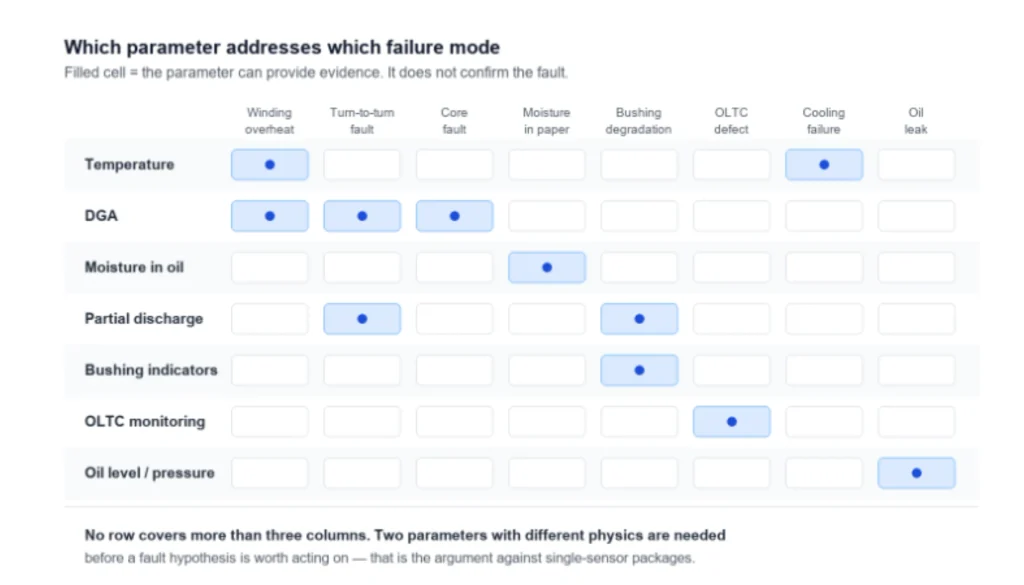
- Temperature, dissolved gas analysis, moisture, partial discharge, bushing, OLTC and cooling status each address a different failure mode, and none of them covers all of them.
- IEEE C57.143-2024 sets out the parameter-selection and risk-benefit framework for liquid-immersed transformers, while IEEE C57.167-2023 covers distribution units.
- Dry-type transformers have no oil-based diagnostics—temperature, ventilation and cooling status are the core measurements.
- Protocol compatibility does not equal successful integration. Data-point mapping, timestamping and alarm handling decide that.
- The cheapest device and the largest system are both wrong answers; the match between capability, asset risk and maintenance strategy is the right one.
Why does transformer monitoring matter for power system reliability?
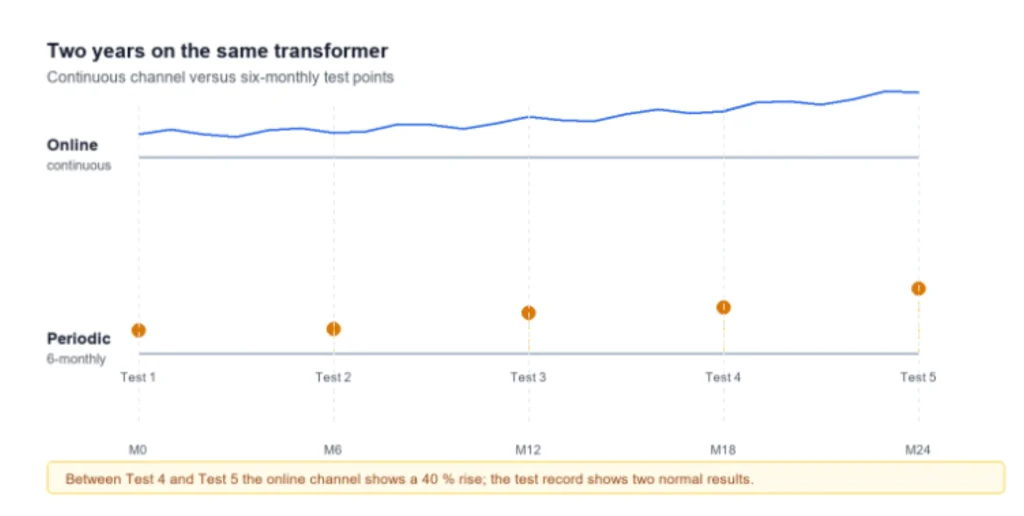
Transformer monitoring is the continuous or scheduled observation of a transformer’s operating parameters—temperature, gases, moisture, discharge and mechanical status—carried out between routine inspections so that abnormal trends become visible before they become outages. Power transformers sit in substations, power plants, industrial facilities and renewable energy sites, and an unexpected outage can interrupt supply, delay production and create repair costs that dwarf the price of the monitoring equipment. Routine inspection and periodic testing remain essential, but they sample the asset at specific points in time rather than observing it continuously.
Online monitoring adds measurements between those inspections. It does not replace them. The value is in spotting a trend early enough that the response can be planned rather than reactive, and that is the case online monitoring is built to make.
What Problems Can Monitoring Detect?
Depending on the sensors and methods installed, a monitoring system can help identify:
- Abnormal temperature or a changing thermal trend.
- Changes in dissolved gases that may indicate developing faults in oil-filled equipment.
- Abnormal moisture levels in insulating oil.
- Partial-discharge activity detected by an appropriate measurement method.
- Changes in bushing condition indicators.
- Abnormal operation of the on-load tap changer (OLTC).
- Cooling-system problems, including fan or oil-pump status abnormalities.
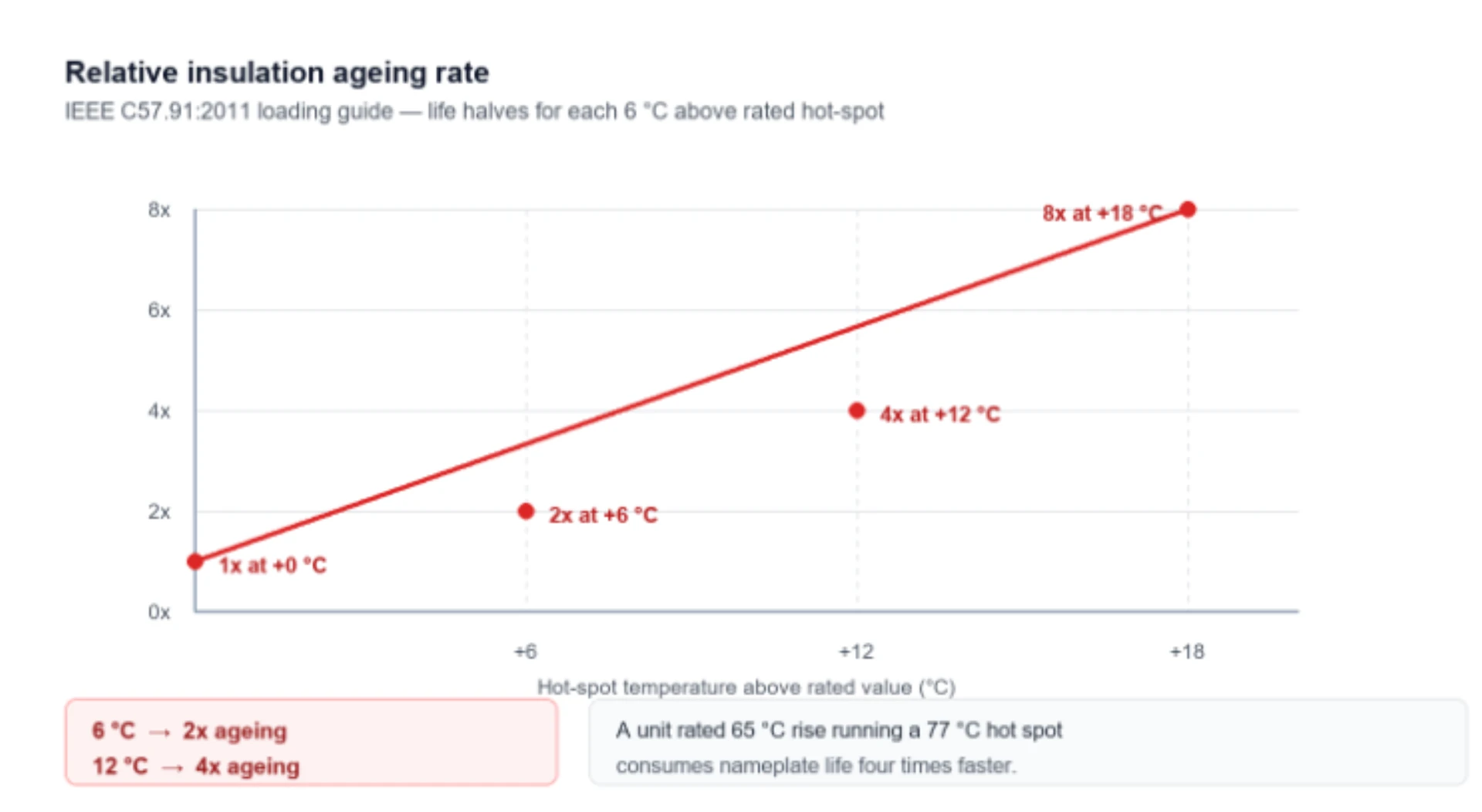
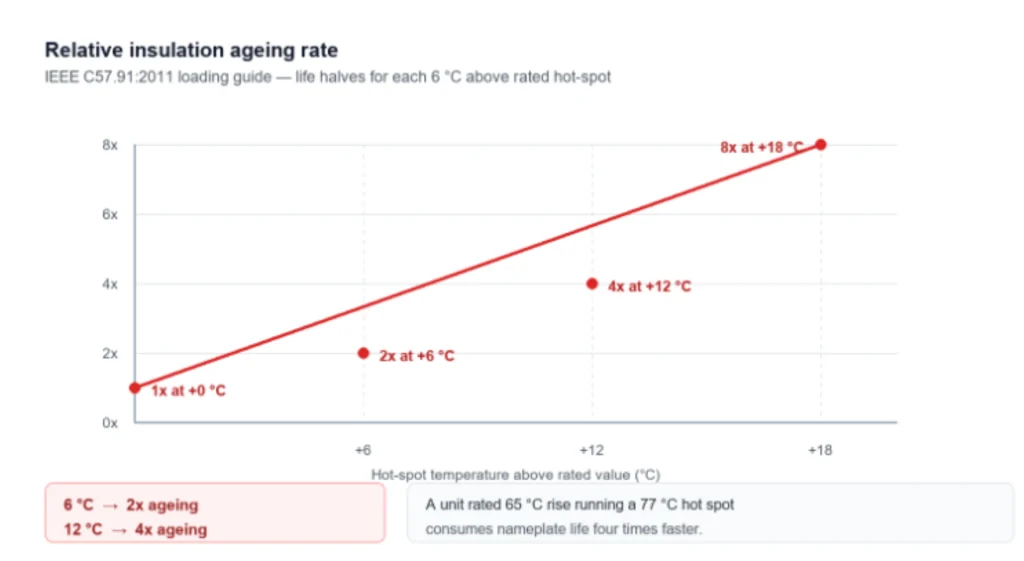
The oil–paper insulation system is usually the critical element. IEEE C57.91:2011 accelerated-ageing research shows that the ageing rate reaches 200% of the reference value—insulation life halves—for roughly every 6 °C rise in hot-spot temperature beyond the rated value (IEEE C57.91:2011, loading guide). Thermal monitoring is therefore disproportionately valuable. A hot spot running 12 °C above rating can consume insulation life at roughly 400% of the assumed ageing rate—four times the nameplate basis (IEEE C57.91:2011, ageing acceleration tables). That is why temperature is the first channel on almost every system.
These measurements do not all carry the same diagnostic weight. A temperature alarm may indicate a thermal problem, but it cannot by itself establish whether the cause is excessive loading, cooling failure or an internal defect. Engineers should read measurements alongside loading, ambient conditions, operating history and other evidence.
When Does Online Monitoring Provide More Value Than Periodic Inspection?
Online monitoring is worth evaluating when a transformer has a high outage impact, sits at a remote site, serves a critical process, or needs closer observation because of its condition or operating history. For an EPC project, the decision should weigh the owner’s operating strategy as well as the initial equipment cost. A monitoring system is less useful if nobody is responsible for reviewing alarms or arranging inspections after abnormal readings.
Which transformer parameters should you monitor?
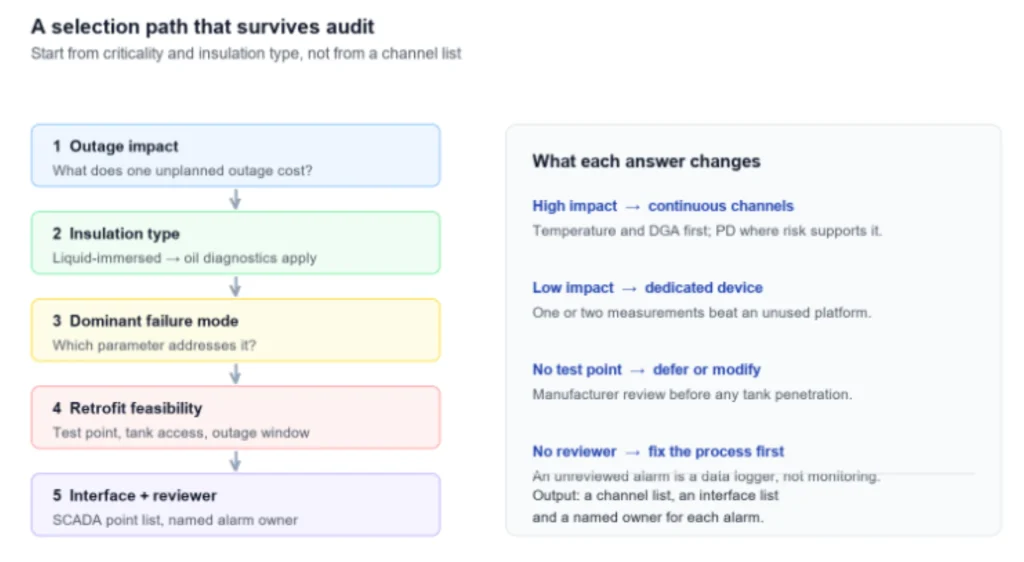
Which parameters to install depends on the transformer design, the failure modes the project team wants to detect and the maintenance decisions the owner is actually resourced to act on, so a specification written from a product catalogue alone usually ends up either short of coverage or carrying channels nobody will use. IEEE C57.143-2024 provides guidance on monitoring equipment for liquid-immersed transformers and components, covering parameter selection, risk-benefit analysis and sensor application (IEEE C57.143-2024, guide scope).
The table below summarises the common monitoring options together with their practical limits.
| Monitoring parameter | Engineering purpose | Important limitation |
|---|---|---|
| Oil and winding temperature | Assess thermal conditions and identify abnormal trends | A measured temperature may not represent the actual winding hot spot |
| Dissolved gas analysis (DGA) | Identify gas trends associated with possible internal faults in oil-filled equipment | Gas interpretation requires context and does not independently confirm every fault |
| Moisture in oil | Track moisture conditions in liquid insulation | Oil moisture alone does not establish the condition of solid insulation |
| Partial discharge (PD) | Detect electrical discharge activity using an appropriate sensing method | Sensitivity depends on method, sensor installation and interference conditions |
| Bushing condition | Monitor selected electrical indicators of bushing deterioration | Capability depends on bushing design and compatible sensors |
| OLTC condition | Assess selected operating, electrical or mechanical indicators | Diagnostic coverage varies by monitoring method |
| Oil level and pressure | Identify abnormal levels or pressure conditions where applicable | An abnormal reading does not identify the root cause on its own |
| Cooling-system status | Identify abnormal fan, pump or control operation | Status signals do not prove adequate cooling performance |
Which Parameters Matter Most for Oil-Immersed Transformers?
Dissolved gas analysis is the measurement of gases dissolved in the insulating oil, where each gas points to a distinct thermal or electrical process inside the tank. For liquid-immersed transformers, temperature monitoring is the common starting point, dissolved gas analysis may add evidence of developing internal faults, and moisture, bushing, OLTC and cooling monitoring address the remaining condition risks. DGA deserves particular attention when the transformer is critical or its history justifies closer observation. IEC 60599:2022 describes how dissolved and free gas concentrations in applicable mineral-oil-filled equipment may be interpreted to assess condition and guide further action (IEC 60599:2022, dissolved gas interpretation).
DGA is not a universal fault detector. Results must be assessed against equipment type, previous measurements, gas trends, loading conditions and other diagnostic evidence. An abnormal result may require confirmatory sampling or additional tests before a maintenance decision is made.
Which Parameters Matter Most for Dry-Type Transformers?
Partial discharge is a localised insulation breakdown that does not bridge the gap between conductors, and repeated activity erodes insulation over time. Dry-type transformers do not use the same oil-based methods as liquid-immersed units, and monitoring commonly focuses on winding temperature, ambient conditions, ventilation and cooling-system operation, with additional electrical condition monitoring selected where justified. The project team should confirm whether the manufacturer supplies temperature sensors, winding temperature indicators, alarm contacts or communication interfaces as standard.
Oil-level, oil-pressure and oil-based DGA measurements are not standard requirements for dry-type transformers. Selecting those functions without considering the transformer construction adds complexity without addressing the relevant condition risks.
Can One Parameter Detect Every Transformer Fault?
No. Each measurement represents a specific physical condition or diagnostic indicator. Temperature can reveal thermal change without identifying its cause. DGA can indicate possible internal fault activity in applicable oil-filled equipment, but it does not replace every electrical or mechanical test. Partial-discharge monitoring depends on the detection method and installation conditions in the same way. Engineers should therefore select parameters from the failure modes of concern, rather than assuming one sensor or one general-purpose device can assess the whole transformer.
What is the difference between online monitoring and periodic testing?
Online monitoring and periodic testing answer different questions and should be specified together, because treating them as competing options is usually a procurement error that shows up as either duplicated instrumentation or an unmonitored failure mode. Monitoring tracks selected parameters over time, while periodic testing evaluates particular electrical, insulation or mechanical characteristics under defined test conditions that no sensor can reproduce. Dissolved gas analysis follows the same split, and this comparison of online DGA monitoring versus laboratory DGA testing sets out what each method can see and what it cannot.
| Comparison | Online monitoring | Periodic or offline testing |
|---|---|---|
| Data collection | Continuous or scheduled, depending on the channel | Collected during planned inspection or testing |
| Trend visibility | Useful for identifying changes between inspections | Reflects the test conditions and time of measurement |
| Diagnostic depth | Limited to installed sensors and supported analysis | Can include specialised tests not available through online sensors |
| Outage requirements | Many measurements collected during normal operation | Some tests require isolation or an outage |
| Main purpose | Ongoing condition awareness and abnormal-trend detection | Condition verification, maintenance assessment and detailed diagnosis |
How Does an Online Monitoring System Work?
A typical transformer monitoring architecture consists of sensors, signal acquisition units, communication interfaces, and a local or remote monitoring platform. Sensors measure selected parameters, the acquisition unit processes or collects the signals, and the communication layer transfers data to a supervisory control and data acquisition (SCADA) system or another platform where supported.
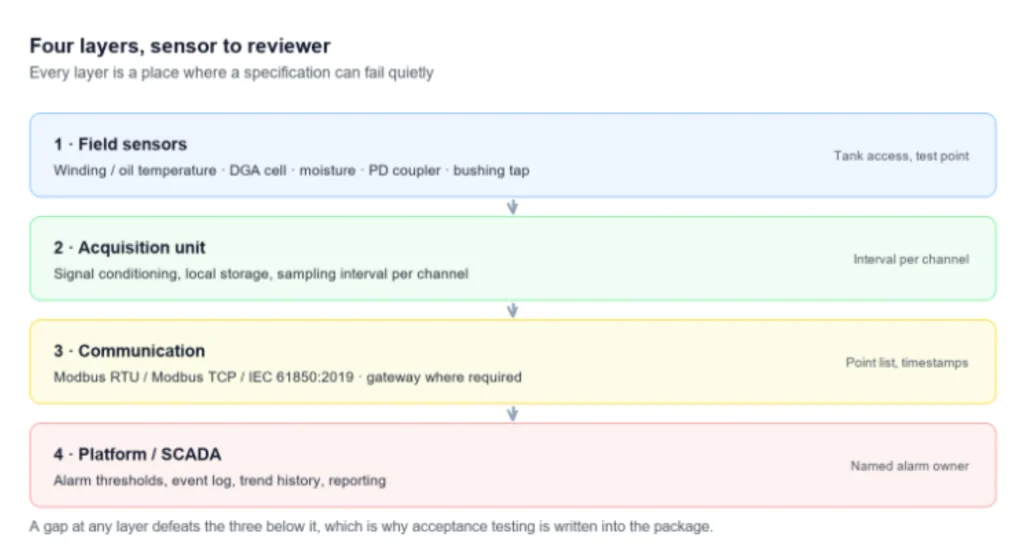
Alarm thresholds, event recording and historical trends help maintenance teams identify changes requiring attention, and the exact capabilities depend on the equipment configuration and software.
Not every parameter is measured at the same rate. Temperature, dissolved gases, partial discharge and mechanical indicators may require different sampling intervals and processing methods, and the supplier should document those differences rather than describing the entire system as uniformly real-time. In practice one package may update temperature every 60 seconds, dissolved gas values every 4 hours and partial-discharge events on trigger.
A supplier datasheet that quoted a single “real-time” figure for every channel usually turned out, on inspection, to mean one-minute sampling for temperature, several hours for gas values and event-driven capture for partial discharge—three very different latencies presented as one claim.
When Is Online Monitoring Not Necessary?
For a low-criticality transformer with manageable outage consequences, effective periodic maintenance and no specific requirement for continuous condition data, a full online system may not be economically justified. The decision should weigh installation and maintenance cost, failure consequences, backup supply availability, and the owner’s ability to respond to alarms. The correct answer may be a small number of dedicated devices rather than a full platform.
How do you choose the right monitoring system?
Selecting a system takes more than comparing channel counts or catalogue features, and EPC contractors should verify that the proposed configuration matches the transformer, the project interface requirements and the maintenance decisions the owner will actually make. The criteria set out in this online DGA monitoring system selection guide apply to the wider package as well: defined requirements first, documented evidence second, price last.
How Should Transformer Type, Rating and Capacity Affect Selection?
Begin with the nameplate and technical documentation. Record type, rated voltage, capacity, cooling arrangement, insulation medium and available auxiliary signals, and identify whether the transformer is newly supplied or already in service. Retrofit projects may carry restrictions on sensor installation, wiring routes, outage windows and access to existing signals.
Voltage rating and capacity define the application, but they do not determine the monitoring configuration on their own. Two transformers with similar ratings may need different systems because their operating environments, failure consequences and maintenance requirements differ.
How Many Monitoring Parameters Do You Actually Need?
A practical approach starts with the monitoring objective and expands only where additional measurements have a clear purpose. The three tiers below are selection categories rather than industry classifications, and the actual configuration should follow the project specification and the equipment’s demonstrated capability.
- Basic: temperature plus selected operating-status signals, for applications with limited monitoring requirements.
- Enhanced: adds DGA, oil moisture or bushing indicators where the risk assessment supports them.
- Integrated: multiple channels, centralised alarms, historical trends and communication with existing plant systems, for critical assets.
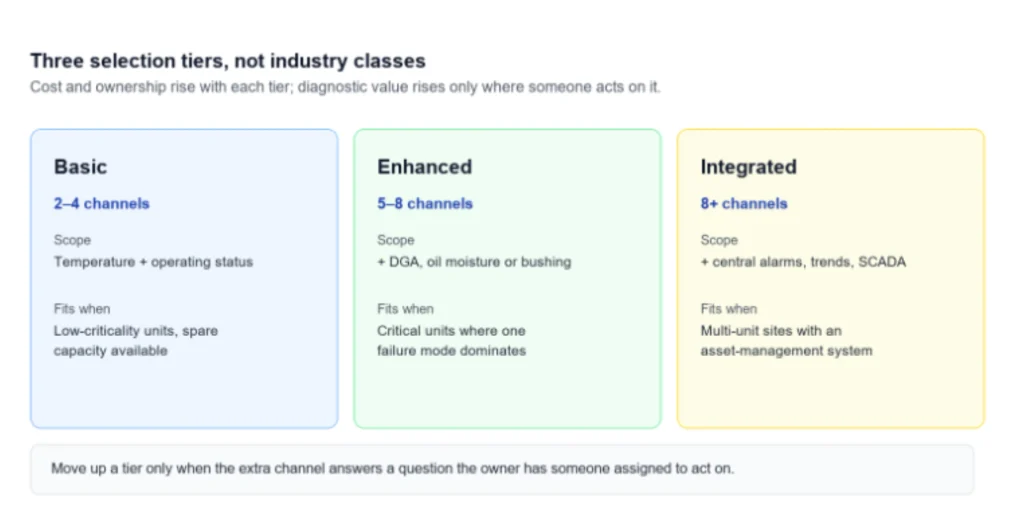
More channels do not automatically produce better decisions. Each additional measurement introduces installation, calibration, interpretation and maintenance requirements that someone has to own.
What Sensor Accuracy, Range and Installation Requirements Should You Check?
The datasheet should state measurement range, accuracy, resolution where relevant, response time and operating conditions for each channel. Engineers should confirm that the specified range covers expected operating conditions and that the method suits the application.
Installation matters as much as the sensor. Check whether the sensor needs an oil connection, an existing test point, a dedicated mounting location, or work near energised equipment, and confirm environmental ratings, electromagnetic compatibility, cable routing, auxiliary power and maintenance access.
Do not apply one accuracy figure to every parameter. Temperature, moisture, dissolved gases and partial discharge use different sensing methods and carry different performance considerations. Where the system forms part of an EPC package, review these requirements before the design is frozen, because late changes to sensor locations, wiring or communication interfaces affect installation work and commissioning schedules.
Which Communication Protocols and Integration Functions Matter?
The system should be compatible with the project’s communication architecture, and depending on equipment and application the relevant interfaces may include Modbus RTU, Modbus TCP or IEC 61850:2019. Protocol compatibility alone does not guarantee successful integration: the project team should confirm the supported protocol version, available data points, register and data-object mapping, event timestamps, alarm handling, and any gateway or software requirement. The device-to-platform link is usually the weakest part of the project, and the options for transformer remote monitoring communication over GSM, 4G and NB-IoT decide whether the data arrives at all.
For an existing substation or plant, obtain the owner’s interface specification before selecting the device. Where remote access is required, cybersecurity, network segmentation, user access and data ownership should also be addressed. The supplier should identify which functions sit in the standard package and which require additional hardware, licences, engineering or customisation.
How Should You Compare Cost and Long-Term Value?
The purchase price is one part of the project cost, and a fair comparison should cover:
- Sensors, acquisition units and monitoring hardware.
- Cabling, mounting accessories and installation work.
- Communication gateways and system integration.
- Software licences, data storage and remote access where applicable.
- Commissioning, training and acceptance testing.
- Calibration, maintenance, replacement parts and technical support.
A lower-priced device suits a simple application. For a critical transformer, missing interfaces, limited data history or difficult maintenance access create costs later that the purchase comparison never showed.
Which solution fits your application?
Different applications place different demands on monitoring equipment, and the solution should reflect the operating environment, the outage consequences and the maintenance resources the owner can realistically commit over the asset life. The same logic applies to the equipment range offered for each application. The monitoring list and the protection list should be reviewed together rather than in separate packages.
| Application | Transformer monitoring requirements to evaluate | Key selection consideration |
|---|---|---|
| Utility substations | Temperature, DGA, bushing condition and selected auxiliary systems | Asset criticality and integration with substation monitoring |
| Power generation | Thermal condition, applicable oil diagnostics and cooling-system status | Impact of transformer unavailability on generation |
| Industrial plants | Temperature, cooling status and risk-based additional measurements | Production continuity and maintenance access |
| Renewable energy sites | Remote data collection, thermal monitoring and applicable oil diagnostics | Site access, communications and remote alarm handling |
| Data centers | Thermal condition, critical operating signals and remote alarms | Supply continuity and coordination with existing systems |
These are starting points for engineering assessment, not fixed configurations.
Dedicated Device or Integrated System?
A dedicated device may be the better option when the requirement is limited to one measurement or a small set of signals: it reduces initial complexity and is often easier to retrofit. An integrated platform becomes more attractive when several parameters must be collected, alarms managed centrally, or data shared with an existing SCADA or asset-management system. Most retrofit decisions land on the dedicated device for exactly this reason.
Before choosing an integrated platform, verify that it supports the required sensors and data interfaces, and confirm whether analysis, event history, remote access and reporting are included or require separate software.
Can an Existing Transformer Be Retrofitted?
Many existing transformers can be considered for retrofit, but feasibility depends on the measurement method and installation requirements. The assessment should cover available test points, sensor mounting locations, auxiliary power, cable routing, communication infrastructure and any work requiring an outage. The transformer manufacturer may also need to review modifications affecting the tank, oil system, bushings or other components.
Not every parameter can be added without physical modification, so a retrofit proposal should distinguish measurements available from existing signals from those requiring new sensors or installation work.
What should you verify before purchasing?
For EPC contractors, procurement teams and project owners, the most useful supplier comparison rests on documented requirements rather than general product claims, and a compliance schedule written before the order is the tool that forces each claim onto paper where it can be checked. The compliance schedule below is the mechanism that turns one into the other. Commissioning followed by acceptance testing is the last opportunity to catch a mismatch, so the inspection and documentation steps described in this sourcing and delivery process should be written into the package before the order is placed.
What Technical Documents Should a Supplier Provide?
Request the documents needed to review the system before purchase:
- Technical datasheets and a list of supported monitoring parameters.
- Sensor specifications and measurement-performance data.
- System architecture, wiring diagrams and installation requirements.
- Communication protocol documentation and available data points.
- Alarm configuration and historical-data capabilities.
- Power supply, environmental and electromagnetic compatibility specifications.
- Commissioning procedures, acceptance criteria, warranty terms and maintenance requirements.
The required set depends on the project specification. Where a standard, certification or test report is mandatory, request the evidence and verify it applies to the offered model rather than to a sibling product.
How Can You Confirm the System Meets Project Requirements?
Prepare a technical compliance schedule before placing the order. For each requirement, record the specified function, the supplier’s offered solution, the supporting document and any deviation:
1. The transformer type and monitoring parameters are supported. 2. Measurement ranges and performance meet the project specification. 3. Installation and wiring requirements are understood. 4. Communication and SCADA interfaces have been verified. 5. Alarm functions and data retention meet the owner’s needs. 6. Testing, commissioning and acceptance responsibilities are defined. 7. Exclusions, additional costs and after-sales support are documented.
Terms such as “intelligent diagnosis”, “early warning” and “real-time monitoring” should be supported by a clear technical description. They are not proof that a system can predict every fault or prevent every outage.
What Should You Send for a Quotation?
To obtain a technically relevant quotation, provide the following items. Transformer type, rated voltage, capacity and cooling method. Required parameters and the reason for monitoring. Number of transformers and project application. New installation or retrofit status. Existing SCADA platform and communication protocols. Installation environment and available auxiliary power. Project specification, required standards and delivery expectations.
That information lets the supplier identify an appropriate configuration, state technical exclusions clearly, and avoid quoting a system that cannot meet the interface or installation requirements.
Transformer monitoring limitations and boundaries
A system reports on the condition of the parameters it measures rather than on the transformer as a whole, so every monitoring package carries a blind spot that the specification should name before the hardware is chosen. The boundaries below are the ones that most often separate a useful installation from an expensive one.
- Monitoring does not replace protection. Protection relays detect defined electrical faults and trip; a monitoring platform observes and reports, and the two functions are engineered to different standards.
- No configuration guarantees advance warning of every failure. Detection depends on fault type, sensor coverage, measurement quality and operating conditions.
- A single parameter rarely identifies a root cause. Temperature rise can come from loading, cooling failure or an internal defect, and the reading alone cannot separate them.
- A monitoring system with no assigned reviewer is a data logger. If nobody is responsible for reading alarms and scheduling inspections, the value of continuous data drops sharply.
- Retrofits may be physically constrained. Tank penetrations, oil connections and bushing modifications often require manufacturer review and an outage window.
- Measurement claims need qualification. Where a supplier states a sampling rate or accuracy, confirm the channel, the method and the test conditions behind the number.
Frequently asked questions
What Is the Difference Between Transformer Monitoring and Transformer Protection?
Monitoring collects operating data and identifies abnormal conditions, while transformer protection systems detect defined electrical faults and initiate actions such as tripping according to their protection design and settings. A monitoring system should not be assumed to replace protection relays—the two are engineered to different standards and different response times.
Can Transformer Monitoring Detect Internal Faults Before Failure Occurs?
Some methods identify abnormal trends associated with developing faults, and detection depends on fault type, sensor coverage, measurement quality and operating conditions. Gas-based methods carry particular weight here: as this DGA fault detection overview explains, electrical protection responds to current and voltage, whereas a slow thermal or insulation fault develops without producing either. No monitoring configuration guarantees advance detection of every failure.
Is Online DGA Necessary for Every Oil-Immersed Transformer?
No. Online DGA should be evaluated on asset criticality, operating history, fault risk, existing oil-testing practice and the value of continuous gas-trend data. A 500 kVA distribution unit on a looped rural feeder with annual lab sampling rarely justifies an online gas monitor, while a 40 MVA generator step-up transformer with a single supply path usually does. Periodic laboratory analysis remains appropriate for many applications.
Can a Monitoring System Connect to an Existing SCADA Platform?
Often, yes, provided the devices and platform support compatible protocols and data interfaces. A system that publishes Modbus TCP registers is straightforward to map into most SCADA front ends, while one that only exposes a proprietary cloud API needs a gateway layer that someone has to own and maintain. Confirm data mapping, alarm handling, timestamps, cybersecurity requirements and any required gateway or integration work before procurement, and record the agreed point list in the contract.
How Much Does a Monitoring System Cost?
Cost depends on the number and type of channels, sensors, installation work, software, communication interfaces and commissioning requirements, so a per-system figure quoted without those inputs is not comparable. Two offered systems at the same price can differ by a factor of three in installed cost once cabling, oil connections, outage time and integration engineering are counted. A reliable quotation needs the transformer details and project specification rather than a generic price per system.
Does Transformer Monitoring Eliminate Regular Maintenance?
No. Monitoring supplements planned inspection, testing, oil analysis and maintenance, and it changes their timing rather than removing them. A reading that stays inside its limits can justify extending an inspection interval; an abnormal trend should be assessed by qualified personnel, with further testing performed when necessary. The maintenance budget does not disappear, but it moves from calendar-driven work toward condition-driven work.
Conclusion
Effective condition monitoring begins with a clear understanding of the transformer, the risks that matter and the decisions the maintenance team needs to make. The most suitable system is not the one with the most sensors; it is the one that provides relevant, reliable measurements and fits the project’s installation and communication requirements. Every channel the owner cannot respond to is a maintenance liability rather than an asset-management tool.
For EPC contractors and asset owners, the procurement process should verify measurement performance, sensor compatibility, system integration, commissioning scope and long-term maintenance cost before the equipment is approved. Preparing the nameplate data, required parameters and communication requirements before requesting a quotation keeps the technical evaluation efficient and prevents costly interface changes during project execution.
Request a quotation for a transformer monitoring system with your nameplate data and interface specification attached, and our engineering team will return a matched configuration against the parameters your risk assessment actually requires.
Author: Beijing Autony Electric Co., Ltd. — Protection Relay Engineering Team · Technical reviewer: Senior Control Panel Design Engineer, 12 years in industrial automation and power distribution · Last updated: 2026-10-17.
Technical references
1. IEEE, IEEE C57.143-2024: IEEE Guide for Application of Monitoring Equipment to Liquid-Immersed Transformers and Components — standards.ieee.org. 2. IEC, IEC 60599:2022: Mineral oil-filled electrical equipment in service — Guidance on the interpretation of dissolved and free gases analysis — webstore.iec.ch. 3. IEEE, IEEE C57.167-2023: IEEE Guide for Monitoring Distribution Transformers — standards.ieee.org. 4. IEEE, IEEE C57.91-2011: IEEE Guide for Loading Mineral-Oil-Immersed Transformers and Step-Voltage Regulators — standards.ieee.org. 5. IEC, IEC 61850:2019: Communication networks and systems for power utility automation — webstore.iec.ch. 6. IEC, IEC 60076-7:2018: Power transformers — Part 7: Loading guide for mineral-oil-immersed power transformers — webstore.iec.ch