Leave your message

-
Leon Zhang sales consultant
-
Email: zxl635973785@gmail.com
-
Phone/WhatsApp/Wechat: +86 13655813266

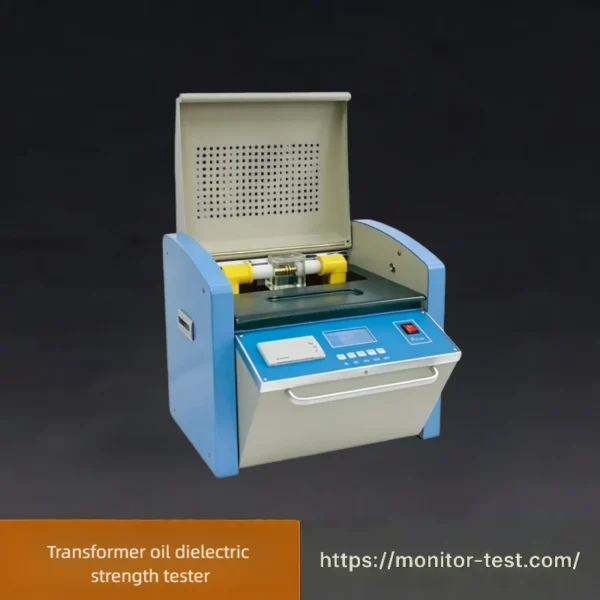
HF-TC-628 Transformer Oil Dielectric Strength Tester
This Transformer Oil Dielectric Strength Tester is designed to measure breakdown voltage of insulating oil accurately. It identifies moisture, impurities and oil deterioration, evaluating insulation performance to avoid high-voltage equipment faults during regular substation preventive maintenance.
Send your requirements, we will quote for you within 12 hours
This intelligent automatic tester is specially developed to measure breakdown voltage of transformer insulating oil for power system preventive maintenance. Controlled by microprocessor, it can automatically finish boosting, stirring, standing, data calculation and printing within 0~80kV testing range.
With large LCD display and Chinese menu guidance, it stores up to 100 groups of test data with power-off protection, shows ambient temperature and humidity in real time, and prints test results via built-in thermal printer. Uniform 50Hz voltage lifting ensures high test accuracy, widely used to check oil dampness, impurity contamination and aging status so as to protect oil-filled high voltage electrical equipment.
Product Features
- Equipped with a microprocessor, the instrument automatically completes voltage boosting, holding, stirring, standing still, calculation and printing procedures, and is capable of cyclic withstand voltage tests for insulating oil within the range of 0 ~ 80kV.
- Adopts large-screen liquid crystal display with Chinese menu prompts for intuitive operation.
- Extremely user-friendly: operators only need simple parameter settings, then the device will finish the withstand voltage test for one oil sample automatically as configured. It automatically stores breakdown voltage values of 1~6 tests and cycle times. After testing, the built-in thermal printer outputs each breakdown reading and the average value.
- Data retention upon power failure: it can save up to 100 groups of test results, and displays real-time ambient temperature and humidity.
- Controlled by single-chip microcomputer to realize uniform voltage rise; the output voltage frequency is precisely stabilized at 50Hz for stable and controllable whole testing process.
Transformer Oil Dielectric Strength Tester Technical Specifications
| Parameter | Technical Index |
|---|---|
| Output Voltage | 0 ~ 80kV (Optional) |
| Voltage Distortion Rate | < 3% |
| Voltage Rise Speed | 0.5 ~ 5kV/s (Adjustable) |
| Standing Time | 15min (Adjustable) |
| Voltage Rise Interval | 5min (Adjustable) |
| Voltage Rise Times | 1 ~ 9 times (Optional) |
| Booster Capacity | 1.5kVA |
| Measurement Accuracy | ±3% |
| Power Supply Voltage | AC 220V±10%, 50Hz±1Hz |
| Power | 200W |
| Operating Temperature | 0℃ ~ 45℃ |
| Operating Humidity | < 75% RH |
| Overall Dimensions | 465×385×425 mm |
Packing List
| Item No. | Description | Quantity | Unit |
|---|---|---|---|
| 1 | Main Unit of Transformer Oil Dielectric Strength Tester | 1 | Set |
| 2 | Standard Oil Test Cup & Electrodes Assembly | 1 | Set |
| 3 | Power Cord | 1 | Piece |
| 4 | Grounding Wire | 1 | Piece |
| 5 | Thermal Printing Paper | 5 | Rolls |
| 6 | English & Chinese Operation Manual | 1 | Copy |
| 7 | Factory Calibration Certificate | 1 | Copy |
| 8 | Product Warranty Card | 1 | Copy |
| 9 | Shockproof Portable Carrying Case | 1 | Piece |
FAQ: Transformer Oil Dielectric Strength Tester (BDV Tester)
Q1: What is Transformer Oil Dielectric Strength Tester?
A: It is an automatic high-voltage test instrument to measure Breakdown Voltage (BDV) of insulating oil. It applies continuously rising AC high voltage to oil sample until electric breakdown/arc occurs; the breakdown voltage value reflects oil insulation capacity, used to judge moisture, particle contamination & aging degree of transformer oil.
Q2: Why do we need to test transformer oil dielectric strength regularly?
- Detect free water, dust, fiber, carbon particles inside oil (the top cause of insulation failure)
- Prevent internal arc discharge, winding breakdown & transformer sudden outage
- Meet power industry maintenance specifications & official inspection requirements
- Guide oil filtration, dehydration or oil replacement to extend transformer service life
Q3: What is the standard electrode gap for routine testing?
A: Default standard gap is 2.5 mm regulated by IEC 60156; adjustable gaps (1.0mm/2.0mm/4.0mm) are optional for special test demands.
Q4: How many breakdown tests shall be done for one oil sample?
A: International standards require 6 consecutive breakdown cycles on the same oil cup; the arithmetic average of 6 results is the final official BDV test report value.
Q5: What are the qualified BDV thresholds for new & in-service transformer oil?
A (2.5mm gap, IEC standard):
- New unused transformer oil (HV/UHV transformer ≥69kV): ≥60 kV
- New oil for distribution transformer ≤69kV: ≥50 kV
- Healthy running in-service oil: 35~45 kV
- Warning range: 30~35 kV (need dehydration & filtration soon)
- Unsafe limit: <30 kV (immediate oil treatment or replacement required)
Q6: Does oil temperature affect breakdown voltage test results?
A: Yes. BDV rises obviously with temperature increase. All test reports must record sample temperature; comparison of historical data must be under the same temperature condition to avoid misjudgmentMegger.
Q7: What types of insulating liquids can this tester measure?
A: Applicable to mineral transformer oil, natural ester oil, synthetic ester oil, silicone insulating oil, widely used for power transformers, bushings, high-voltage switchgears, reactors insulating fluid testingMegger.
Q8: What international standards does the instrument support?
A: Pre-programmed test modes for IEC 60156, ASTM D877, ASTM D1816, GB/T 507, users can switch standards with one click on the touch panel.
Q9: Why are my test results unstable & fluctuate greatly each time?
Main causes:
- Test cup/electrode not thoroughly cleaned, residual old oil & impurities remain
- Air bubbles trapped inside oil sample before testing
- Fingerprint grease attached on electrode surface
- Electrode spacing deviates from standard 2.5mm
- Oil sample absorbs moisture during sampling & transportation
Q10: Why is the measured BDV value continuously lower than standard?
A: Top influencing factors in sequence:
- Excessive free moisture inside oil (most primary reason)
- Suspended fine particles, paper fiber, metal debris & carbon dust
- Oil oxidation aging, increased acidity
- Dissolved air inside oil creates tiny voids
Reviews
There are no reviews yet.