Leave your message

-
Leon Zhang sales consultant
-
Email: zxl635973785@gmail.com
-
Phone/WhatsApp/Wechat: +86 13655813266

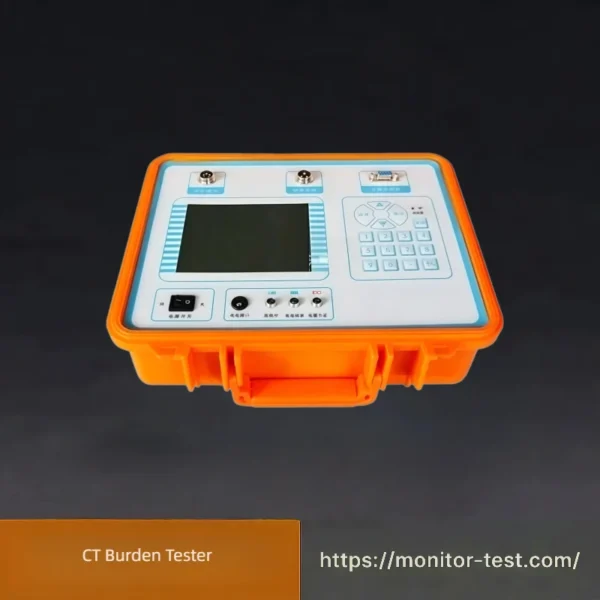
HF-IT-207 CT Burden Tester
The CT Burden Tester accurately measures the impedance of CT secondary circuits and calculates actual burden values. It checks whether the load stays within the rated range, prevents excessive burden from causing CT errors, securing reliable metering and relay protection operation in substations.
Send your requirements, we will quote for you within 12 hours
Errors of electric energy metering devices belong to comprehensive metering errors, including energy meter error, combined error of current transformer, combined error of voltage transformer, and metering error caused by voltage drop on VT secondary leads. The formula is shown below:
ε=εW + εTA + εTV + εf
Where:
εW — Energy meter error (%)
εTA — Combined error of current transformer (%)
εTV — Combined error of voltage transformer (%)
εf — Metering error caused by voltage drop on VT secondary leads (%)
ε=εW + εTA + εTV + εf
Where:
εW — Energy meter error (%)
εTA — Combined error of current transformer (%)
εTV — Combined error of voltage transformer (%)
εf — Metering error caused by voltage drop on VT secondary leads (%)
In metering circuits of power plants and substations, outdoor current transformers are generally 200~400m away from energy meters in control rooms. The circuit consists of terminal blocks, switches, fuses and wires. Contact resistance, wire resistance and distributed parameters form loop impedance, resulting in voltage drop on the secondary circuit between CT and energy meters.
VT secondary voltage drop refers to the total voltage drop generated by cables, terminal contact resistance, fuses, intermediate relay contacts, air switches and other components.
The error caused by VT secondary voltage drop means the percentage of voltage difference between VT secondary terminals and load terminals relative to actual secondary voltage, as well as the phase difference between the two voltages.
The error caused by VT secondary voltage drop means the percentage of voltage difference between VT secondary terminals and load terminals relative to actual secondary voltage, as well as the phase difference between the two voltages.
The On-site Test Operation Guide for Electric Energy Metering Devices issued by State Grid Corporation of China clearly requires measurement of actual secondary burden of current transformers and voltage transformers.
VT Actual Secondary Burden: Total admittance formed by measuring instruments, secondary cables and cable-to-ground capacitance connected to VT secondary side during operation.
CT Actual Secondary Burden: Total effective impedance consisting of impedance of measuring instruments, secondary cables and contact resistance connected to CT secondary side during operation.
VT Actual Secondary Burden: Total admittance formed by measuring instruments, secondary cables and cable-to-ground capacitance connected to VT secondary side during operation.
CT Actual Secondary Burden: Total effective impedance consisting of impedance of measuring instruments, secondary cables and contact resistance connected to CT secondary side during operation.
Other Names
Current Transformer Secondary Circuit Burden Meter, Transformer Secondary Circuit Load Tester, CT Secondary Burden Tester
Product Features
- Supports fully automatic measurement.
- Adopts engineering plastic enclosure, sturdy and durable, effectively ensuring safety of operators and test system.
- Equipped with automatic range switching function to guarantee test accuracy.
- Adopts electronic principle combined with DSP technology, featuring stable measurement and strong anti-interference performance.
- Automatically calculates all parameters after measurement for convenient analysis and testing.
- Large-screen Chinese LCD display, all operations guided by Chinese menu. It supports data storage, browsing and data transmission with computers.
- Powered by built-in 7.2V/11Ah lithium battery. It exerts no influence on tested circuits and prevents protection misoperation, and can work on site without external power supply.
- On-load test: samples current via clamp sensor, no need to disconnect secondary circuits. Live online measurement without power cut. Automatic range switching adjusts measurement range according to measured values to ensure precision and display digits.
- Continuous working time up to 24 hours; measurement can be carried out while charging.
- Comes with portable charger; external charger is available for measurement when battery is low.
- Compact size and light weight.
- Capable of storing 480 groups of test data; data can be retained for 10 years after power off.
- Operating temperature: -5℃ ~ 40℃
- Relative humidity: <95% (25°C)
- Altitude: <2500m
- Ambient conditions: No severe vibration and strong electromagnetic field
Packing List
| Item | Description | Qty | Unit | Remarks |
|---|---|---|---|---|
| 1 | CT Burden Tester Main Unit | 1 | Set | Built-in lithium battery |
| 2 | AC Charger | 1 | Pc | External power supply |
| 3 | Current Clamp Sensor | 1 | Pc | For on-load sampling |
| 4 | Test Lead Set | 1 | Set | Voltage test cables |
| 5 | USB Communication Cable | 1 | Pc | Data upload to PC |
| 6 | Operation Manual (English + Chinese) | 1 | Copy | |
| 7 | Calibration Certificate | 1 | Copy | Optional |
| 8 | Hard Carry Case | 1 | Pc | Shockproof transport case |
FAQ: CT Burden Tester
Q1: What is a CT Burden Tester used for?
A: It measures the total secondary loop impedance of Current Transformers and calculates actual burden. It verifies whether the real load is within CT rated burden, avoids excessive burden causing ratio/phase error, and ensures accurate metering and reliable protective relay operation.
Q2: What is CT secondary burden?
A: CT burden refers to the total series impedance on the CT secondary circuit, including instrument impedance, cable resistance, terminal contact resistance and relay contacts. Excessive burden will saturate the CT core and lead to measurement or protection failure.
Q3: Can this tester perform live testing without disconnecting CT secondary?
A: Yes. Equipped with clamp current sampling, it supports on-load live measurement. No need to open the CT secondary circuit, eliminating the risk of dangerous open-circuit voltage.
Q4: Is offline test also available?
A: Yes. It supports both offline injection testing (power off) and online live testing, meeting different site safety requirements.
Q5: Why is CT secondary open-circuit extremely dangerous?
A: If CT secondary is open while primary carries current, extremely high induced voltage will occur, endangering personnel and damaging equipment. Our live test function avoids this risk.
Q6: Does the instrument need external power during field testing?
A: No. Built-in lithium battery supports standalone operation without external power. It can also work while charging if the battery is low.
Q7: How long can the tester work continuously?
A: Up to 24 hours continuous operation on a full charge.
Q8: Can test data be saved and exported?
A: It stores up to 480 groups of measurement data, and data can be retained for 10 years after power-off. Data can be uploaded to PC via USB cable for report generation.
Q9: What is the operating environment requirement?
A: Operating temperature: -5℃ ~ 40℃; Relative humidity: <95% (25°C); Applicable altitude: below 2500m; Avoid strong vibration and intense electromagnetic interference.
Q10: What risks if CT actual burden exceeds rated value?
A: CT iron core saturation occurs, generating large measurement errors for energy metering. For protection CTs, it may cause relay mal-operation, refusal to trip or delayed tripping under fault conditions.

Reviews
There are no reviews yet.