

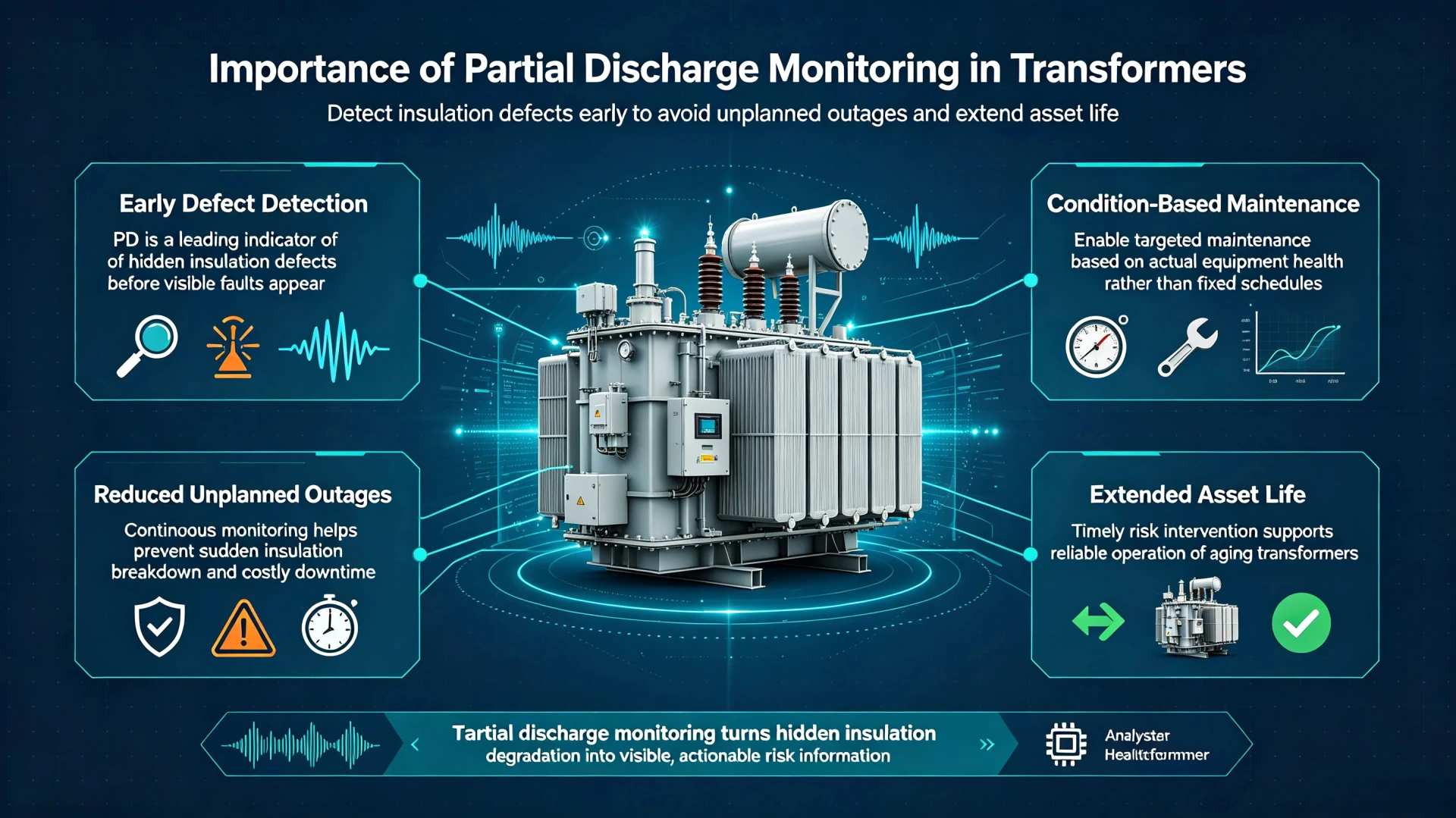
The Importance of Partial Discharge Monitoring in Transformers: Preventing Insulation-Related Failures
Transformer insulation degradation is often a gradual process that develops over months or years. Partial discharge (PD) is one of the key measurable phenomena associated with this process, making it an important indicator of insulation condition in power transformers.
Traditional maintenance typically relies on scheduled inspection, offline testing, and periodic diagnostic testing. While these methods remain valuable, they only provide information at specific points in time. Between two tests, insulation condition can change—sometimes significantly—without being noticed.
PD monitoring provides continuous or periodic information about discharge activity and how it changes over time. The value is not in predicting every fault, but in building a clearer picture of insulation condition: monitoring → trend → condition assessment → maintenance decision. This supports earlier intervention and more informed maintenance planning for critical transformers, helping prevent insulation-related failures before they lead to unplanned outages.
Why Is Partial Discharge Monitoring Important for Transformers?
1. Detect Developing Insulation Problems Earlier
PD activity can be associated with developing insulation defects such as voids, cracks, delamination, contamination, surface deterioration, and localized insulation stress. PD activity can indicate localized insulation deterioration and should be evaluated together with other diagnostic information—not treated as automatic proof of insulation failure.
2. Monitor Changes in Insulation Condition Over Time
The value of PD monitoring is not only in detecting PD, but in observing how it changes. Key trends include PD magnitude, repetition rate, phase distribution, discharge pattern, location, and long-term trend. A stable PD pattern and a rapidly changing PD pattern may require different engineering attention.
3. Support Condition-Based Maintenance
PD data feeds into condition assessment, which supports maintenance planning and decisions on inspection, repair, or outage scheduling. This helps operators move from fixed-interval maintenance toward decisions based on actual transformer condition.
4. Reduce Dependence on Periodic Testing Alone
Offline PD testing remains important for commissioning, diagnostic testing, and detailed assessment, but it provides information at specific testing times. Online monitoring can complement these tests by providing information during normal transformer operation, helping fill the gaps between periodic measurements.
5. Monitor Critical Transformers Without Routine Outages
For power transformers, generator step-up transformers, high-voltage transformers, critical substation transformers, and aging transformers, continuous condition awareness is especially valuable. Depending on the sensor and installation configuration, online monitoring can collect PD information while the transformer remains in service.
What Can Partial Discharge Tell You About Transformer Insulation?
Partial discharge is not a single event—it is part of a chain of insulation condition information. Understanding this chain helps operators interpret PD data more accurately:
| Stage | Description |
|---|---|
| Insulation defect | Voids, cracks, delamination, contamination, or surface deterioration |
| Local electric-field stress | The defect causes localized stress concentration within the insulation system |
| Partial discharge activity | Discharge occurs at or near the defect site |
| Changes in PD characteristics | Magnitude, repetition rate, phase distribution, discharge pattern, or location may change over time |
| Condition assessment | PD data is evaluated together with other diagnostic information to assess insulation condition |
| Maintenance decision | Inspection, repair, further testing, or outage planning |
This chain shows why PD monitoring is not simply about detecting discharge—it is about turning discharge information into a clearer picture of insulation condition and supporting informed maintenance decisions.
What Information Does Partial Discharge Monitoring Provide?
| Monitoring Information | What It Can Show |
|---|---|
| PD magnitude | Relative intensity of discharge activity |
| PD repetition rate | Frequency of discharge events |
| PRPD pattern | Phase-related discharge characteristics |
| PD trend | Whether activity is stable, increasing or changing |
| PD location | Possible location of the discharge source |
| Sensor correlation | Helps distinguish and validate detected signals |
Why Is PD Trend Monitoring Important?
A single PD measurement answers one basic question: Is PD present?
Long-term monitoring goes further: Is the PD activity changing?
This difference matters because insulation condition is not static. A transformer may show low-level PD activity that remains stable for years, or it may show discharge behavior that gradually changes in magnitude, repetition rate, or pattern. Trend monitoring helps engineers distinguish between these situations and decide whether further attention is needed.
| Observation | Possible Engineering Significance |
|---|---|
| Stable PD activity | May indicate relatively stable discharge behavior |
| Increasing PD magnitude | Requires further assessment |
| Increasing repetition rate | May indicate changing discharge activity |
| Changing PRPD pattern | May indicate a change in discharge characteristics |
| Changing location | May indicate a different or moving discharge source |
For example, a stable PRPD pattern with consistent magnitude may suggest that the discharge source is not rapidly evolving. In contrast, a rising repetition rate combined with a changing pattern may indicate that the discharge activity is developing and deserves closer investigation.
These observations are not standalone fault diagnoses. Engineers should evaluate PD trends together with transformer operating conditions and other diagnostic data. Load level, temperature, moisture, and historical test results can all influence how PD data should be interpreted. Trend monitoring is most useful when it is treated as part of a broader condition assessment process, not as a single decisive indicator.
Which Transformers Can Benefit From Partial Discharge Monitoring?
Online PD monitoring can be particularly valuable for transformers where insulation condition, asset criticality or outage consequences justify continuous diagnostic information. Typical applications include:
1. Aging Transformers
Transformers approaching or exceeding their design life are more likely to experience insulation degradation. PD monitoring provides ongoing information on insulation condition and helps support decisions on continued operation, maintenance, or replacement.
2. Critical Power Transformers
Where a transformer failure would cause significant outage impact, continuous PD monitoring provides an additional layer of condition awareness. It helps operators detect developing problems earlier and plan maintenance before an unplanned outage occurs.
3. Generator Step-Up Transformers
GSU transformers operate under high electrical and thermal stress and are directly linked to generation availability. PD monitoring helps track insulation health and supports reliable operation of these critical assets.
4. High-Voltage and EHV Transformers
For HV and EHV transformers, especially those in key substations, insulation condition is a major factor in reliable grid operation. PD monitoring provides continuous diagnostic information that complements periodic testing and inspection.
5. Transformers With Previous Insulation Concerns
Transformers with abnormal diagnostic results, previous PD activity, or an insulation-related maintenance history may benefit from closer monitoring. PD trend data can help assess whether the condition is stable or changing over time.
Partial Discharge Monitoring vs Periodic Transformer Testing
| Aspect | Periodic Testing | PD Monitoring |
|---|---|---|
| Measurement timing | Specific test periods | Continuous or scheduled monitoring |
| Transformer status | Often offline for detailed tests | Can operate online depending on system |
| Data | Point-in-time | Time-series trend |
| Main value | Detailed diagnostic assessment | Condition tracking |
| Maintenance use | Testing and verification | Trend-based condition assessment |
For a detailed comparison, see Online vs Offline Partial Discharge Testing for Transformers.
How Is Partial Discharge Detected?
| Technology | How It Works | Key Features |
|---|---|---|
| HFCT | Clamps around grounding down conductors to capture high-frequency current pulses from PD | Easy to install, no need to open transformer, suitable for retrofit |
| UHF | Detects electromagnetic waves (300MHz–3GHz) from PD | Strong anti-interference, accurate positioning, requires reserved installation positions |
| Acoustic / AE | Mounts on outer tank wall to detect acoustic signals from PD | Completely non-invasive, useful for auxiliary monitoring and fault screening |
The selection of PD detection technology depends on transformer construction, installation conditions, noise environment and monitoring objectives.
For more details, see Transformer Partial Discharge Detection.
Partial Discharge Monitoring and Other Transformer Condition Monitoring Methods
| Method | Main Information |
|---|---|
| PD Monitoring | Insulation discharge activity |
| DGA | Dissolved gases and developing fault indicators |
| Winding Temperature Monitoring | Thermal condition |
| Vibration Monitoring | Mechanical condition |
| Bushing Monitoring | Bushing electrical condition |
PD monitoring should normally be considered as one part of a broader transformer condition assessment strategy rather than a standalone diagnostic method.
Frequently Asked Questions
1. Why is partial discharge monitoring important for transformers?
It can provide information about early insulation faults, reduce unexpected outages and secure reliable transformer operation.
2. What can partial discharge indicate in a transformer?
It can indicate hidden insulation defects such as internal voids, cracks and contaminated insulation materials.
3. Can partial discharge monitoring detect insulation deterioration?
Yes. It can indicate insulation deterioration and can provide information about the progression of insulation defects.
4. Is online partial discharge monitoring better than offline testing?
They serve different purposes and can complement each other.
5. Which transformers should use partial discharge monitoring?
Critical grid transformers, high-voltage and large-capacity transformers can adopt this monitoring solution. It can provide information about their insulation health.
6. What parameters are monitored during transformer PD monitoring?
PD amplitude, pulse repetition rate, phase-resolved PD pattern and background noise are tracked. It can indicate abnormal partial discharge activities inside the transformer.
Conclusion
Partial discharge monitoring is important because it provides information about discharge activity and changes in transformer insulation condition over time.
PD monitoring → trend analysis → condition assessment → maintenance planning
For applications requiring continuous transformer insulation monitoring, see our Transformer Partial Discharge Online Monitoring Device.
Reference & Technical Sources
- IEC 60270:2015 – High-voltage test techniques – Partial discharge measurements
- IEEE C57.12.00 – Standard General Requirements for Liquid-Immersed Power Transformers
- IEC 60076-3 – Power transformers – Insulation levels, dielectric tests and external clearances in air
- International Council on Large Electric Systems (CIGRE) TB 296 – Partial Discharge Monitoring for Power Transformers
- Power Equipment Condition Monitoring and Fault Diagnosis Industry Technical Guidelines
[…] Why Is PD Monitoring Important for Power Transformers? […]
[…] For a more detailed explanation of why PD monitoring matters for transformer insulation, see our guide to the importance of partial discharge monitoring in transformers. […]