

Introduction
For transformers installed in rural areas or other unattended locations, a local alarm is often not enough. A siren may be useful when people are working nearby, but it does little good when the nearest maintenance team is several kilometers away.
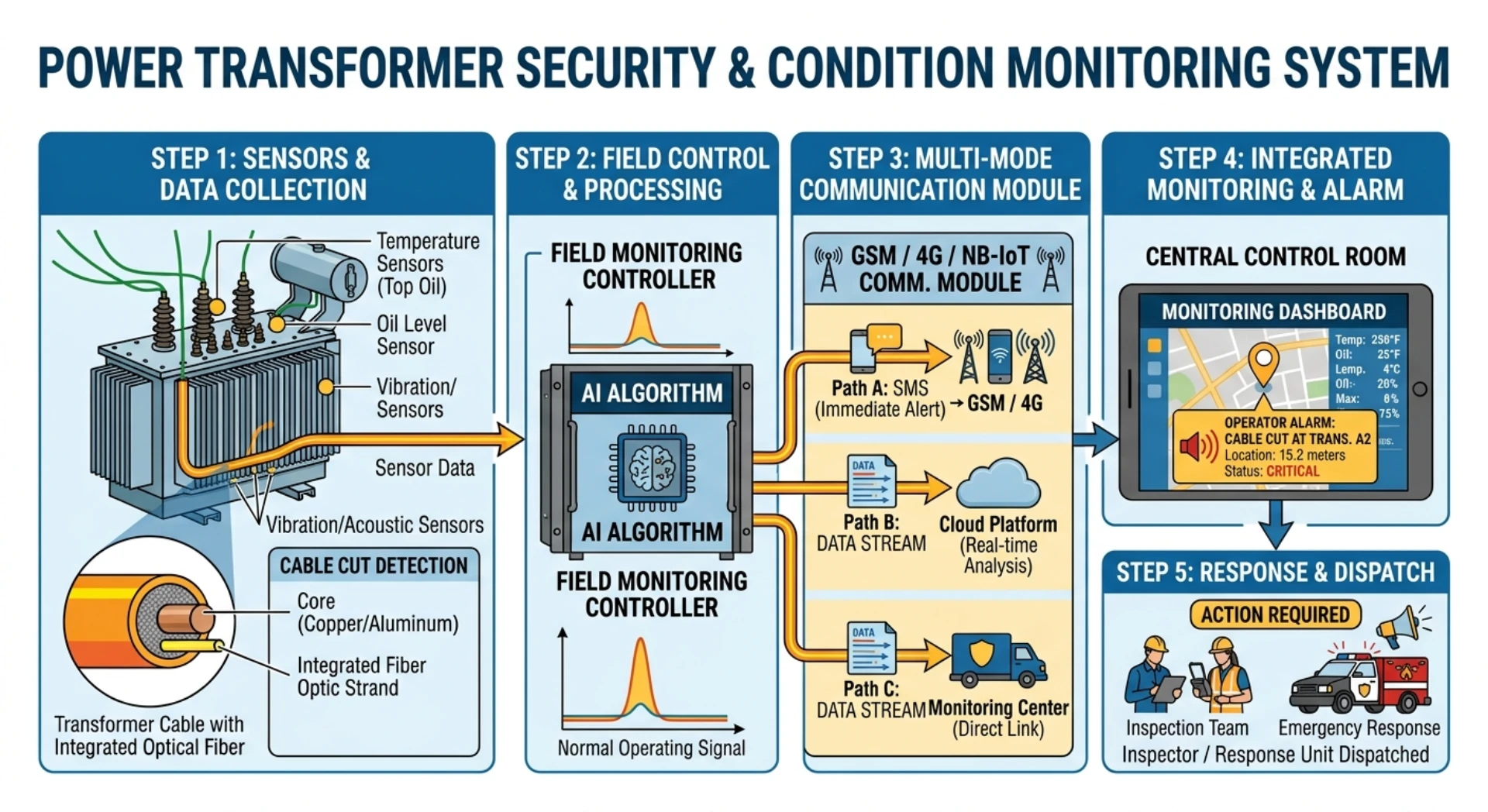
This is why communication is an important part of a remote transformer security system. Sensors detect an abnormal event at the transformer, a controller processes the signal, and a communication module sends the event to the people or platform responsible for the site.
Depending on the location and the monitoring requirements, this communication link may use GSM, 4G, or NB-IoT. The right choice depends less on which technology is newest and more on network coverage, available power, the amount of data that needs to be transmitted, and how the monitoring system will be operated.
This guide explains how transformer remote monitoring communication works, where GSM, 4G, and NB-IoT fit, and what should be checked before installing a system at an unattended transformer site.
What Is Transformer Remote Monitoring Communication?
The Role of Communication in Remote Transformer Monitoring
A remote monitoring system normally has several stages:
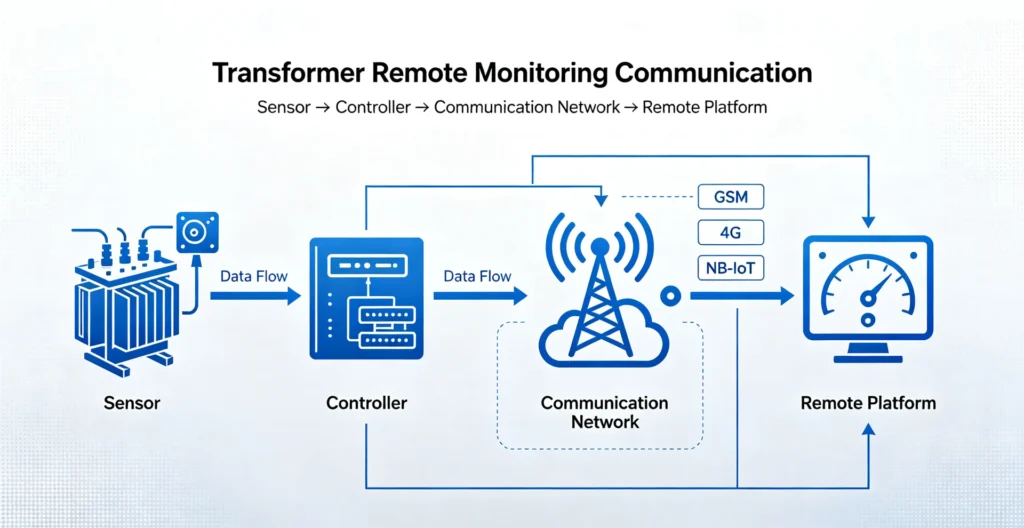
The sensors are installed at the transformer and detect events such as movement, vibration, cable interruption, tampering, or power loss. The controller receives these signals and determines whether they meet the configured alarm conditions.
The communication module then transfers the alarm from the site to a phone, cloud platform, monitoring center, or another connected system.
Without this communication link, the system can still provide a local alarm, but an operator who is not at the site has no immediate way to know that something has happened.
What Data Can Be Transmitted?
The actual data depends on the monitoring device and its sensor configuration. Typical information includes:
- Transformer tilt or movement
- Vibration events
- Cable interruption or disconnection
- Anti-theft bolt or enclosure tampering
- Power failure
- Phase loss
- Abnormal voltage
- Alarm type and event time
- Battery status
- Cellular signal strength
- Communication status
Not every installation needs all of these functions. A small rural transformer may only require theft-related alarms and power-loss detection, while a larger utility network may need several sensor inputs and remote device status.
Why Communication Matters for Unattended Transformers
Unattended transformers create a simple problem: there may be nobody nearby to see or hear an abnormal event.
This is particularly common in rural distribution networks, agricultural areas, railway corridors, solar installations, and other locations where transformers are spread over a large area.
Routine inspection still has a role, but it cannot provide continuous coverage. A communication-enabled monitoring system can report an event between inspections, giving the maintenance team a reason to investigate instead of waiting for the next scheduled visit or a customer outage report.
How Does Remote Transformer Security Monitoring Work?
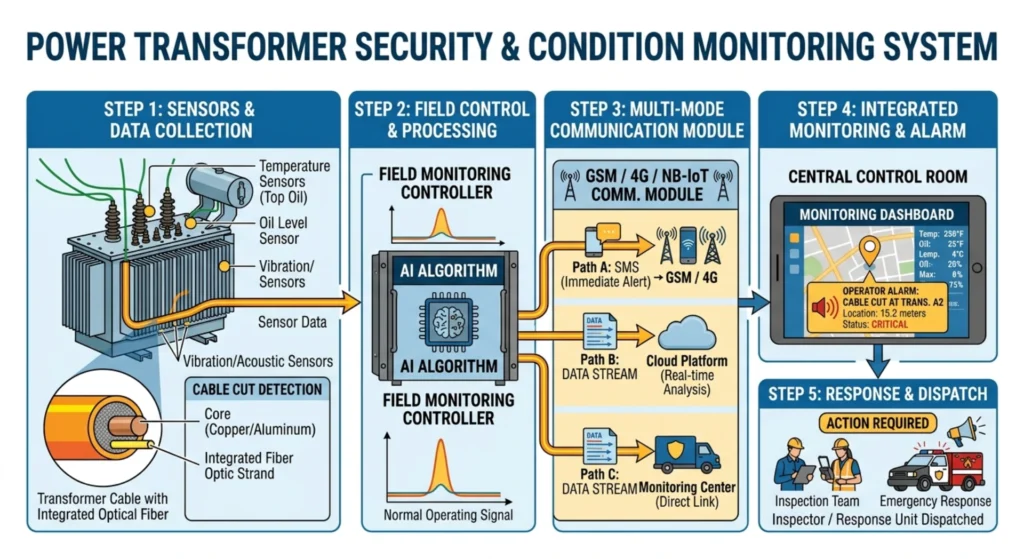
Step 1 – Sensors Detect an Abnormal Event
The sensors installed at the transformer depend on the security risks and monitoring requirements.
For example:
- Vibration sensors can detect significant mechanical disturbance.
- Tilt sensors can identify changes in the transformer’s position.
- Cable monitoring can detect an interruption or disconnection in a monitored circuit.
- Tamper sensors can detect opening, removal, or other physical interference.
- Power monitoring can identify power loss, phase loss, or abnormal electrical conditions.
A single sensor does not necessarily mean that theft has occurred. In practice, several signals may be combined to give the operator more useful information.
Step 2 – The Controller Processes the Signal
Sensor signals are sent to the monitoring controller.
The controller checks the incoming signal against configured thresholds or alarm rules. Depending on the device, it may also use a delay, confirmation period, or other logic before generating an alarm.
This is important at outdoor transformer sites because vibration, weather, maintenance work, and other normal activities can occasionally produce signals that should not be treated as security events.
Step 3 – The Communication Module Sends the Event
Once the controller determines that an alarm condition has occurred, the communication module sends the event through the available cellular network.
The destination depends on the system. It may be:
- A predefined phone number through SMS
- A cloud monitoring platform
- A mobile application
- A utility or control-room system
The information sent may include the transformer ID, alarm type, event time, and location, depending on the device.
Step 4 – The Operator Receives the Notification
The operator can then decide what action is appropriate.
For example, a vibration alarm alone may require verification, while a combination of cable interruption, power loss, and tamper signals may justify sending a field crew to inspect the transformer.
The important point is that the event reaches someone who can make that decision without waiting for a routine inspection.
GSM for Remote Transformer Monitoring
How GSM Communication Works
GSM is a cellular communication technology that has traditionally been used for voice and SMS services. In transformer security applications, one of its simplest uses is sending an SMS when an alarm occurs.
A monitoring device is fitted with a GSM module and SIM card. When the controller confirms an alarm, the device sends a predefined message to the configured phone numbers.
This approach is relatively simple and can work well when the monitoring requirement is mainly alarm notification rather than continuous data collection.
Where GSM Still Makes Sense
GSM can be a practical choice when:
- The main requirement is SMS alarm notification.
- Only a small amount of information needs to be transmitted.
- GSM coverage is available at the transformer site.
- The monitoring device already supports GSM.
- A simple communication architecture is preferred.
For a remote transformer that only needs to report events such as tampering, cable interruption, or power loss, a more advanced data connection may not provide much additional value.
Limitations of GSM
GSM should not be selected simply because it is familiar.
The main limitations are related to data capability and network availability. SMS-based monitoring is suitable for short alarm messages, but it is less appropriate when the system needs frequent sensor data, cloud communication, remote configuration, or larger data transfers.
There is also an important practical consideration: cellular networks are changing. The availability of legacy GSM service depends on the country and mobile operator. For a new project, the local operator’s network plans should therefore be checked before specifying GSM equipment.
4G Communication for Remote Transformer Monitoring
How 4G Connects a Transformer to a Monitoring Platform
4G provides an IP-based cellular connection that allows a monitoring device to communicate with a cloud server or other remote system.
Instead of sending only a short SMS, the device can transmit sensor values, event records, device status, and other information at regular intervals or when an event occurs.
This makes 4G useful when the transformer monitoring system is part of a larger remote management platform.
Advantages of 4G
4G is generally a better fit when the system requires:
- Continuous or more frequent data transmission
- Cloud-based monitoring
- Remote device configuration
- Historical event records
- Multiple sensor inputs
- Integration with other monitoring equipment
- More detailed device-status information
Another advantage is flexibility. The same cellular connection can support several monitoring functions instead of being limited to short alarm messages.
Where 4G Is a Good Fit
4G is commonly worth considering for:
- Distribution networks with multiple monitored transformers
- Remote substations
- Industrial facilities
- Mining and oilfield sites
- Solar and renewable-energy installations
- Large construction projects
- Utility monitoring systems
The deciding factor is not the industry itself. It is the amount of data, the required connectivity, and the network available at the site.
4G vs GSM for Transformer Monitoring
| Feature | GSM | 4G |
|---|---|---|
| Typical alarm method | SMS | SMS or IP-based data |
| Data capability | Limited | Higher |
| Cloud connection | Limited depending on device | Well suited |
| Device management | Basic | More flexible |
| Typical application | Simple alarm notification | Connected remote monitoring |
| Power demand | Depends on module and operating mode | Generally higher than low-power IoT options |
Actual capabilities depend on the monitoring device, SIM service, and local cellular network.
NB-IoT for Remote Transformer Security Monitoring
What Is NB-IoT?
NB-IoT, or Narrowband Internet of Things, is a cellular technology designed for low-power IoT devices.
It is intended for applications where devices send relatively small amounts of data rather than large files, video, or other bandwidth-intensive information.
That makes the technology relevant to distributed monitoring points such as transformers, meters, sensors, and other field equipment.
Why NB-IoT Can Work Well for Transformer Monitoring
A remote transformer monitoring device may spend most of its time waiting for an event and only need to send a small amount of information when something changes.
This operating pattern can suit NB-IoT.
Typical applications include:
- Periodic device-status reporting
- Battery-powered monitoring
- Alarm event transmission
- Small sensor data packets
- Large numbers of distributed monitoring points
The main attraction is low-power operation rather than high data throughput.
NB-IoT for Battery-Powered Devices
For battery-powered equipment, communication power consumption matters because the cellular module can be one of the larger loads in the system.
NB-IoT is designed with low-power IoT applications in mind, but actual battery life depends on much more than the communication standard. Sensor type, reporting interval, alarm frequency, battery capacity, temperature, signal conditions, and device design all affect the result.
For this reason, a statement such as “3–5 years of battery life” should be treated as a project-specific target rather than a universal specification. The manufacturer’s test conditions and expected operating profile should be checked.
Limitations of NB-IoT
NB-IoT is not available everywhere, and local operator support needs to be confirmed before deployment.
It is also not intended for high-bandwidth monitoring. If the application requires frequent large data transfers, extensive remote management, or other data-intensive functions, 4G may be a better choice.
GSM vs 4G vs NB-IoT for Transformer Remote Monitoring
| Feature | GSM | 4G | NB-IoT |
|---|---|---|---|
| Main role | Basic alarm communication | Data and connected monitoring | Low-power IoT communication |
| Alarm transmission | Yes | Yes | Yes |
| Data capability | Low | High | Low |
| Power demand | Moderate, device-dependent | Generally higher | Low-power oriented |
| Cloud connectivity | Depends on device | Strong | Supported for suitable platforms |
| Battery applications | Possible | Less suitable in many cases | Well suited |
| Remote monitoring | Yes | Yes | Yes |
| Best fit | Simple alarms | Richer monitoring | Low-power field devices |
A Practical Selection Rule
A simple starting point is:
Mainly SMS alarms → GSM
More data and cloud connectivity → 4G
Low-power, small-data monitoring → NB-IoT
But this should only be the first filter. Network coverage and the actual power budget need to be checked before making the final selection.
What Communication Method Should You Choose for a Remote Transformer?
1. Check Cellular Coverage First
The communication technology is only useful if it works at the transformer site.
Do not rely entirely on a general coverage map, especially for transformers located in valleys, remote farmland, mountainous areas, or behind large structures.
For important projects, check the actual signal conditions at representative installation sites.
2. Look at the Available Power
Power availability can change the communication choice considerably.
A transformer site with reliable auxiliary power has fewer restrictions than a standalone monitoring device powered by a small battery.
Typical considerations include:
- Reliable AC power: 4G becomes easier to use.
- Battery-powered equipment: Low-power communication becomes more important.
- Solar-powered monitoring: NB-IoT can be considered where network coverage is suitable.
The complete power budget should include the controller, sensors, communication module, and standby consumption.
3. Estimate the Data Requirement
Not every monitoring system needs continuous data transmission.
For example:
- A few security alarms per month may only require a small amount of data.
- Periodic sensor readings require more regular communication.
- A system with several sensors, historical records, and cloud management may benefit from 4G.
Choosing the communication method based only on the number of sensors can therefore be misleading. The communication pattern matters as well.
4. Consider Remote Management
If operators need to change parameters, check device status, retrieve historical events, or update equipment remotely, an IP-based connection such as 4G may be more practical.
A simple SMS device may be enough when the only requirement is to notify a few people of an alarm.
5. Plan for Communication Failures
Cellular communication can be interrupted by weak signal, network outages, SIM problems, power failures, or equipment faults.
A suitable system should therefore provide some indication of communication failure where possible. For critical installations, consider whether a backup communication path is justified.
The important thing is to distinguish “no alarm occurred” from “the monitoring device could not communicate.”
What Happens When Cellular Communication Is Lost?
Local Alarm Can Continue to Operate
Loss of cellular communication does not necessarily mean that the local monitoring functions stop working.
If the system has an independent local alarm output, the siren or warning light can continue to operate when an alarm condition is detected.
Backup Power Can Keep the Monitoring Device Running
Where backup power is provided, the controller and sensors may continue operating during an AC power failure.
The exact operating time depends on the battery capacity and the power consumption of the complete system.
Event Storage and Retransmission
Some monitoring devices can store events locally when communication is unavailable and send them after the connection returns.
This is useful for applications where losing the communication link for several minutes or hours should not result in a permanent loss of event records.
However, this is a device-level function rather than an automatic feature of GSM, 4G, or NB-IoT. It should be confirmed in the equipment specification.
Remote Transformer Security Monitoring vs Traditional Inspection
| Traditional Inspection | Remote Monitoring |
|---|---|
| Manual inspection | Automatic event detection |
| Periodic checks | Continuous monitoring |
| Requires a field visit | Alarm can be received remotely |
| Difficult to scale across remote sites | Better suited to distributed assets |
| Problems may be discovered later | Abnormal events can be reported when detected |
Why Remote Monitoring Helps Unattended Transformers
Routine inspection remains necessary. Remote monitoring does not replace field maintenance or physical inspection.
Its value is that it fills the gap between inspections.
If a transformer is checked once every few weeks, a theft attempt occurring the day after an inspection may remain unnoticed until the next visit or until an outage is reported. A connected monitoring device can report the event when it is detected.
Communication and Response Time
A typical sequence without remote communication may look like this:
Tampering → damage occurs → outage or other problem is noticed → operator is informed → field crew is dispatched → site is inspected
With remote monitoring:
Tampering → sensor detects an event → controller confirms the alarm → communication sends the event → operator reviews the alarm → field crew is dispatched if necessary
The actual response time depends on network conditions, alarm configuration, operator procedures, and the distance to the site. The main benefit is that the operator does not have to wait for someone to discover the problem locally.
What Can GSM, 4G and NB-IoT Monitor?
The communication technology itself does not determine what is being monitored. The sensors and controller determine that. GSM, 4G, or NB-IoT simply provides the path for sending the resulting information.
Transformer Theft and Tampering
Vibration, tilt, cable, and tamper sensors can generate security events. The communication module transfers those events to the designated operator or monitoring platform.
Transformer Tilt and Movement
A tilt sensor can report a change in the transformer’s position.
For more information, see our article on transformer tilt detection.
Transformer Vibration
Vibration sensors can be used to identify significant mechanical disturbance around the transformer.
For more information, see our article on transformer vibration monitoring.
Cable Cutting and Disconnection
Cable monitoring can report an interruption in a monitored cable or circuit.
For more information, see our article on transformer cable cutting detection.
Power Loss and Electrical Abnormalities
Power monitoring can report events such as loss of supply, phase loss, or abnormal voltage.
This information can also help operators distinguish between different types of field events, although the final cause normally needs to be verified.
How Remote Transformer Monitoring Sends Security Alarms
SMS Alarm
SMS is still useful when the monitoring requirement is simple.
A device can send a predefined message to one or more phone numbers when an alarm occurs. Depending on the system, the message may contain the transformer ID, alarm type, time, and location.
The advantage is simplicity. No dedicated monitoring application is required for the recipient to receive the basic alert.
Cloud-Based Monitoring
A cloud platform becomes more useful when a utility or service company has many transformers to manage.
Instead of receiving separate messages from individual sites, operators can view multiple assets from one interface and review alarm history, device status, and other available data.
Mobile Notifications
Mobile applications can provide richer information than a conventional SMS, particularly when the system includes several types of alarms and device-status information.
Local Audible Alarm
Remote communication does not have to replace the local alarm.
A transformer anti-theft monitoring system can use both. A siren or warning light provides local deterrence, while GSM, 4G, or NB-IoT sends the event to a remote operator.
This combination is often more useful than relying on either method alone.
Applications of GSM, 4G and NB-IoT Transformer Monitoring
Rural and Agricultural Distribution Transformers
Rural transformers are often separated by considerable distances, making frequent manual inspection expensive.
For simple alarm reporting, GSM may be sufficient where legacy network service remains available. NB-IoT can be considered for low-power devices where the local operator supports it.
Mining and Oilfield Sites
These sites can contain widely distributed electrical equipment and may require more detailed remote information.
Where suitable cellular coverage exists, 4G can provide a practical connection between field monitoring equipment and a central platform.
Construction Sites
Construction sites change over time, and monitoring equipment may need to be installed or moved quickly.
GSM or 4G can be used depending on the required data and the available network.
Municipal Distribution Networks
Utilities managing many distribution transformers may benefit from centralized monitoring rather than relying entirely on individual SMS messages.
A 4G-connected system can provide a foundation for cloud-based asset and alarm management where the network and infrastructure support it.
Unattended Substations
Remote substations may have limited staffing and require alarms to reach a control center or maintenance team without relying on local personnel.
A transformer monitoring communication system can provide this connection as part of a broader remote monitoring arrangement.
Railway and PV Facilities
Railway power systems and large PV sites often cover long distances or wide areas. Remote communication allows field devices to report abnormal conditions without requiring continuous physical inspection.
How to Deploy a Transformer Remote Monitoring Communication System
Deployment should start with the transformer site, not with the communication technology.
Before choosing a GSM, 4G, or NB-IoT device, determine what needs to be monitored, how the equipment will be powered, what cellular services are available, and how alarms will be handled.
1. Assess the Transformer Site
Check:
- Cellular coverage
- Available power supply
- Transformer type and mounting arrangement
- Outdoor environmental conditions
- Distance from the maintenance team
- Theft and unauthorized-access risks
- Existing SCADA or monitoring infrastructure
For remote sites, an actual signal test is preferable to relying only on a coverage map.
2. Choose the Communication Method
Once the site conditions are known, compare the available communication options.
GSM may be enough for straightforward SMS alarms. 4G is generally more appropriate when the device needs an IP connection, cloud access, or more frequent data transmission. NB-IoT is worth considering for low-power, small-data applications where the local cellular operator supports the technology.
Also check SIM availability, network bands, roaming requirements, and the expected service life of the equipment.
3. Install and Connect the Sensors
Install only the sensors needed for the monitoring objective.
A typical transformer security system may include:
- Vibration sensors
- Tilt sensors
- Cable-cut detection
- Tamper sensors
- Power monitoring
- Auxiliary inputs
The controller collects the sensor signals and applies the configured alarm logic.
Installation quality matters here. A poorly mounted vibration or tilt sensor can produce unstable readings, while incorrect cable monitoring connections can result in missed or false alarms.
4. Configure the Monitoring Controller
The communication and alarm parameters normally include:
- SIM card and APN settings where required
- SMS recipient numbers
- Cloud server or platform settings
- Sensor thresholds
- Alarm delays or confirmation settings
- Transformer identification
- Location information
Avoid copying exactly the same thresholds to every transformer. Site conditions and installation methods can vary considerably.
5. Test Alarm Transmission
Before leaving the transformer unattended, test the complete alarm path.
For each installed function, verify that:
- The sensor detects the intended event.
- The controller identifies the correct alarm.
- The communication module sends the event.
- SMS or cloud notifications are received.
- Transformer identification is correct.
- Location information is correct.
- Local alarms operate where installed.
A controlled test during commissioning is much easier than troubleshooting a communication problem after the equipment has been put into service.
6. Commission the Remote Monitoring System
The final check should cover the complete chain from sensor to operator.
Confirm that normal sensor data is received, alarm messages arrive correctly, communication remains stable, and the responsible personnel know how to respond to each type of event.
It is worth defining this response process before the system goes live. For example, a vibration alarm may require confirmation, while a combination of tamper and cable interruption may require immediate field inspection.
Once the system has passed these checks, the transformer can be placed into normal remote monitoring.
How to Choose a Transformer Remote Monitoring Device
Communication Options
Check whether the device supports GSM, 4G, or NB-IoT and whether its supported cellular bands match the network available at the installation site.
Sensor Inputs
Check the number and type of inputs.
If the project requires tilt, vibration, cable monitoring, tamper detection, and power monitoring, make sure the controller can accommodate the required sensors without relying on unsupported interfaces.
Alarm Methods
Look for the alarm channels actually required by the project:
- SMS
- Cloud platform
- Mobile notification
- Local siren
- Warning light
- Other system interfaces
Using more than one notification path can be useful for critical sites.
Power Supply and Battery Backup
Check whether the device uses AC power, an external battery, solar power, or a combination.
For battery-powered equipment, ask for the expected battery life under a defined operating profile rather than relying on a generic number. Alarm frequency, reporting interval, signal strength, temperature, and sensor consumption can all change the result.
Environmental Protection
For outdoor transformer installations, check:
- IP protection rating
- Operating temperature
- Humidity resistance
- UV exposure
- Corrosion resistance
- Surge and lightning protection where applicable
Communication and Platform Compatibility
If the project already uses a SCADA system or cloud platform, confirm the communication protocol and integration method before purchasing the monitoring device.
Compatibility at the beginning of the project can save considerable integration work later.
Remote Transformer Monitoring Device Checklist
| Requirement | What to Check |
|---|---|
| Communication | GSM / 4G / NB-IoT |
| Network | Local coverage and supported bands |
| Alarm | SMS / cloud / local alarm |
| Sensors | Tilt / vibration / cable / tamper |
| Power | AC / battery / solar |
| Protection | IP rating |
| Environment | Operating temperature and humidity |
| Installation | Pole / cabinet / outdoor installation |
| Management | Local and/or remote configuration |
| Integration | Cloud / SCADA / other interfaces |
GSM, 4G and NB-IoT Transformer Monitoring FAQ
What is transformer remote monitoring communication?
Transformer remote monitoring communication is the connection between monitoring equipment installed at the transformer and the people or systems receiving the information. It allows alarms and selected operating data to be sent from an unattended transformer to a remote location.
Which communication method is best for remote transformer monitoring?
There is no universal answer.
GSM can work well for simple SMS alarms, 4G is generally better when more data and cloud connectivity are required, and NB-IoT is suited to low-power applications that transmit relatively small amounts of data.
The local cellular network and power supply should be checked before making the final choice.
Can GSM send transformer theft alarms by SMS?
Yes. A GSM-enabled monitoring device can send SMS notifications when its controller detects a configured alarm condition.
The exact message content depends on the device.
Is 4G better than GSM for transformer monitoring?
4G is generally the better option when the system needs cloud connectivity, more frequent data transmission, or remote device management.
If the requirement is simply to send an occasional SMS alarm, GSM may still be sufficient where the local network supports it.
Is NB-IoT suitable for battery-powered transformer monitoring?
It can be. NB-IoT is designed for low-power IoT applications and can be a good match for battery-powered monitoring devices transmitting small amounts of data.
Actual battery life depends on the complete device and operating conditions, so project-specific test data should be checked.
Does remote transformer monitoring require Wi-Fi?
No.
Most remote transformer monitoring systems use cellular communication because Wi-Fi coverage is generally unavailable at isolated transformer sites.
GSM, 4G, and NB-IoT are possible options depending on local network availability and system requirements.
What happens if the cellular network is unavailable?
The result depends on the monitoring device.
Local alarm functions may continue operating, and devices with backup power can continue monitoring during a power interruption. Some systems can also store events and retransmit them after communication is restored.
These functions should be confirmed in the device specification rather than assumed.
Can a transformer monitoring device send alarms to multiple phone numbers?
Many monitoring devices support multiple SMS recipients, although the number of recipients and notification methods depend on the specific device.
Choosing the Right Communication Link for Remote Transformers
Communication is only one part of a transformer security monitoring system, but it is the part that connects an unattended site with the people responsible for it.
GSM, 4G, and NB-IoT can all be useful. The right choice depends on the cellular service available at the site, power conditions, the amount of data being transmitted, and whether the system needs cloud connectivity or remote management.
For a basic transformer security application, SMS may be all that is required. For larger networks with multiple sensors and centralized monitoring, a 4G connection may provide more flexibility. Where low power consumption and small data volumes are the priority, NB-IoT may be worth considering if the local network supports it.
For an integrated solution combining transformer security sensors with remote communication, see our Transformer Anti-Theft Monitoring Device.