Leave your message

-
Leon Zhang sales consultant
-
Email: zxl635973785@gmail.com
-
Phone/WhatsApp/Wechat: +86 13655813266

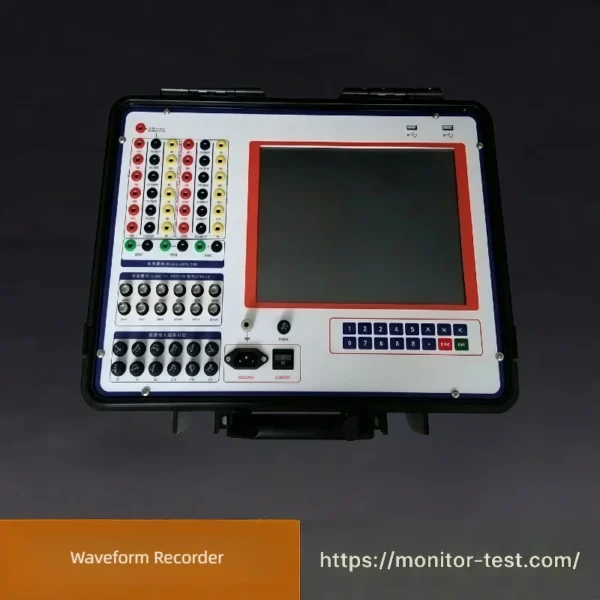
HF-PQ-T202 Waveform Recorder
The Waveform Recorder captures transient voltage and current waveforms during power system faults. It records complete fault data to support relay protection testing, fault diagnosis and post-failure analysis for substations.
Send your requirements, we will quote for you within 12 hours
HF-PQ-T202 Portable Waveform Recorder & Analyzer is a transient signal recording instrument. Pre-installed generator test templates enable users to conveniently conduct generator short-circuit characteristic test, no-load characteristic test, excitation system disturbance test, 10% step excitation test, de-excitation time constant measurement, self-synchronizer calibration, unit load recording and other experiments.
Abundant software modules support graphic analysis, combined operation, RMS calculation, AC power calculation, three-phase symmetry analysis, spectrum analysis, harmonic analysis, curve correlation analysis, graphic editing and phasor diagram plotting. Test data and results can be exported as WORD/EXCEL reports or JPG images for further analysis.
Main Test Items & Functions
- Real-time drawing of test curves with zoom and positioning functions
- Graph editing: free marking, color adjustment to facilitate report compilation
- Spectrum analysis tool to obtain signal spectrum graphics
- Draw correlation curves with arbitrary signals selected as X-axis and Y-axis
- Harmonic analysis, supporting up to the 1024th harmonic
- Arithmetic operations (addition, subtraction, multiplication, division, integration) on collected signals
- Calculate RMS value and power of selected channel signals
- Power and symmetry analysis for selected three-phase signals
- Plot phasor diagrams of selected signals
- Select signal type via software: instantaneous DC value or AC RMS value
- Built-in standard templates for generator three-phase short-circuit, no-load curve, excitation disturbance, de-excitation time constant, frequency voltage characteristic, load test and self-synchronization test; software automatically calculates test parameters
- Auto-generate WORD and Excel test reports
- Automatic curve marking on reports to realize automated report production
- Redefine names and units for all sampling channels
- Auto-save test environment and instrument configuration
- Automatic calculation of test parameters for each template
- Simple channel filtering function
- Export test data via USB flash drive or mobile hard disk
- Windows XPE operating system with built-in self-protection and recovery against virus attacks
- Anti-shake processing to avoid misoperation
Technical Parameters
| Category | Specification Details |
|---|---|
| Analog Acquisition Channels | 12 channels of low voltage/current sampling Voltage range: -10V~10V, -200V~200V, -400V~400V Current range: -20mA~20mA |
| Signal Type Selection | Voltage/current type configurable via software |
| Measurement Accuracy | -400V~400V: Error<0.5V -200V~200V: Error<0.2V -10V~10V: Error<0.01V -20mA~20mA: Error<0.02mA |
| Digital Input Channels | 5 channels of passive contact switch measurement |
| Structure | Split cabinet design for convenient test control and data analysis |
| Interface | 2×USB ports for data download, keyboard and mouse connection |
| Display | 12.1-inch large color touch screen for human-machine interaction |
| Storage | Built-in 8G storage space |
| Input Impedance | -10V~10V range: >10MΩ -200V~200V range: 820KΩ -400V~400V range: 820KΩ -20mA~20mA range: 200Ω |
| Power Supply | AC220V, 50Hz ±10% |
| Power Consumption | <90W |
| Weight | <15KG |
FAQ for Waveform Recorder
Q1: What is the Waveform Recorder mainly used for?
A: It is designed for generator commissioning and power transient testing. It records voltage/current waveforms to complete generator no-load, short-circuit, excitation disturbance, de-excitation and self-synchronization tests.
Q2: How many analog acquisition channels does the device have?
A: It is equipped with 12 low voltage/current analog sampling channels plus 5 passive digital contact channels, meeting multi-signal synchronous recording requirements.
Q3: What signal input ranges are supported?
A: Voltage ranges: -10V~10V, -200V~200V, -400V~400V; Current range: -20mA~20mA. Signal types can be selected via software.
Q4: What analysis functions are built in the software system?
A: It supports spectrum analysis, harmonic analysis (up to 1024th harmonic), RMS calculation, three-phase symmetry analysis, phasor plotting, signal arithmetic operations and curve correlation analysis.
Q5: Can the instrument automatically generate test reports?
A: Yes. It can auto-generate WORD and Excel test reports with automatic curve marking. Data can also be exported as JPG images or saved to USB storage devices.
Q6: Is there dedicated test template for generator tests?
A: Standard templates are pre-installed: generator short-circuit test, no-load characteristic test, excitation disturbance test, de-excitation time constant test, load test and self-synchronization test. The software automatically calculates test parameters.
Q7: What kind of display does it adopt?
A: 12.1-inch color touch screen, intuitive human-machine operation, convenient for on-site commissioning personnel.
Q8: What operating system is used? Is it vulnerable to viruses?
A: Adopts Windows XPE system with self-protection and recovery mechanism to prevent virus intrusion and system corruption.
Q9: How to export recorded test data?
A: Two USB ports are reserved. Users can export data via USB flash drive or portable hard disk for offline analysis on PC.
Q10: What are the power requirements and weight?
A: Power supply: AC220V, 50Hz ±10%; power consumption less than 90W; weight less than 15kg.
Q11: Can I redefine channel names and units?
A: All sampling channels support custom naming and unit modification. Test environment settings can be automatically saved.
Q12: Is it suitable for fault waveform recording of protection relay commissioning?
A: Yes. Synchronous multi-channel waveform recording helps observe transient signals, analyze relay operation logic and verify protection performance.
Reviews
There are no reviews yet.