Leave your message

-
Leon Zhang sales consultant
-
Email: zxl635973785@gmail.com
-
Phone/WhatsApp/Wechat: +86 13655813266

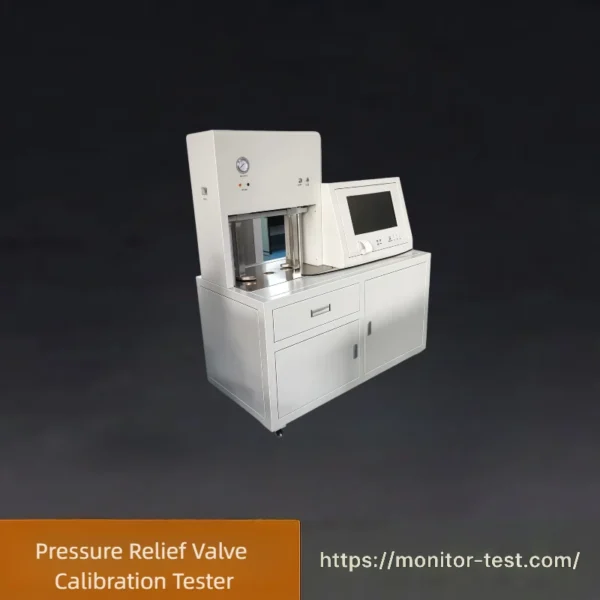
HF-TC-610 Pressure Relief Valve Calibration Tester
This wheeled PRV calibration bench complies with JB standards, adopting air medium to automatically complete opening pressure, closing pressure and sealing tests. It supports data curve recording and multiple safety protections for transformer valve regular calibration work.
Send your requirements, we will quote for you within 12 hours
The pressure relief valve serves as the pressure protection component and a critical tank safeguard for oil-immersed transformers. A faulty pressure relief valve that fails to open reliably may rupture the transformer tank and conservator; if it cannot seal tightly after opening, transformer oil leakage will occur, triggering equipment shutdown or severe safety incidents.
The operational reliability of pressure relief valves is critical to the safe operation of transformers.
This calibration device complies with industrial standards JB7065-2015 Pressure Relief Valves for Transformers and JB/T7069-2004 Test Guidelines for Pressure Relief Valves for Transformers issued by the Ministry of Machinery Industry.
Test items include visual inspection, aging opening pressure test, nominal opening pressure test, closing pressure test, sealing pressure test and sealing performance test. Designed for calibrating pressure relief valves mounted on oil-immersed power equipment, the equipment simulates the actuation principle of valves under internal transformer faults and uses compressed air to measure the opening and closing pressure values of relief valves.
Features & Core Functions
- Pressure acquisition: Real-time automatic dynamic pressure sampling
- Clamping structure: Electric compression clamping mechanism
- Calibration correction: Equipped with independent metering transmission and correction interfaces to support on-site full-machine calibration by third parties without equipment disassembly
- Universal calibration compatibility: Supports calibration for pressure relief valves of special structures and various calibers
- Actuation characteristic test: Captures real opening and closing pressure via continuous pressure acquisition to realize contact-free measurement
- Sealing performance test: Users can freely set test pressure and holding time; the system executes sealing tests automatically
- High automation: One-time workpiece clamping enables automatic full testing including aging opening pressure (with dedicated parameter window), nominal opening pressure, closing pressure, sealing performance and signal contact inspection
- Comprehensive safety protection: Integrated multi-layer safety mechanisms including overpressure protection, delay protection and overpressure lockout protection
- Overpressure protection: Prevents equipment damage caused by excessive test pressure
- Delay protection: Eliminates personal injury risks to operators during calibration cycles
- Overpressure lockout protection: Blocks misoperation-induced safety hazards for field staff
- Wide applicable range: Compatible with all domestic and imported pressure relief valve models for calibration
Technical Specifications
| Item | Parameter |
|---|---|
| Ambient operating temperature | -10℃ ~ +40℃ |
| Main unit power supply | AC 220±10% V, 50±1 Hz |
| Air compressor power supply | AC 220±10% V, 50±1 Hz |
| Main unit power consumption | 400 W |
| Air compressor rated power | 5500 W |
| Pressure measurement range | 0 ~ 400 kPa |
| Pressure display resolution | 0.1 kPa |
| Sealing test pressure range | 10 ~ 150 kPa |
| Adjustable sealing holding time | 5 ~ 180 min |
| Pressure boosting rate | 25 ~ 40 kPa/s |
| Applicable valve caliber | Φ25 mm ~ Φ130 mm |
| Overall measurement accuracy class | Class 0.5 |
| Air storage tank working strength | 0.8 MPa |
| Test medium | Dry compressed air |
| Data storage capacity | Unlimited storage for batches of calibration records |
| Software function | Synchronous real-time plotting of opening & closing pressure-time curves |
| Control mode | Microcomputer measurement & control system |
| Display configuration | 19-inch true-color LCD screen |
| Main unit dimension | 1400 × 700 × 1550 mm |
| Main unit weight | ≤ 150 kg |
| Equipment form | Wheeled bench-mounted structure (non-portable) |
| Overall outline dimension | Length ≤1400 mm, Width ≤700 mm, easy for elevator transportation and laboratory deployment |
Simplified Operation Steps for PRV Calibration Device
- Before testing, check the power supply, air compressor, air pipeline and safety protection functions to ensure the equipment is in normal working condition. Keep the test environment clean and within standard temperature range.
- Clean the surface of the pressure relief valve, select a suitable sealing gasket according to the valve diameter, and place the valve on the fixture. Use the electric clamping function to fix the valve tightly to avoid air leakage.
- Turn on the main unit system, enter the test interface, and set standard parameters including pressurization speed, sealing test pressure and holding time. Enable overpressure and delay protection functions.
- Start the automatic test. The equipment automatically completes aging opening pressure test, actual opening pressure test, closing pressure test and sealing performance test, and records real-time pressure curves.
- After the test is finished, check the test data and curves, save the records or export calibration reports through the system.
- Release the internal air pressure, loosen the clamping mechanism and remove the tested valve. Finally shut down the host and air compressor, and tidy up the equipment.
FAQ for Pressure Relief Valve (PRV) Calibration Tester
Q1: What national standards does this calibration tester comply with?
A: It strictly follows JB7065-2015 and JB/T7069-2004, supporting full testing items including opening pressure, closing pressure and sealing performance of transformer PRVs.
Q2: What range of PRV calibers can this device calibrate?
A: Applicable caliber covers Φ25 mm to Φ130 mm, compatible with most domestic and imported transformer pressure relief valves on the market.
Q3: Why adopt compressed air as the test medium instead of transformer oil?
A: Air brings cleaner operation, no oil contamination or residual liquid cleaning work. It can accurately simulate the actual pressure surge state inside faulty transformers with low testing costs.
Q4: Is third-party field calibration available for this equipment?
A: Yes. Independent metering transmission and correction interfaces are reserved, allowing third-party metering verification without disassembling the whole machine on site.
Q5: What safety protection mechanisms does the tester have?
A: Equipped with three safety locks: overpressure protection, delay protection and overpressure forbidden startup protection to prevent equipment damage and operator personal injury during testing.
Q6: Can the machine automatically finish all test items after one clamping?
A: One-time clamping realizes automatic measurement of aging opening pressure, opening pressure, closing pressure, sealing property and signal contact check, with a dedicated parameter window for aging pressure setting.
Q7: Can test data and pressure curves be exported?
A: The machine supports unlimited local data storage. The software synchronously displays pressure-time curves, and users can export data via USB to generate formal calibration reports.
Q8: What are the requirements for the supporting air compressor?
A: Matched air compressor power is 5500 W with the air tank rated strength of 0.8 MPa, matching the device’s 0~400 kPa full pressure test range.
Q9: Is this calibration bench portable for outdoor field tests?
A: It is a wheeled desktop integrated device, easy to move into laboratories via elevators, but not designed as lightweight portable equipment for field live-line maintenance.
Q10: How to handle air leakage at the clamping position during testing?
A: Clean the sealing surface of PRV and gaskets completely, replace aging gaskets, and reactivate the electric clamping structure to ensure tight fitting between contact surfaces.
Reviews
There are no reviews yet.