Leave your message

-
Leon Zhang sales consultant
-
Email: zxl635973785@gmail.com
-
Phone/WhatsApp/Wechat: +86 13655813266

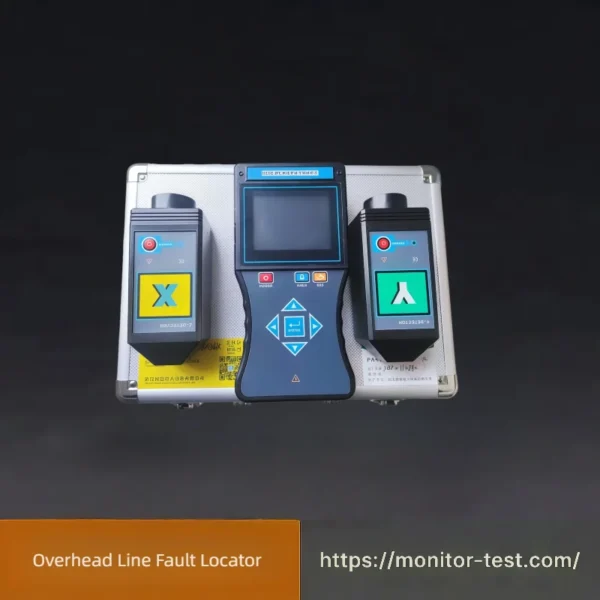
HF-CH-206 Overhead Line Fault Locator
This portable Overhead Line Fault Locator rapidly locates grounding, short-circuit and break faults on overhead power transmission lines. Featuring high testing accuracy, anti-interference performance and long battery life, it greatly improves efficiency for daily power grid inspection and fault troubleshooting work.
Send your requirements, we will quote for you within 12 hours
The Overhead Line Fault Locator is dedicated to troubleshooting faults on 6–35kV overhead power lines. It integrates fault diagnosis, AC positioning, DC positioning and DC withstand voltage testing to handle various faults including grounding, short-circuit and arc grounding defects. The innovative AC mode enables detection without pole climbing; with complete safety protections and built-in lithium batteries, the lightweight whole set delivers efficient, convenient field fault location for power grid maintenance.
Product Features
The Overhead Line Fault Locator is designed for fault location on 6–35 kV overhead lines. It can identify various faults including low-resistance faults, high-resistance faults, arc grounding faults and phase-to-phase short-circuit faults.
It delivers a full set of complete overhead line fault locating solutions, integrating four core functions: fault diagnosis, AC positioning, DC positioning and DC withstand voltage testing.
Equipped with an innovative AC positioning mode, it detects characteristic signals directly underneath power lines without climbing poles to mount sensors. The device boasts simple and user-friendly operation. Its transmitter is built with a large-capacity lithium battery for convenient field use and easy portability.
The complete system consists mainly of a transmitter, a receiver, an AC sensor, a wireless DC sensor, an arc grounding adapter and assorted accessories.
Features & Main Functions
-
Application: Fault searching and positioning for 6–35kV overhead power lines
-
Integrates four functions: fault diagnosis, AC positioning, DC positioning and DC withstand voltage test.
-
Fault Diagnosis
- Recommends the optimal positioning method accordingly.
- Measures insulation resistance and capacitance of power lines.
- AC Positioning (For outage lines with low transition resistance earth faults)
- Signal transmission: Actively inject high-power special low-frequency AC signals.
- Signal reception: Sectional detection along the line; no need to climb poles for sensor installation.
- High efficiency: Pole climbing is eliminated, greatly improving testing efficiency and reducing labor intensity.
- DC Positioning (For outage lines, applicable to high/low transition resistance earth faults & arc grounding faults)
- Signal transmission: Actively inject high-power pulsed DC signals.
- Signal reception: Sectional inspection along the line; pole climbing is required to attach sensors.
- Universal positioning mode, especially effective for challenging arc grounding fault location.
-
DC Withstand Voltage TestAcceptance inspection after fault maintenance and repair.
-
The transmitter is equipped with automatic discharge function upon shutdown to guarantee operational safety.
-
Built-in overcurrent protection and overtemperature protection for the transmitter.
-
Large-capacity built-in lithium battery pack inside the transmitter for easy portability.
-
The receiver adopts fully digital high-sensitivity signal processing, delivering clear and intuitive fault judgment results.
-
Data storage function ensures saved data will not be lost after power-off, facilitating accurate fault pinpointing.
Packing List:Overhead Line Fault Locator
| No. | Item Name | Quantity | Unit | Notes |
|---|---|---|---|---|
| 1 | Signal Transmitter | 1 | Set | Built-in lithium battery, with automatic discharge, overcurrent & overtemperature protection |
| 2 | Handheld Signal Receiver | 1 | Set | Full digital high-sensitivity signal processing, data memory function |
| 3 | AC Induction Sensor | 1 | Pc | For AC overhead line fault detection |
| 4 | Wireless DC Sensor | 1 | Pc | Used together with DC positioning mode |
| 5 | Arc Grounding Adapter | 1 | Pc | Special accessory for arc grounding fault locating |
| 6 | Power Charger | 1 | Pc | For transmitter battery charging |
| 7 | Connecting Cables & Test Wires | 1 | Set | All matched connecting wires |
| 8 | English User Operation Manual | 1 | Copy | Detailed operation instructions |
| 9 | Factory Calibration Certificate | 1 | Copy | For overseas project acceptance |
| 10 | Product Quality Certificate & Warranty Card | 1 | Copy | After-sales service voucher |
| 11 | Shockproof Portable Hard Carrying Case | 1 | Pc | Storage and transportation use |
FAQ – Overhead Line Fault Locator
Q1: What voltage range of power lines is this locator suitable for?
A: It is specially designed for fault location on 6kV to 35kV overhead distribution lines, widely used in urban and rural power grid overhead lines.
Q2: What kinds of line faults can this device detect?
A: It can locate low-resistance grounding faults, high-resistance grounding faults, arc grounding faults and phase-to-phase short-circuit faults on overhead lines comprehensively.
Q3: What four core functions does the complete machine integrate?
A: Fault diagnosis, AC positioning, DC positioning and DC withstand voltage test. It covers the whole process from fault judgment to post-repair acceptance.
Q4: What is the biggest advantage of the AC positioning mode?
A: You can detect fault signals directly under the lines. No need to climb utility poles to install sensors, which saves plenty of time and reduces working risks greatly.
Q5: When should we use DC positioning mode?
A: It applies to high/low transition resistance grounding faults and difficult arc grounding faults. Sensors need to be hung on the line poles during testing.
Q6: What is the purpose of DC withstand voltage function?
A: It is used for acceptance testing after faults are fully repaired, to verify the overall insulation performance of overhead lines.
Q7: What safety protections are equipped on the transmitter?
A: It supports automatic discharge after shutdown, together with overcurrent protection and overtemperature protection, to ensure safe field operation.
Q8: Does the receiver have a data storage function?
A: Yes. It can store test data, and data will not be lost after power failure, making repeated checking and fault pinpointing more convenient.
Q9: What power supply does the transmitter adopt?
A: Built-in large-capacity lithium battery pack, lightweight and easy to carry for long-time outdoor field work.
Q10: What components does the full set consist of?
A: Transmitter, handheld receiver, AC sensor, wireless DC sensor, arc grounding adapter, charging adapter, connecting wires, manual, calibration certificate and shockproof carrying case.
Reviews
There are no reviews yet.