Leave your message

-
Leon Zhang sales consultant
-
Email: zxl635973785@gmail.com
-
Phone/WhatsApp/Wechat: +86 13655813266

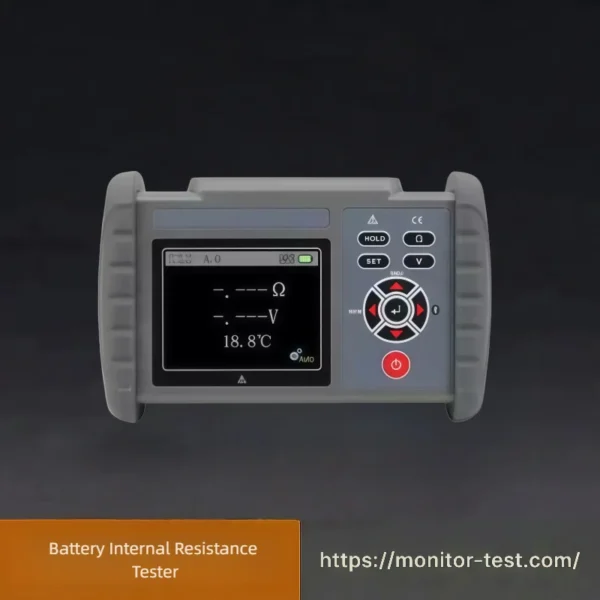
HF-BT-402 Portable Battery Internal Resistance Tester
Battery Internal Resistance Tester rapidly tests internal resistance and voltage of single cells and battery packs. It evaluates battery health status, identifies faulty batteries, and supports regular maintenance of UPS, power stations and energy storage systems.
Send your requirements, we will quote for you within 12 hours
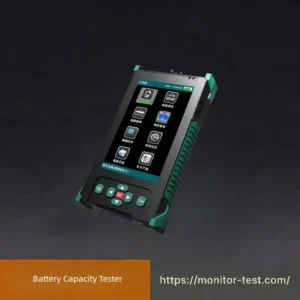
Portable Battery Internal Resistance Tester is lightweight and handheld equipment designed to test single cell voltage, battery string voltage, internal resistance and connection resistance. It supports automatic testing, data storage, Wi-Fi transmission and battery capacity estimation, widely used for maintenance of lead-acid and lithium battery packs in power stations, UPS and energy storage systems.
Main Unit Components
① USB Port: Used to export test data via USB flash drive or complete program update;
② Test Port: For connection with test clamps;
③ Charging Port: Connect to the device charger;
④ LCD: 4.3-inch color liquid crystal display with 480*272 resolution.
② Test Port: For connection with test clamps;
③ Charging Port: Connect to the device charger;
④ LCD: 4.3-inch color liquid crystal display with 480*272 resolution.
Main Functions & Features
① Tests storage battery voltage, internal resistance and connection resistance;
② Can be used as a voltmeter to measure single cell battery voltage;
③ Built-in reference table of battery internal resistance for customer reference and analysis;
④ Supports capacity estimation of storage batteries;
⑤ Equipped with reverse connection protection and high voltage protection for batteries;
⑥ Buzzer alarm and on-screen text prompts for judgment results or faults;
⑦ Stores data by battery string, easy for users to check data of each battery inside the string;
⑧ Automatic test under battery string mode: the tester starts testing automatically once batteries are detected;
⑨ Supports Chinese input of station name, tester and battery manufacturer;
⑩ Lithium battery charging status indicator;
⑪ Users can independently set screen saver switch, screen startup time and screen saver brightness;
⑫ Data recording and storage, supporting Wi-Fi data transmission;
⑬ Upper computer analysis function, including supporting upper computer APP.
② Can be used as a voltmeter to measure single cell battery voltage;
③ Built-in reference table of battery internal resistance for customer reference and analysis;
④ Supports capacity estimation of storage batteries;
⑤ Equipped with reverse connection protection and high voltage protection for batteries;
⑥ Buzzer alarm and on-screen text prompts for judgment results or faults;
⑦ Stores data by battery string, easy for users to check data of each battery inside the string;
⑧ Automatic test under battery string mode: the tester starts testing automatically once batteries are detected;
⑨ Supports Chinese input of station name, tester and battery manufacturer;
⑩ Lithium battery charging status indicator;
⑪ Users can independently set screen saver switch, screen startup time and screen saver brightness;
⑫ Data recording and storage, supporting Wi-Fi data transmission;
⑬ Upper computer analysis function, including supporting upper computer APP.
This product is compiled and drafted on the basis of its technical performance and functions, in accordance with power industry standard DL/T1397.5-2014 and State Grid Corporation enterprise standard Q/GDW1901.5-2013.
Technical Specifications
| Item | Range | Resolution |
|---|---|---|
| Whole battery string voltage measurement | 0–600V | 0.01V |
| Single cell voltage | 0–24V | 0.001V |
| Voltage measurement accuracy | ±2.0%rdg±6dgt | — |
| Internal resistance | 0–1000 mΩ | 1μΩ |
| Connection resistance | 0–20 mΩ | 1μΩ |
| Internal resistance measurement accuracy | ±2.0%rdg±6dgt | — |
| Temperature | -20℃ ~ 80℃ | 0.1℃ |
| Single cell storage capacity | 500 records (max. 999 cells per record) | — |
| Whole string storage capacity | 400 groups (max. 999 cells per group) | — |
FAQ – Portable Battery Internal Resistance Tester
Q1: What is a portable battery internal resistance tester used for?
A1: It quickly measures battery internal resistance and open-circuit voltage to evaluate battery health, detect aging, poor contact and latent faults. Widely applied to lead-acid batteries, lithium batteries in UPS, energy storage, communication base stations and electric vehicles.
Q2: Which battery types can this tester test?
A2: Suitable for lead-acid batteries, lithium iron phosphate batteries, ternary lithium batteries, nickel-cadmium batteries and other single cells. Please confirm battery voltage range before testing.
Q3: What test method does the instrument adopt?
A3: Adopts AC four-wire test method, effectively eliminating the influence of test line resistance and contact resistance, ensuring high measuring accuracy.
Q4: Can I test the battery while it is charged or under load?
A4: Static testing is recommended. Avoid testing batteries with large charging current or heavy load current to prevent measurement deviation and instrument damage.
Q5: Why do repeated tests show slightly different resistance readings?
A5: Main causes: unstable battery surface temperature, inconsistent probe contact pressure, loose terminals. Keep probes tightly attached and wait for data stabilization before recording results.
Q6: What is the significance of abnormal internal resistance data?
A6: Obviously rising internal resistance usually indicates battery aging, electrolyte deterioration, internal dry-out or poor pole connection. It is an important indicator for screening defective batteries.
Q7: Does the tester support data storage and export?
A7: Most models support on-site data storage; high-end versions support USB data export and data upload to PC for report generation.
Q8: How to extend the service life of test probes?
A8: Keep probe tips clean and free of oxide layer. Polish rusted contacts regularly. Do not bend test wires violently to avoid internal wire breakage.
Q9: What is the operating temperature range?
A9: Normally 0℃ ~ 40℃. Avoid working under direct sunlight, high humidity or corrosive gas environment. Low temperature will slightly affect battery resistance reference value.
Q10: Does the instrument need regular calibration?
A10: Yes. Annual calibration is suggested to guarantee measurement precision. Calibration can be completed with standard resistance accessories.
Q11: Can this tester judge battery capacity directly?
A11: Internal resistance reflects battery status but cannot directly measure actual capacity. Combined capacity discharge test is required for accurate capacity confirmation.
Q12: Is overload protection equipped?
A12: Built-in overvoltage and reverse connection protection. But do not connect the tester to voltage exceeding the rated measurement range.
Reviews
There are no reviews yet.