Leave your message

-
Leon Zhang sales consultant
-
Email: zxl635973785@gmail.com
-
Phone/WhatsApp/Wechat: +86 13655813266

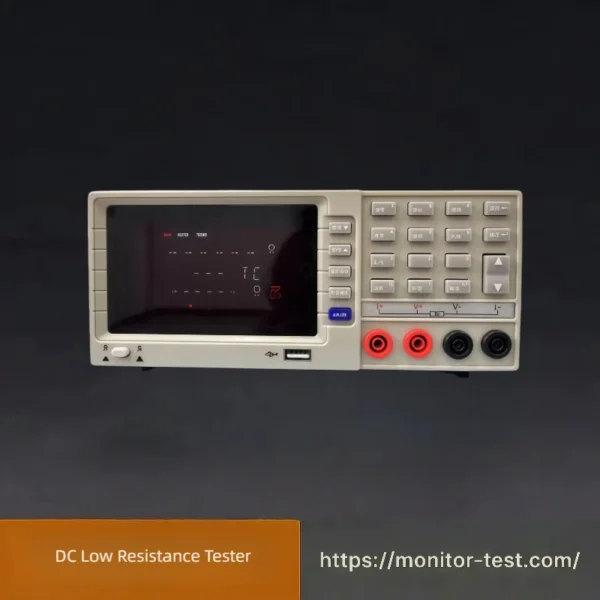
HF-TC-633 DC Low Resistance Tester
DC Low Resistance Tester adopts constant current output to accurately measure tiny DC resistance. It is widely used to test transformer windings, motor coils, busbar joints and switch contacts during factory inspection and on-site maintenance.
Send your requirements, we will quote for you within 12 hours
DC Low Resistance Tester is designed for precise measurement of micro DC resistance. With stable constant DC current output, it effectively eliminates thermoelectric potential interference. It is widely used to test transformer windings, motor coils, busbar connections and switch contacts in power plants, substations and electrical manufacturing workshops for factory acceptance and field maintenance.
Performance Features
- 4-color high-definition VFD color display
- Ultra-high speed measurement: maximum test rate up to 60 times per second
- Supports temperature compensation function
- Thermoelectric potential compensation with automatic zeroing
- Three selectable current modes to meet diverse testing requirements
- Abnormal test lead detection to avoid misjudgment
- Direct reading / absolute deviation / relative deviation / temperature display
- Multiple interfaces available to satisfy different user demands
Technical Specifications
| Item | Specification |
|---|---|
| Measuring Range | Resistance: 0.1μΩ ~ 300Ω Temperature: 0℃ ~ 100℃ |
| Basic Accuracy | Resistance: 0.02% ± 5 digits |
| Maximum Readout | 30,000 counts |
| Current Mode | Pulsed Current |
| Test Speed | 1s, 300ms, 150ms |
| Test Signal | Constant current test for 1~4 ranges |
| Trigger Mode | Internal, Manual, External & Remote Trigger |
| Display Output | Direct reading, ℃ |
| Ranges | 5 ranges, manual / auto ranging |
| Calibration | Short-circuit zeroing across full ranges |
| Standard Interface | RS232C (optional) |
| Communication Protocol | SCPI |
| Others | Keylock & data hold function |
| Accessory | Temperature probe |
Applications
DC Low Resistance Tester is used to measure micro DC resistance accurately.
It is widely applied for testing transformer windings, motor coils, busbar joints, switch contacts, cable conductors and welding connections. It can detect poor contact, loose joints and coil turn short circuits. Suitable for transformer factories, power substations, electrical equipment manufacturers and on-site power maintenance acceptance tests.
It is widely applied for testing transformer windings, motor coils, busbar joints, switch contacts, cable conductors and welding connections. It can detect poor contact, loose joints and coil turn short circuits. Suitable for transformer factories, power substations, electrical equipment manufacturers and on-site power maintenance acceptance tests.
Packing List of DC Low Resistance Tester
| No. | Category | Item | Quantity | Unit | Remarks |
|---|---|---|---|---|---|
| 1 | Host Device | DC Low Resistance Tester | 1 | set | Standard configuration |
| 2 | Test Accessories | Four-wire test leads (current & voltage wires) | 1 | set | For resistance measurement |
| 3 | Test Accessories | Temperature sensor probe | 1 | pc | For temperature compensation test |
| 4 | Power Accessories | Power cable | 1 | pc | For mains power supply |
| 5 | Documentations | User manual | 1 | copy | English version |
| 6 | Documentations | Factory calibration certificate | 1 | copy | With test data |
| 7 | Documentations | Quality inspection report | 1 | copy | Factory compliance report |
| 8 | Optional Accessories | RS232 communication cable | 1 | pc | Optional, for PC connection |
| 9 | Optional Accessories | Upper computer test software | 1 | set | Optional, for data management |
| 10 | Optional Accessories | Portable carrying case | 1 | pc | Optional, for field carrying |
FAQ — DC Low Resistance Tester
Q1: What objects can this tester measure?
A1: It is suitable for transformer windings, motor coils, busbar joints, switch contacts, cables and welded connections to check winding short circuits and poor contact faults.
Q2: What is the measuring range of the instrument?
A2: Resistance range: 0.1μΩ ~ 300Ω; temperature measuring range: 0℃ ~ 100℃. Basic resistance accuracy reaches 0.02% ±5 digits.
Q3: Why adopt pulsed current measurement mode?
A3: Pulsed current effectively reduces heating effect on windings and suppresses thermoelectric potential interference, ensuring stable and repeatable test results.
Q4: Does the tester support temperature compensation?
A4: Yes. With temperature compensation function, measured resistance can be converted to standard temperature value for consistent comparison.
Q5: What trigger modes are available?
A5: Internal trigger, manual trigger, external trigger and remote trigger are supported, convenient for automatic assembly line testing.
Q6: Can it realize automatic ranging?
A6: It has five measuring ranges, supporting both auto ranging and manual ranging. Full-range short-circuit zeroing is available for calibration.
Q7: What communication interface does it have?
A7: RS232C interface is optional, and it follows SCPI protocol to connect with PC for automatic data collection.
Q8: What is the fastest test speed?
A8: Three speeds optional: 1s, 300ms and 150ms. The maximum test rate can reach 60 times per second.
Q9: Are there practical auxiliary functions?
A9: It supports test lead abnormality detection, keylock and data hold, as well as multiple display modes: direct reading, absolute deviation and relative deviation.
Q10: Can the instrument be used for on-site power maintenance?
A10: Yes. High precision and anti-interference design make it applicable for factory incoming inspection, FAT and substation field acceptance tests.
Reviews
There are no reviews yet.