

What Gases Should Be Monitored in Transformer Oil?
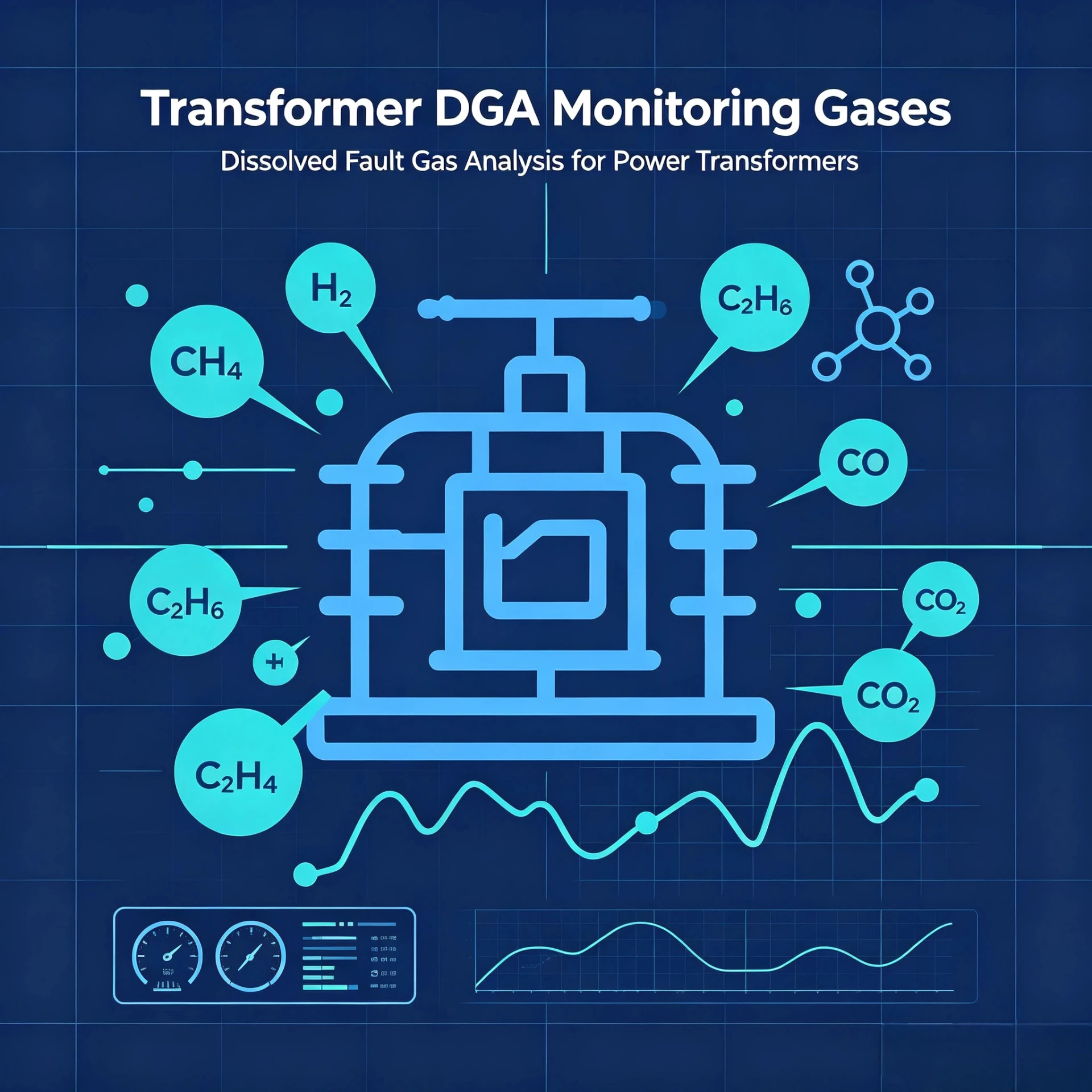
Transformer DGA monitoring gases commonly include hydrogen (H₂), methane (CH₄), ethane (C₂H₆), ethylene (C₂H₄), acetylene (C₂H₂), carbon monoxide (CO), and carbon dioxide (CO₂). However, the required gas configuration depends on the transformer application, monitoring objective, fault types of interest, and required diagnostic depth.
Which Gases Are Commonly Monitored in Transformer Oil?
H2: Which Gases Are Commonly Monitored in Transformer Oil?
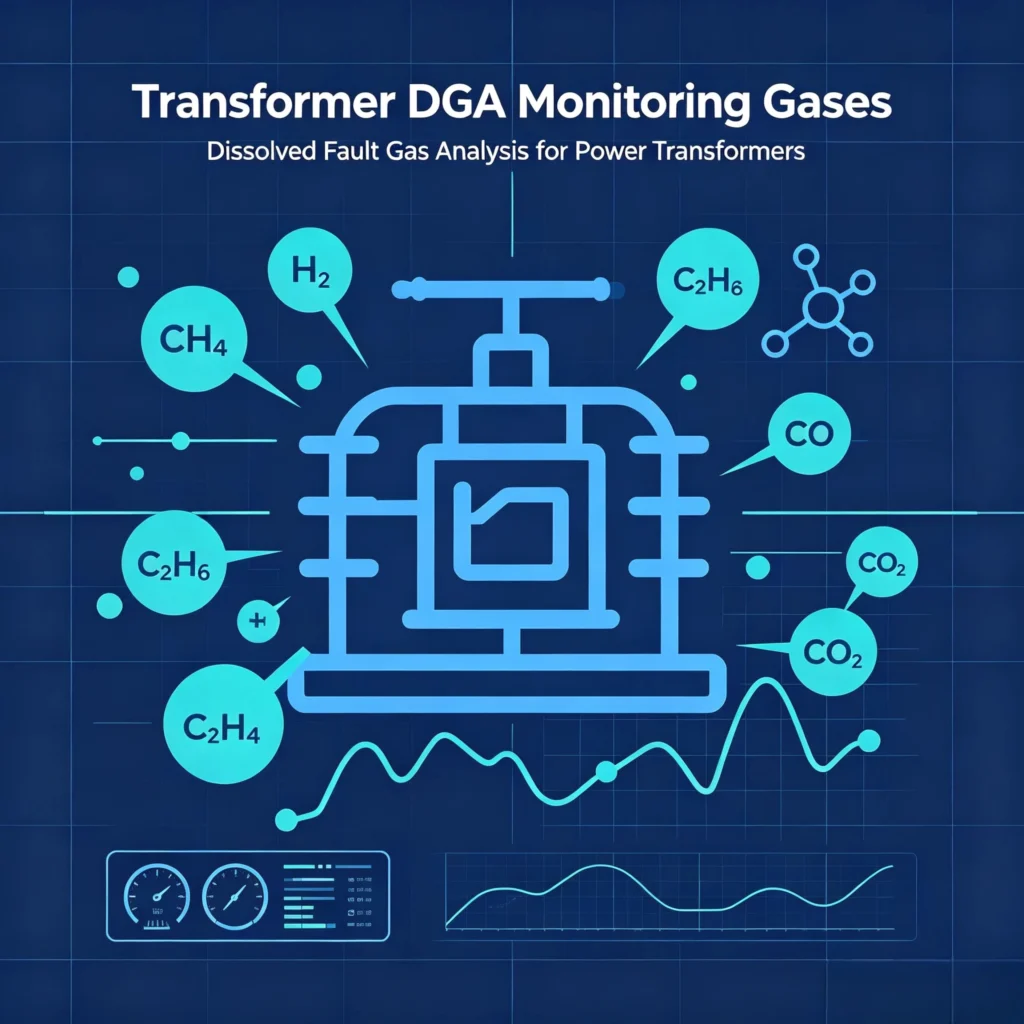
Transformer DGA typically focuses on seven key gases, each monitored for a specific diagnostic purpose. The table below summarizes the commonly monitored gases in transformer oil and why they are measured.
| Gas | Formula | Why It Is Monitored |
|---|---|---|
| Hydrogen | H₂ | Electrical activity / partial discharge monitoring |
| Methane | CH₄ | Thermal and electrical activity |
| Ethane | C₂H₆ | Thermal fault monitoring |
| Ethylene | C₂H₄ | Higher-temperature thermal activity |
| Acetylene | C₂H₂ | Arcing / high-energy discharge indication |
| Carbon Monoxide | CO | Cellulose insulation degradation |
| Carbon Dioxide | CO₂ | Cellulose insulation condition |
Some monitoring systems also measure oxygen (O₂), nitrogen (N₂), and moisture. O₂ and N₂ are not fault gases themselves but can provide context for gas generation and oil condition, while moisture affects insulation performance and aging.
These gases are monitored because each one reflects a different internal process — electrical discharge, thermal stress, or insulation degradation. Their concentrations, combinations, and trends form the basis for DGA interpretation. For detailed explanations of what each gas indicates, see What Do DGA Gases Mean?
Why Are These Gases Monitored in Transformers?
These gases are monitored because they reflect different internal processes inside a transformer. They can be grouped into three categories:
Electrical Fault Indicators
H₂ and C₂H₂ are associated with electrical activity. H₂ is often linked to partial discharge, while C₂H₂ is a key indicator of arcing and high-energy discharge.
Thermal Fault Indicators
CH₄, C₂H₆, and C₂H₄ are associated with thermal decomposition of oil. Their relative levels help indicate thermal fault temperature ranges.
Cellulose Insulation Indicators
CO and CO₂ are associated with cellulose insulation condition. They indicate paper degradation and insulation aging rather than oil decomposition.
Monitoring these gases provides early insight into electrical, thermal, and insulation-related conditions, supporting timely maintenance decisions.
Hydrogen Monitoring in Transformers
Hydrogen is one of the most commonly monitored gases in transformer DGA because it can provide an early indication of electrical activity and certain insulation faults. It is often the first gas to rise above baseline when abnormal conditions begin to develop.
Why monitor H₂?
Hydrogen monitoring helps detect the earliest stages of electrical or thermal abnormality. Because H₂ is generated by several mechanisms — partial discharge, low-energy discharge, and certain thermal processes — it serves as a broad early indicator rather than a fault-specific one.
When is single-gas H₂ monitoring considered?
Single-gas H₂ monitoring may be used in some applications where cost or installation constraints limit the number of gases measured. It can provide basic early warning of electrical activity, but it cannot support comprehensive fault classification or ratio-based diagnostic methods. For critical transformers, multi-gas monitoring is generally preferred.
What should engineers check?
- Is H₂ rising above its historical baseline?
- Is the rate of increase accelerating?
- Are other gases such as CH₄, C₂H₄, or C₂H₂ also rising?
- Does the H₂ trend correlate with load, temperature, or operating events?
These questions help determine whether hydrogen is a transient fluctuation or part of a developing condition.
Methane Monitoring in Transformers
Methane is monitored because changes in CH₄ concentration can provide useful information about thermal or electrical activity inside an oil-filled transformer. It is one of the key hydrocarbon gases generated when transformer oil begins to decompose under abnormal conditions.
Why CH₄ Is Monitored
Methane is primarily associated with thermal decomposition of oil at relatively low temperatures. Because it forms at lower temperatures than ethylene or acetylene, a rising CH₄ level can serve as an earlier indicator of thermal stress.
Combination With Other Gases
Methane becomes more informative when evaluated together with other gases:
- CH₄ + C₂H₆ → may indicate low-temperature thermal activity
- CH₄ + H₂ → may suggest electrical discharge or partial discharge
- CH₄ + C₂H₄ → may point toward higher-temperature thermal conditions
Value in Continuous Monitoring
Continuous CH₄ monitoring provides trend data rather than a single snapshot. Tracking how methane changes over time helps distinguish normal aging from a developing thermal condition — a stable level may reflect normal operation, while a steady or accelerating rise may warrant closer attention.
Acetylene Monitoring in Transformers
Acetylene (C₂H₂) is one of the most important gases in transformer DGA. Its presence is associated with high-energy electrical discharge and arcing, making it a key focus in multi-gas monitoring systems.
Importance of C₂H₂
Unlike methane or ethylene, which form at moderate temperatures, acetylene requires extremely high localized energy to generate. Even small amounts of C₂H₂ often attract attention because they may indicate a condition that could develop rapidly.
Arcing and High-Energy Discharge
C₂H₂ is most closely associated with arcing and high-energy electrical discharge. Continuous acetylene monitoring is particularly valuable for critical transformers or units with a history of electrical faults, where detecting high-energy discharge is an important monitoring objective.
Why C₂H₂ Matters in Multi-Gas Monitoring
Acetylene is rarely interpreted on its own. Its diagnostic value increases when combined with other gases:
- C₂H₂ + H₂ → may indicate high-energy discharge
- C₂H₂ + C₂H₄ → helps distinguish arcing from thermal faults
- Rising C₂H₂ trend → may indicate an active or developing condition requiring investigation
Other Important DGA Monitoring Gases
Beyond H₂, CH₄, and C₂H₂, several other gases are commonly monitored to complete the DGA picture.
Ethane — C₂H₆
Ethane is monitored for thermal activity, particularly at lower temperatures. It typically appears alongside methane and helps indicate the early stages of oil decomposition.
Ethylene — C₂H₄
Ethylene is associated with higher-temperature thermal activity. Rising C₂H₄ levels may indicate more severe thermal decomposition, especially when evaluated together with ethane and acetylene.
CO — Carbon Monoxide
CO is monitored for cellulose insulation condition. It is primarily associated with thermal degradation of paper and pressboard insulation, making it a key indicator of solid insulation health.
CO₂ — Carbon Dioxide
CO₂ is also associated with cellulose insulation condition. It is produced alongside CO during insulation aging and degradation, and the CO/CO₂ relationship provides additional diagnostic insight.
Together, these gases provide broader coverage of thermal, electrical, and insulation-related conditions, supporting more complete transformer condition assessment.
Single-Gas vs Multi-Gas DGA Monitoring
Different monitoring configurations serve different purposes. A multi-gas DGA monitor provides broader information, but the required configuration should be determined by the transformer type, criticality, fault risks, and monitoring objectives.
| Configuration | Typical Purpose | Considerations |
|---|---|---|
| Single-Gas | Monitor a specific gas of interest | Lower measurement scope |
| 3-Gas / Limited-Gas | Focus on selected fault indicators | Application dependent |
| Multi-Gas | Broader transformer condition monitoring | More comprehensive gas coverage |
Single-gas monitoring may be suitable for basic early warning or cost-sensitive applications, but it cannot support ratio-based diagnostics or comprehensive fault classification. Limited-gas configurations offer a middle ground, covering selected fault indicators based on specific monitoring goals.
Multi-gas monitoring provides broader coverage of thermal, electrical, and insulation-related conditions, enabling more complete interpretation when combined with gas ratios and diagnostic methods. It is generally preferred for critical transformers, high-value assets, and unattended substations where reliable condition assessment is essential.
The right choice depends on the application — not simply on the number of gases measured.
How Many DGA Gases Should a Transformer Monitor?
There is no single answer that applies to every transformer. The appropriate gas coverage depends on transformer type, criticality, fault risks, and monitoring objectives.
Critical Power Transformers
Critical power transformers generally require broader gas coverage. Measuring the full set of key fault gases — H₂, CH₄, C₂H₆, C₂H₄, C₂H₂, CO, and CO₂ — supports ratio-based diagnostics and more complete fault classification.
Generator Step-Up Transformers
For generator step-up transformers, both electrical and thermal fault monitoring are important. Gas coverage should support detection of partial discharge, arcing, and thermal faults, making multi-gas monitoring the typical choice.
Distribution Transformers
For distribution transformers, the required coverage depends on transformer rating, criticality, budget, and maintenance strategy. In some cases, limited-gas or single-gas monitoring may be sufficient for basic early warning.
Industrial Transformers
For industrial transformers, gas coverage should reflect specific load conditions, operating environment, and the consequences of failure. Transformers serving critical processes may justify broader monitoring, while less critical units may not.
The key principle is that gas coverage should match the monitoring objective — not simply follow a fixed number. More gases provide more diagnostic capability, but the right configuration depends on the application.
DGA Gas Detection Limit: What Should Engineers Consider?
When evaluating an online DGA monitoring system, detection limit is often the first parameter engineers look at — but it is not the only one that matters. Detection limit alone does not reflect overall measurement performance.
| Parameter | What It Tells You |
|---|---|
| Detection Limit | Lowest reliably detectable concentration |
| Measurement Range | Lowest to highest measurable concentration |
| Accuracy | Difference between measured and actual value |
| Repeatability | Consistency of repeated measurements |
| Stability | Performance over long-term operation |
A very low detection limit is useful for early indication, but it means little if accuracy or repeatability is poor. For long-term trend analysis, repeatability and stability often matter more than a single low detection limit, because reliable trends depend on consistent measurements over months or years.
Engineers should also consider calibration performance, cross-gas interference, and performance under real operating conditions such as temperature variation and outdoor installation. These factors affect whether the system delivers trustworthy data in practice.
In short, detection limit should be evaluated together with accuracy, repeatability, and stability — not in isolation.
DGA Gas Measurement Range
Detection limit and measurement range need to be evaluated together. A low detection limit only tells you the smallest concentration a system can detect — not whether it can accurately measure the full range encountered in real operation.
Gas concentrations in transformer oil vary significantly with transformer condition. A healthy transformer may produce only trace levels, while a developing fault can generate concentrations many times higher. A monitoring system should therefore handle:
- Low-level detection — for early indication of abnormal gas generation
- Normal operating range — for routine trend monitoring
- Abnormal / high concentrations — for fault conditions where gas levels rise sharply
If the range is too narrow, readings may saturate or lose accuracy during a fault — exactly when reliable data matters most. Detection limit and measurement range are complementary specifications and should be assessed together.
How Frequently Should DGA Gases Be Measured?
Measurement frequency should depend on transformer criticality, monitoring objectives, gas behavior, and required response time. There is no single interval that suits every transformer.
| Monitoring Approach | Typical Use |
|---|---|
| Periodic Measurement | Routine condition assessment |
| Frequent Measurement | Higher-risk or critical transformers |
| Continuous / Online Monitoring | Critical assets and early-warning applications |
Periodic laboratory testing is suitable for routine condition assessment, but it only provides a snapshot at the time of sampling. For transformers with higher risk or faster gas generation, more frequent measurement improves trend visibility. Continuous online monitoring is typically used for critical assets where early warning and timely response are essential.
For a transformer gas monitoring system, continuous or near-continuous measurement provides the most complete trend data. It allows operators to detect sudden changes, track gas generation rates, and respond before a developing fault progresses. The appropriate frequency should match the transformer’s criticality and the consequences of failure — not simply follow a fixed schedule.
Why Is DGA Gas Measurement Stability Important?
For online DGA monitoring, measurement stability is just as important as accuracy. An online system operates continuously for years, so its readings must remain consistent over long-term operation — not just perform well during initial calibration.
Several factors affect stability:
- Long-term operation — sensors may gradually change behavior over months or years
- Sensor drift — slow deviation from the calibration baseline can distort trend data
- Calibration — intervals and methods affect long-term reliability
- Repeatability — repeated measurements should produce consistent results
- Environmental effects — temperature, humidity, and outdoor conditions can influence performance
Stability matters because online DGA monitoring relies on trend analysis. If readings drift, a stable transformer may appear to be developing a fault, or a real fault may be masked by inconsistent data.
Unlike laboratory instruments used occasionally under controlled conditions, online equipment must deliver reliable data in real substation environments day after day. Engineers should therefore evaluate long-term stability, drift characteristics, and calibration requirements — not just detection limits or initial accuracy.
How to Select the Right DGA Gas Configuration
Selecting the right DGA gas configuration is not about choosing the maximum number of gases — it is about matching gas coverage and measurement performance to the transformer and its monitoring objectives. The following steps provide a practical selection framework.
Step 1: Identify Transformer Type and Criticality
Determine whether the transformer is a critical power transformer, generator step-up transformer, distribution transformer, or industrial transformer. Criticality directly affects how comprehensive the monitoring should be.
Step 2: Define the Faults You Want to Monitor
Clarify whether the monitoring objective focuses on electrical faults (partial discharge, arcing), thermal faults, cellulose insulation degradation, or a combination. This determines which gases are essential.
Step 3: Determine Required Gas Coverage
Based on the fault types of interest, decide which gases must be measured. Key fault gases include H₂, CH₄, C₂H₆, C₂H₄, C₂H₂, CO, and CO₂.
Step 4: Compare Single-Gas and Multi-Gas Configurations
Single-gas configurations offer basic early warning, while multi-gas configurations support ratio-based diagnostics and more complete fault classification. The right choice depends on the transformer’s criticality and monitoring goals.
Step 5: Check Detection Limits
Confirm that the detection limit is low enough to identify abnormal gas generation at an early stage — but do not evaluate it in isolation.
Step 6: Check Measurement Range
Ensure the range covers both normal operating levels and abnormal/high concentrations, so readings remain accurate during a developing fault.
Step 7: Check Measurement Frequency
Match measurement frequency to transformer criticality and required response time. Continuous online monitoring is typically preferred for critical assets.
Step 8: Evaluate Long-Term Measurement Stability
Confirm repeatability, drift characteristics, and calibration requirements, since online equipment must deliver reliable trend data over years of continuous operation.
Together, these steps help ensure that the selected DGA gas configuration matches both the transformer’s risk profile and the project’s monitoring objectives.
Transformer DGA Gas Monitoring Checklist
| Question | Why It Matters |
|---|---|
| Which gases need to be monitored? | Defines gas coverage |
| Is single-gas monitoring sufficient? | Determines system configuration |
| Is multi-gas monitoring required? | Provides broader diagnostic information |
| What is the required detection limit? | Determines sensitivity |
| What measurement range is required? | Ensures applicable gas concentration range |
| How often should gases be measured? | Defines monitoring frequency |
| How stable is the measurement over time? | Important for continuous monitoring |
| Is SCADA integration required? | Determines communication requirements |
This checklist focuses on gas coverage and measurement performance. It works together with the Online DGA Monitoring System Selection guide: gas selection defines what to measure, while system selection defines how to measure it.
FAQs About Transformer DGA Monitoring Gases
Which gases should be monitored in transformer oil?
The seven core monitoring gases are H₂, CH₄, C₂H₆, C₂H₄, C₂H₂, CO, and CO₂. Low-risk ordinary transformers can adopt single H₂ monitoring, while critical grid transformers require full seven-gas comprehensive monitoring.
Why is hydrogen monitored in transformer oil?
Hydrogen is the most sensitive early indicator of transformer internal incipient faults, capable of capturing partial discharge and abnormal electrical/thermal activities earlier than other gases, serving as the first line of fault early warning.
What does acetylene in transformer oil indicate?
Acetylene is a unique marker of high-energy electrical arcing and discharge faults. Its increase indicates developing severe electrical faults inside the transformer and requires timely inspection and risk control.
What does methane mean in transformer DGA?
Methane mainly indicates low-temperature thermal degradation and mild electrical discharge faults in transformer oil, serving as the core index for judging mild thermal overheating of equipment.
What does ethylene indicate in transformer oil?
Ethylene corresponds to high-temperature thermal faults and severe local overheating, which is the key gas for judging high-risk thermal failure of transformers.
Why are CO and CO2 monitored in transformers?
CO and CO2 are dedicated indicators for evaluating the aging and thermal degradation of cellulose paper insulation, helping engineers grasp the health status of transformer solid insulation and predict residual service life.
Is hydrogen monitoring enough for a transformer?
Single hydrogen monitoring is only sufficient for basic early warning of non-critical transformers. It cannot classify fault types or identify thermal faults and insulation aging, so it cannot meet the full-condition monitoring needs of core power equipment.
What is a multi-gas DGA monitor?
A multi-gas DGA monitor is an industrial online monitoring device that synchronously detects seven core dissolved gases in transformer oil, supports gas pattern analysis and trend tracking, and realizes accurate fault diagnosis and grading.
Should a power transformer use a multi-gas DGA monitor?
All grid-level, large-capacity, and key power supply transformers are recommended to be equipped with multi-gas DGA monitors to achieve comprehensive fault monitoring and reduce outage risks.
How often should transformer DGA gases be monitored?
Online DGA monitors support 24/7 continuous automatic monitoring. For daily operation, real-time trend recording and regular data sorting are recommended; for abnormal gas fluctuations, enhance monitoring frequency and track fault development dynamically.
Conclusion
Professional transformer DGA monitoring relies on integrated gas pattern and trend analysis rather than single-gas judgment. H₂ provides universal early warning for electrical incipient faults; CH4, C2H6 and C2H4 form a complete grading system for thermal faults; C2H2 is the core indicator of high-energy arcing faults; CO and CO2 accurately reflect solid cellulose insulation aging status.
Single-gas monitoring is suitable for low-budget and low-risk ordinary transformers, while multi-gas DGA monitoring is the standard configuration for critical power transformers, providing comprehensive, accurate and traceable condition data to support scientific O&M and asset management decisions. For projects requiring long-term stable online condition monitoring, industrial-grade multi-gas DGA monitors can effectively reduce transformer failure risks and extend equipment service life.
Reference Standards & Technical Sources
1. IEEE C57.104-2019, Guide for the Interpretation of Gases Generated in Mineral Oil-Immersed Transformers
2. IEC 60599, Mineral oil-filled electrical equipment – Interpretation of dissolved and free gas analysis data
3. IEC 60422, Supervision and maintenance of mineral insulating oils in electrical equipment
4. CIGRE Technical Brochure on Transformer Condition Monitoring and DGA Diagnosis