Leave your message

-
Leon Zhang sales consultant
-
Email: zxl635973785@gmail.com
-
Phone/WhatsApp/Wechat: +86 13655813266

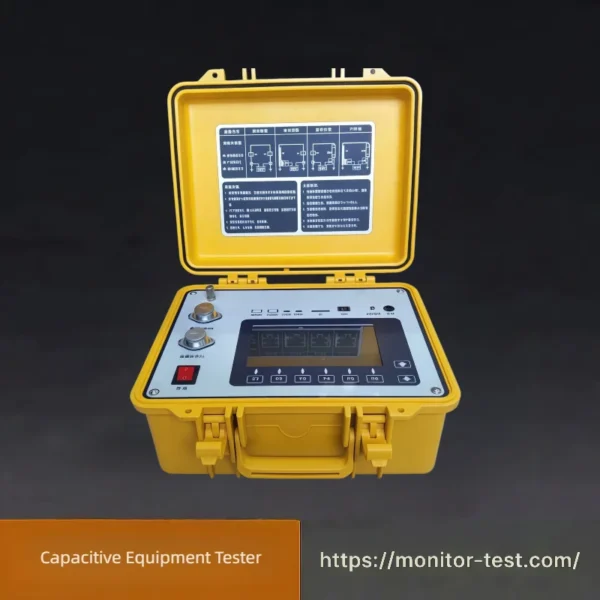
HF-PC-209 Capacitive Equipment Tester
Capacitive Equipment Tester is a portable on‑line insulation monitor for HV capacitive apparatus. It measures tan‑δ, capacitance and end‑screen current, supports dual test modes, anti‑harmonic interference, with real‑time trend display for on‑site insulation condition assessment.
Send your requirements, we will quote for you within 12 hours
HF-PC-209 On‑line Insulation Monitor for Capacitive Equipment
Adopting an innovative design structure, the HF-PC-209 overcomes defects of conventional live‑line detection systems and supports multiple test functions. It performs on‑line or live‑line measurement of dielectric loss and capacitance for capacitive‑type equipment. It is mainly used for real‑time on‑line monitoring of parameters including capacitance, dielectric loss and end‑screen leakage current of operating transformer bushings, CTs, CVTs and coupling capacitors, so as to evaluate the insulation condition of such equipment.
Functional Features
- It adopts high‑accuracy external through‑core current sensors to replace conventional “sampling protection units” (which contain multiple switching loops. When testing, end‑screen current is switched to the tester, risking open‑circuit of end‑screen; multiple short‑circuit jumpers are required to feed end‑screen current into the tester). Featuring through‑core construction, the sensor is installed close to equipment. No cut‑off or disconnection is needed for end‑screen lead wires, fundamentally eliminating safety hazards such as end‑screen open‑circuit. The sensor accurately measures input signals within 100 μA ~ 800 mA. With low input impedance, it withstands 10 A short‑term overload and 10 kA lightning surge, satisfying on‑site live‑line test requirements.
- Sensors feature die‑cast aluminum fully‑sealed waterproof housing, and secondary sides adopt waterproof cable connectors for simple test connection. After sensor installation, testing only requires connecting secondary sensor cables for plug‑and‑play, with no extra operation on end‑screen signal leads.
- The core processor runs an embedded real‑time operating system, equipped with extended 16‑bit high‑speed multi‑channel synchronous sampling A/D converters, enabling real‑time measurement and high‑precision computation for monitored quantities. Multi‑device simultaneous monitoring is supported.
- Two on‑line dielectric loss measurement modes are available: differential loss and capacitance‑ratio comparison between two identical capacitive devices; or measurement of capacitance and dielectric loss with PT secondary voltage as reference. Combining self‑calibrated high‑accuracy current sensors and digital filtering technology, it effectively improves measuring accuracy and stability of dielectric loss. Equipped with electromagnetic shielding and digital wave filtering, test results remain unaffected by harmonic interference and impulse noise.
- Differential loss and capacitance‑ratio comparison for same‑type capacitive devices is implemented. This avoids distorted dielectric‑loss readings caused by PT‑secondary reference voltage and mitigates interference from uneven surrounding electric fields.
- Fitted with a 7‑inch liquid‑crystal capacitive touch screen, it displays real‑time monitored data and presents voltage, current, dielectric loss and capacitance‑ratio in trend graphs.
- Besides real‑time on‑site detection, it supports long‑term continuous on‑line monitoring and automatic data logging.
- Two resistive current detection modes are supported: using PT secondary voltage or leakage current from peer capacitive equipment, for accurate multi‑parameter acquisition of voltage, current and dielectric loss.
- By replacing “sampling protection units” with external sensors, the system can be conveniently upgraded from live‑spot check to full on‑line monitoring while equipment stays in service. Upgrade requires no sensor disassembly or power outage; only additional installation of IED monitoring units.
- Portable lightweight design with simple operation. Built‑in high‑capacity lithium‑ion battery adapts to various field working conditions.
Technical Specifications
Overall Specifications
| Item | Specifications |
|---|---|
| Display | 7‑inch high‑brightness TFT‑LCD, optimized for outdoor application |
| Power Supply | Built‑in high‑capacity lithium‑ion battery |
| Ambient Temperature | ‑20 ℃ ~ 60 ℃ |
| Cable Accessories | 2 × 25 m measuring cables |
| Dimensions | 345 mm × 295 mm × 175 mm |
| Instrument Weight | 4 kg |
Measurement Range & Accuracy
| Parameter | Range | Accuracy |
|---|---|---|
| Current MeasurementCx / Cn | 100 μA ~ 800 mA | ±(0.5% reading + 1 digit) |
| Voltage Measurement (Vn) | 3 V ~ 300 V | ±(0.5% reading + 1 digit) |
| Dielectric Loss (Tanδ) | ‑20% ~ 20% | ±0.05% |
| Capacitance Ratio (Cx:Cn) | 1:1000 ~ 1000:1 | ±(0.5% reading + 1 digit) |
| Capacitance (Cx) | 10 pF ~ 0.5 μF | ±(0.5% reading + 2 digits) |
Note: Practical measurement accuracy depends on test‑signal magnitude and accuracy of the applied PT (or CVT).
Other Characteristics
- Waveform Display: Real‑time waveform visualization of measured signals for intuitive analysis.
- Harmonic Rejection: Waveform distortion of input signals will not degrade dielectric‑loss measurement accuracy.
- Power Management: Audible low‑battery alarm plus automatic power‑off.
- Charging Time: <6 h under power‑off state.
FAQ for Capacitive Equipment Tester
Q1: Can this tester work while high‑voltage capacitive equipment remains energized?
A1: Yes. Equipped with external split‑core sensors, it supports live‑line on‑line monitoring without equipment power‑off, and avoids end‑screen open‑circuit risks.
Q2: What key parameters can the Capacitive Equipment Tester measure?
A2: It measures dielectric loss tanδ, capacitance value, capacitance ratio and end‑screen leakage current, to evaluate the insulation status of bushings, CT, CVT and coupling capacitors.
Q3: How does it suppress on‑site electromagnetic & harmonic interference?
A3: It adopts digital filtering, electromagnetic shielding and same‑phase comparison algorithm, which keeps test results stable under complex field interference conditions.
Q4: Is this unit suitable for long‑term continuous monitoring?
A4: Yes. It supports real‑time trend graph display and automatic data logging; it can also be upgraded from spot check to permanent online monitoring by adding IED units.
Q5: What about its power supply for field operation?
A5: Built‑in high‑capacity lithium‑ion battery for portable field use. It triggers audible low‑battery alarm and auto‑shutdown when power is insufficient.
Reviews
There are no reviews yet.