Leave your message

-
Leon Zhang sales consultant
-
Email: zxl635973785@gmail.com
-
Phone/WhatsApp/Wechat: +86 13655813266

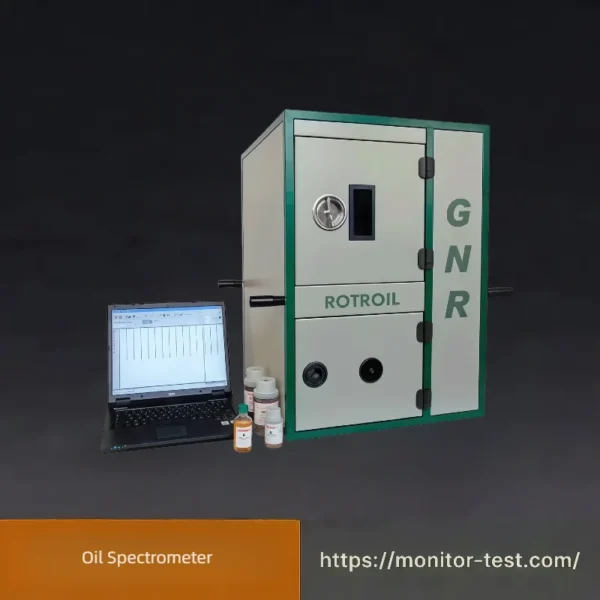
HF-TC-643 Oil Spectrometer
This Oil Spectrometer accurately measures multiple element concentrations in lubricating oil and hydraulic oil. It monitors component abrasive wear and identifies oil contamination, supporting scientific equipment condition assessment and maintenance decision-making.
Send your requirements, we will quote for you within 12 hours
The HF-TC-643 Oil Spectrometer complies with ASTM D6595 standards. It adopts rotating disc electrode atomic emission spectrometry to measure various element contents in oil samples for equipment condition monitoring and fault prediction. It is widely used for elemental analysis of lubricating oil, gear oil, fuel, hydraulic oil and grease to detect wear metals, contaminants, additives and corrosive impurities, facilitating predictive maintenance and cost reduction.
Instrument Features
- Analyze 24 elements including Fe, Al, Cr, Ag, Cu, Ni, Pb, Sn, Ca, Mg, Si, Ti, Na, Sb, V, B, Ba, Mo, Zn, P, Cd, Mn, K, Li; expandable up to 32 elements.
- Measuring range: Zn, P, Ba, Si: 0–6000 ppm; other elements: 0–1000 ppm.
- The repeatability and accuracy of test results meet ASTM D6595 standards.
- Complete quantitative analysis of all elements within 30 seconds, generate data reports and support result printing.
- No sample pretreatment required; samples can be directly tested after sampling.
- Control software runs on Windows OS to fully automate the test process.
- The analysis software can automatically recalibrate based on unified reference standards.
- Test results are automatically synchronously output within 30 seconds.
- Designed in accordance with MIL-S-83129A standard; test results conform to ASTM D6595 and the U.S. DoD Joint Oil Analysis Program (JOAP).
- Intuitive human-machine interface supports complete system setup and calibration. It can store, retrieve and statistically analyze sample data and print test results.
Technical Parameters
- Main Power Supply: 220V AC / 50Hz
- Power Consumption: 500W
- Dimensions: 86 × 73 × 45 cm
- Weight: ~85 kg
- Optical System: Paschen-Runge optical mounting (full spectrum)
- Working Principle: Rotating disc electrode spark OES complying with ASTM D6595, equipped with rotary disc sample feeding device and built-in automatic electrode sharpener
- Excitation Source: High repetition rate AC pulsed arc light source
- Direct light output without optical fiber
- Focal Length: 500 mm
- Automatic background correction
- Over 160 pre-installed analytical lines for future function upgrade
- Spectral Range: 210 ~ 600 nm (190 ~ 800 nm)
- Data Acquisition System: Single integrator GNR data acquisition system based on 32-bit AD DSA microprocessor, controlled by built-in computer
- Software: Automatic calibration curve fitting via Lagrange quadratic polynomial interpolation; manual adjustment supported
- Calibration & Analysis Unit: ppm or %
- Support graphical display and curve printing
- Unlimited storage of calibration curves (limited by hard disk capacity)
- Users may customize printed element format and sequence
- Measuring Range: 0 ~ 10,000 ppm; Resolution: 0.01 ~ 1.00 ppm
- Editable test report templates
- Store and reproduce sample analysis results, including standard deviation, relative standard deviation, average value, minimum and maximum values
FAQ for Oil Spectrometer
Q1: What is the main application of the oil spectrometer?
A1: It detects element contents in lubricating oil, gear oil, fuel, hydraulic oil and grease. It monitors wear metals, pollutants and additives for equipment condition monitoring, fault prediction and predictive maintenance.
Q2: Which elements can this instrument analyze?
A2: It can test 24 elements such as Fe, Al, Cr, Cu, Pb, Si, Zn, P, etc., and can be expanded to 32 elements at most.
Q3: What are the measuring ranges for different elements?
A3: Zn, P, Ba, Si: 0–6000 ppm; other elements: 0–1000 ppm. The automatic monitoring range reaches 0–10,000 ppm.
Q4: Does the instrument meet international industry standards?
A4: Yes. It complies with ASTM D6595 and MIL-S-83129A standards, and satisfies the requirements of the U.S. DoD Joint Oil Analysis Program (JOAP).
Q5: How long does a full element analysis take?
A5: Quantitative analysis of all elements can be completed within 30 seconds, and test results will be automatically output synchronously.
Q6: Is sample pretreatment required before testing?
A6: No pretreatment is needed. The oil sample can be tested directly after sampling, which greatly improves testing efficiency.
Q7: Can the software realize automatic calibration?
A7: Yes. The software supports automatic recalibration based on reference standards. It adopts Lagrange quadratic polynomial interpolation for curve fitting, and manual setting is also available.
Q8: What functions are equipped in the supporting software?
A8: It supports system setting, calibration, data storage, retrieval, statistical analysis and result printing. Users can customize report templates and the output order of elements.
Q9: What are the basic power and size parameters?
A9: Power supply: 220V AC / 50Hz; power consumption: 500W; dimensions: 86×73×45 cm; weight: about 85 kg.
Q10: Does the instrument support curve storage and graphical display?
A10: It supports graphical display and curve printing. There is no upper limit for calibration curve storage, which only depends on the hard disk capacity.
Reviews
There are no reviews yet.