Leave your message

-
Leon Zhang sales consultant
-
Email: zxl635973785@gmail.com
-
Phone/WhatsApp/Wechat: +86 13655813266

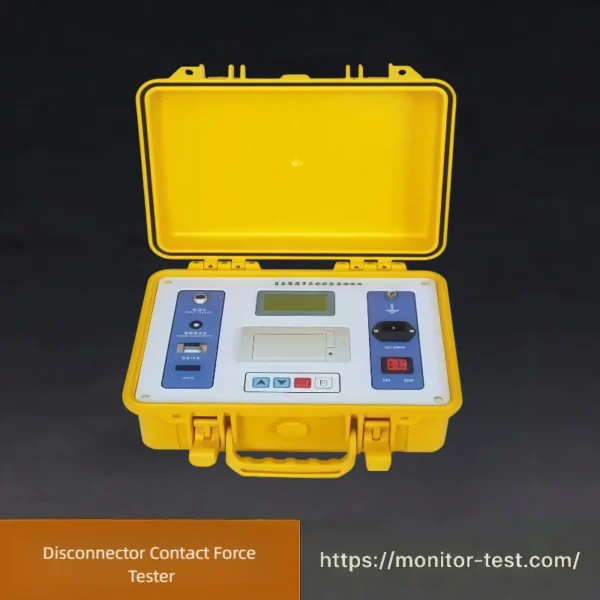
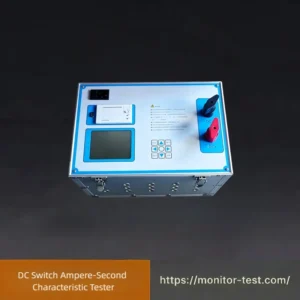
HF-WC-634 Disconnector Contact Force Tester
Disconnector Contact Force Tester is dedicated to measuring contact force of high-voltage disconnectors. It accurately assesses contact engagement status, discovering hidden risks of insufficient pressure. Widely used for substation maintenance, it effectively prevents overheating faults triggered by poor contact in power distribution systems.
Send your requirements, we will quote for you within 12 hours
High-voltage switchgears are widely used in power systems. Outdoor disconnectors are exposed to atmospheric environments and severely affected by climatic conditions. They operate under harsh conditions and are prone to mechanical or electrical faults. Contact surfaces are easily corroded by rainwater, dust and harmful gases, resulting in poor contact and overheating. The springs providing contact pressure may lose elasticity due to thermal annealing, which further reduces contact pressure. This creates a vicious cycle of contact overheating and may eventually burn out contacts and trigger accidents.
During maintenance, engineers usually only replace obviously failed and fractured springs. Springs with degraded pressure cannot be identified and replaced. In subsequent operation, contact current distribution becomes uneven due to inconsistent pressure, leading to poor contact and overheating. The overheating spreads gradually to all contacts. Besides, many disconnectors have adjustable contact force. Inadequate adjustment or inconsistent pressure among contacts will cause the same problems.
At present, most maintenance staff judge the contact condition only by measuring loop resistance. They consider maintenance work completed once the loop resistance meets requirements. In fact, loop resistance consists of resistance of terminals, conductive tubes and contact resistance. It has a wide tolerance range and only proves the circuit is conductive, and cannot directly reflect changes in contact resistance. Tests show that loop resistance may still be within limits whether two pairs or four pairs of contacts are engaged. Similarly, different contact force values barely affect loop resistance.
Relevant maintenance regulations and standards specify contact force measurement. Spring scales are recommended measuring tools. However, measuring contact force at height with spring scales is inconvenient, inaccurate and unsafe. For certain disconnectors such as shear-arm type, contact force cannot be measured by spring scales at all.
Main Technical Parameters
| Item | Specification |
|---|---|
| a. Power Supply | AC 220V |
| b. Power Dissipation | ≤20W |
| c. Measuring Range | Sensor A ≤980 N; Sensor B ≤2000 N |
| d. Measuring Error | ±1%FS |
| e. Communication | USB or RS232 serial port |
| f. Working Power | 24V lithium battery; Charging source: AC220V±10%, 50Hz |
| g. Max. Storage | 20,000 sets of disconnector test data |
| h. Working Environment | Temperature: -10℃ ~ 40℃; Humidity ≤80%RH |
Main Functions
a. HF-WC-634 Disconnector Contact Force Tester can measure and store contact force data for all types of disconnectors of 100kV and below. Data can be compared with standard values and historical records to draw conclusions and guide maintenance.
b. Test data can be uploaded to PC and automatically converted into WORD and EXCEL files for statistics and analysis.
c. Test reports can be generated automatically when matched with supporting PC software.
b. Test data can be uploaded to PC and automatically converted into WORD and EXCEL files for statistics and analysis.
c. Test reports can be generated automatically when matched with supporting PC software.
Packing List
| Description | Quantity | Unit |
|---|---|---|
| Main Unit of Disconnector Contact Force Tester | 1 | Pc |
| Force Sensor A (≤980N) | 1 | Set |
| Force Sensor B (≤2000N) | 1 | Set |
| Test Connection Cables | 1 | Set |
| AC Charging Power Cord | 1 | Pc |
| USB & RS232 Communication Cable | 1 | Pc |
| English & Chinese Operation Manual | 1 | Copy |
| Factory Calibration Certificate | 1 | Copy |
| Hard Transport Case with Shockproof Foam | 1 | Set |
FAQ – Disconnector Contact Force Tester
Q1: What is a Disconnector Contact Force Tester used for?
A: It measures the clamping force of contact fingers on high-voltage disconnectors (isolating switches). Insufficient contact force causes overheating, excessive contact resistance and thermal failure. It applies to GW/GN series disconnectors, tulip contacts, circuit breaker contacts and switchgear plug contacts.
Q2: What measuring range options are available?
A: Standard ranges: 0–500 N, 0–1000 N, 0–2000 N. Accuracy: ≤1% FS ±1 N. Custom force ranges are available upon request.
Q3: Which contact types can be tested?
A: Straight blade disconnector contacts, tulip (multi-finger) contacts, clamp-type disconnectors (GW16/GW17), indoor GN series and low-voltage drawer switch contacts. Different sensor probes shall be selected according to contact gap.
Q4: How to select and adjust the test probe?
A: Measure the actual contact gap width with calipers, adjust the simulated probe to match the gap precisely. Mismatched gap will lead to large measurement deviation. Multiple standard probes (6 mm / 8 mm / 10 mm) are supplied; custom probes for special contacts are supported.
Q5: Is zero calibration required before each test?
A: Yes. Perform zero reset after connecting the sensor and before inserting into contacts. If the sensor position changes during testing, re-zeroing is mandatory.
Q6: Can I perform tests on live disconnectors?
A: Strictly prohibited. All tests must be carried out after power cut, earthing and safety locking procedures. The instrument is not designed for live working.
Q7: What is the correct testing posture?
A: Insert the probe vertically into the contact engagement zone, avoid tilting. Side force creates force component errors. Wait until the reading stabilizes before recording data. Take 2–3 readings on each contact and use the average value.
Q8: How to judge whether contact force is qualified?
A: Compare measured value against the disconnector OEM rated force. General rule: measured value ≥90% of rated force is acceptable. Force deviation among fingers of the same phase should not exceed 15%. Consult switch manufacturer datasheets for exact thresholds.
Q9: Why does the reading fluctuate continuously?
A: Common causes:
- Probe tilted or not fully seated inside contact fingers;
- Oxidation, dirt or burrs on contact surface;
- Loose sensor cable connector;
- Damaged contact spring with irregular deformation.
Clean contacts, reposition probe and check wiring before retest.
Q10: Unit fails to power on
A: Check battery level. Charge with the dedicated charger. If still no display after full charging, contact service team; do not disassemble the main unit.
Q11: Display shows zero drift without load
A: Check if the sensor probe suffers impact damage; inspect cable and aviation plug for loose pins. Re-run zero calibration. If drift persists, the sensor needs calibration or replacement.
Q12: Measured value obviously lower than expected
A:
- Probe gap mismatched with actual contact gap;
- Probe inserted outside the main contact engagement line;
- Contact spring fatigue or permanent deformation;
- Sensor out of calibration cycle.
Reviews
There are no reviews yet.