Leave your message

-
Leon Zhang sales consultant
-
Email: zxl635973785@gmail.com
-
Phone/WhatsApp/Wechat: +86 13655813266

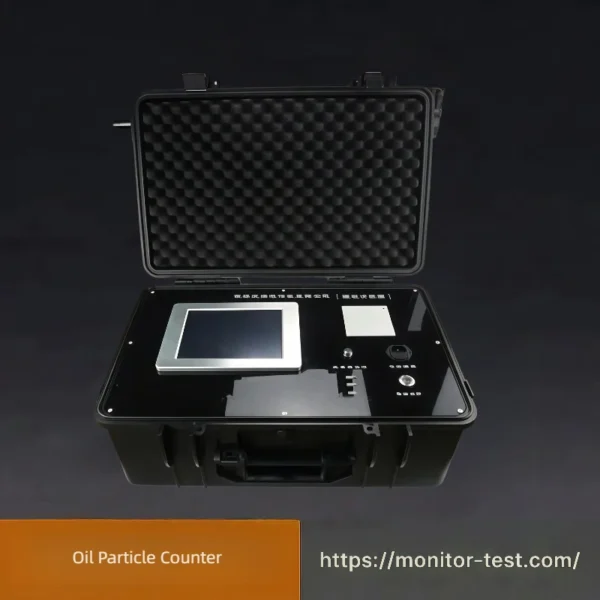
HF-TC-645 Oil Particle Counter
This Oil Particle Counter accurately counts particles of various sizes in transformer oil and hydraulic oil. It assesses oil contamination level according to ISO 4406 and NAS 1638 standards to guide equipment maintenance.
Send your requirements, we will quote for you within 12 hours
HF-TC-645 Portable Oil Particle Counter adopts the light blockage (light extinction) principle to detect the size and quantity of solid particles in liquids. It is widely used in aviation, aerospace, power, petroleum, chemical industry, transportation, ports, metallurgy, machinery, automobile manufacturing and other fields. It performs solid particle contamination testing for hydraulic oil, lubricating oil, transformer insulating oil, turbine oil, gear oil, engine oil, aviation kerosene, water-based hydraulic fluid, as well as insoluble particle detection for organic liquids and polymer solutions.
Performance Features
- Adopts light blockage (light extinction) principle
- High-precision imported German sensor ensures excellent resolution and accuracy
- Precision metering pump provides stable sampling flow and accurate volume control
- Color LCD display with touch-key operation
- Preloaded with six standards: NAS1638, ISO4406, GJB420A, GJB420B, SAE749D, SAE4059E
- Built-in micro printer for direct output of test reports
- Supports bottle sampling and online continuous detection
- Dual USB ports for connecting U-disk, mouse and keyboard; convenient for data sorting, storage and retrieval
Technical Specifications
| Item | Specification |
|---|---|
| Light Source | German semiconductor laser |
| Measuring Range | 1 μm ~ 400 μm |
| Sensitivity | 1 μm (ISO 4402) / 4 μm |
| Measuring Channels | 8 channels |
| Sampling Flow | 5~200 mL/min |
| Resolution | Better than 10% |
| Repeatability | ±0.5 ISO class |
| Storage | 32G |
| Data Output | Built-in printer / USB flash disk |
| Power Supply | AC220V / built-in lithium battery |
| Working Temperature | 0℃ ~ 50℃ |
| Calibration Period | 1 year |
| Dimension | 550×400×250 mm |
Operating Steps for Oil Particle Counter
Pre-operation Preparation
- Check the instrument, power supply, sampling tube and sample bottles for intact condition.
- Confirm sufficient sample oil without bubbles and visible impurities.
- Switch on the power; wait for the instrument to complete self-check and warm-up.
- Select corresponding standard: ISO 4406 / NAS 1638 according to testing requirements.
Flushing Procedure
- Connect sampling pipeline correctly.
- Pour sample oil into the sampling bottle.
- Start the flushing program to clean the internal flow cell and pipeline and eliminate residual contamination.
Formal Sampling Test
- Set sampling volume and flow rate on the touch screen.
- Start measurement. The instrument automatically samples, detects particles of each size channel and records data.
- Avoid vibration and external light interference during testing.
Data Processing & Output
- After measurement, view particle distribution and contamination class on screen.
- Choose to print the report via the built-in printer or save data to USB flash drive.
Post-test Maintenance
- Flush the pipeline with clean oil to prevent oil sediment clogging.
- Shut down the instrument properly after cleaning.
- Disconnect power, tidy cables and store the device in a dry environment.
FAQ for Portable Oil Particle Counter
Q1: What is the working principle of the oil particle counter?
A1: It adopts the light blockage (light extinction) principle. When particles pass through the laser beam, light attenuation is detected to calculate particle quantity and size, and then judge oil contamination grade.
Q2: Which oil types can this instrument test?
A2: It supports transformer insulating oil, hydraulic oil, lubricating oil, turbine oil, aviation kerosene, water-based hydraulic fluid and other liquid samples. It can also detect insoluble particles in organic liquids.
Q3: What contamination standards are built into the device?
A3: Six standards are pre-installed: NAS1638, ISO4406, GJB420A, GJB420B, SAE749D and SAE4059E, which can be selected freely on the screen.
Q4: What is the sensitivity and measuring range?
A4: Measuring range: 1 μm ~ 400 μm; sensitivity: 1 μm (ISO 4402) or 4 μm, equipped with 8 independent measuring channels.
Q5: Does it support both bottle sampling and online detection?
A5: Yes. It can perform off-line sampling test with sample bottles and can be connected to pipelines for continuous online monitoring.
Q6: How to export test data?
A6: Users can print reports directly via the built-in micro printer, or export stored data to a USB flash disk through dual USB ports.
Q7: Can the instrument work outdoors without mains power?
A7: Yes. It supports AC220V mains power and built-in lithium battery power supply, suitable for field on-site testing.
Q8: Why should pipeline flushing be carried out before formal testing?
A8: Residual dirt inside pipelines and flow cells will affect test accuracy. Flushing removes residual contaminants and ensures reliable test results.
Q9: What are the requirements for oil samples?
A9: Oil samples should avoid bubbles and large visible impurities. Bubbles will be mistaken for particles and cause inaccurate measurement data.
Q10: How often does calibration need to be performed?
A10: The recommended calibration cycle is one year to guarantee long-term testing precision.
Q11: What is the storage capacity of the equipment?
A11: Built-in 32G storage space, which can store massive test records for later inquiry and sorting.
Reviews
There are no reviews yet.