Leave your message

-
Leon Zhang sales consultant
-
Email: zxl635973785@gmail.com
-
Phone/WhatsApp/Wechat: +86 13655813266

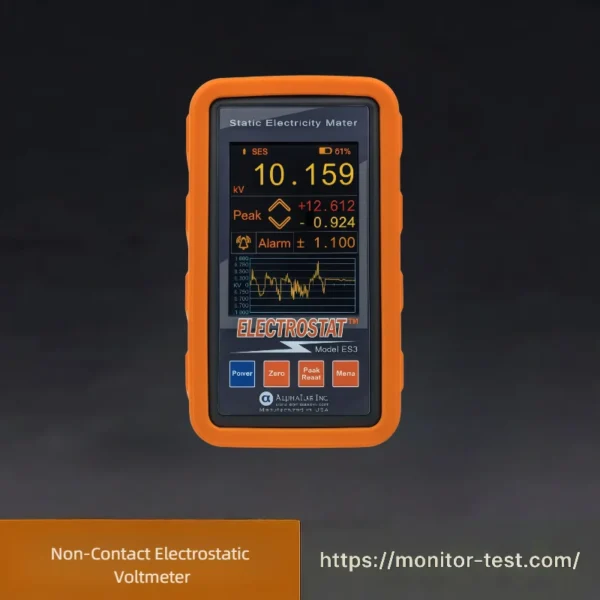
HF-GT-204 Non-Contact Electrostatic Voltmeter
Non-Contact Electrostatic Voltmeter safely measures surface electrostatic potential without physical contact with measured objects. It features high measurement accuracy and fast response speed, applicable to power equipment inspection, electronic manufacturing and anti-static engineering testing scenarios.
Send your requirements, we will quote for you within 12 hours
Product Introduction
Model HF-GT-204 Electrostatic Voltmeter is a pocket-sized non-contact digital static measuring instrument. Developed based on advanced domestic and overseas static testing instruments, it has been optimized and upgraded repeatedly according to years of user feedback.
This device measures the electrostatic voltage on object surfaces as well as the positive/negative polarity of static charges. Its shell is made of anti-static material to form a grounding path, so operators do not need to wear anti-static wrist straps during measurement. It adopts a 3½-digit LCD screen to display voltage readings, which refresh 3 times per second. The measured values vary with the distance between the meter and the tested object.
Features & Main Functions
- Measures surface electrostatic voltage magnitude and judges positive/negative polarity of static charges on objects.
- Equipped with 3½-digit digital LCD display, automatically shows static voltage readings.
- Ideal for repeated static voltage measurement and continuous monitoring tasks.
- Automatically identifies the positive and negative polarity of electrostatic voltage.
- Built-in battery level indicator; “BAT” prompt appears when battery power is low.
- Multi-range design available, which reflects the correlation between static voltage readings and measuring distance.
- Assists in analyzing the root causes of static generation, detects the position, magnitude and polarity of static electricity, providing scientific data to eliminate static troubles.
- Evaluates the static elimination performance of ion fans, static eliminating bars, ion air guns and other static neutralizers; helps confirm the optimal installation position for static removal equipment.
Technical Specifications
| No. | Item | Parameter Details |
|---|---|---|
| 1 | Input Impedance & Capacitance | Input impedance > 10E16 Ω; Input capacitance < 1 pF |
| 2 | Measuring Range | 0 ~ ±200 kV, auto-ranging |
| 3 | Measurement Error | Less than ±10% |
| 4 | Display Mode | 3½-digit LCD display, with polarity indication |
| 5 | Low Battery Alert | Battery low voltage reminder |
| 6 | Response Speed | 3 updates per second |
| 7 | Operating Ambient Conditions | Temperature: -40℃ ~ 60℃; Relative Humidity ≤ 80% |
| 8 | Power Supply | One piece of 6F22 9V stacked battery |
| 9 | Overall Dimensions | 118mm × 68mm × 32mm |
Measurable & Evaluable Items
The HF-GT-204 can be used to measure and evaluate the following items:
- Surface static charge and surface electrostatic voltage
- Improvement effects of anti-static processes and static elimination solutions
- Location, intensity and polarity of static electricity sources
- Quantity of air ions reaching the surface of objects
- Operating efficiency of ion generators and static discharge equipment
- Intensity of DC electric field in the air
- AC electric field component estimated by the difference between positive and negative peak values
- Approximate surface conductivity or sheet resistance of materials
- Approximate attractive or repulsive force between charged surfaces
- Voltage difference across the thickness of insulating sheets and films
- Effectiveness of ESD grounding and static dissipation measures
- Potential static hotspots on large-area surfaces
Application Fields
- Electronic component and semiconductor manufacturing
- ESD electrostatic protection testing
- Static electricity monitoring in cleanrooms
- Material static testing in laboratories
- Large-format printing and film processing
- Inspection of insulating materials including plastics, paper and textiles
- Static detection for packaging and conveying production lines
- Performance verification of ion fans and ion generators
- Performance evaluation of static elimination equipment
- Validation of anti-static grounding and static dissipation processes
- Scanning and positioning of surface static hotspots
FAQ:Non-Contact Electrostatic Voltmeter
1. What is a non-contact electrostatic voltmeter used for?
It measures electrostatic voltage, charge polarity and static accumulation on object surfaces without touching the measured workpiece. It is widely adopted for ESD protection inspection, static monitoring in cleanrooms, semiconductor, printing and textile industries.
2. Why is it called non-contact? What is the standard measuring distance?
The sensor does not make physical contact with the tested surface. Most calibrated measuring distances are 25mm; stable spacing ensures accurate and repeatable test results.
3. Can it test both conductive metal surfaces and insulating materials?
Yes. For conductive surfaces, readings represent accurate surface potential voltage. For insulators like plastic, film and fabric, values reflect the total accumulated static charge on the material surface.
4. Does the measuring distance affect test data?
Definitely. Readings will fluctuate if the distance between sensor and surface changes drastically. Keep the fixed calibrated distance during all tests for consistent comparison.
5. Can it capture instantaneous transient static peaks?
High-precision models are equipped with a short peak capture window (about 5ms). They can record sudden positive and negative static peak values that disappear quickly.
6. What alarm functions does the instrument support?
Most devices allow users to set custom static voltage thresholds, with visual flashing alerts, variable-frequency beep or constant tone alarm modes to remind excessive static electricity.
7. How to judge whether ion fans / static eliminators work normally?
Test surface static voltage before and after turning on the ion equipment. If static value drops rapidly and tends to zero, the static elimination performance is qualified.
8. Does the instrument need grounding or anti-static wristbands during operation?
Pocket portable types with anti-static housings do not require operators to wear anti-static wrist straps. High-precision industrial models suggest grounding the device for minimized interference.
9. What is the service life of the built-in battery?
Handheld rechargeable versions support long-term standby; disposable 9V battery types can work continuously for dozens of hours. A low-battery prompt will pop up when power is insufficient.
10. Can the measured static curves be exported to a computer?
Premium digital models are fitted with USB-C ports, supporting real-time data transmission, waveform recording and firmware upgrading via PC software. Some also reserve analog output interfaces.
11. What is the applicable temperature range for the meter?
General operating temperature ranges from -40℃ to 60℃, suitable for indoor workshops, laboratories and harsh on-site industrial environments.
12. Does the instrument require regular calibration?
Yes. Formal calibration is traceable to NIST standards. Periodic calibration guarantees long-term measuring accuracy.
13. What is the maximum measuring range of common electrostatic voltmeters?
Conventional handheld products cover ±200kV; high-precision precision instruments are within ±30kV with higher resolution up to 1V.
14. Can it locate static hotspots on large-area materials?
Yes. You can scan the whole surface slowly; positions with continuously high voltage values are static hotspots where static charges accumulate severely.
15. What factors will interfere with test results?
Ambient airflow, strong surrounding electromagnetic fields, excessive environmental humidity, unstable measuring distance and too large/small measured object size will all cause data deviation.
Reviews
There are no reviews yet.