Leave your message

-
Leon Zhang sales consultant
-
Email: zxl635973785@gmail.com
-
Phone/WhatsApp/Wechat: +86 13655813266

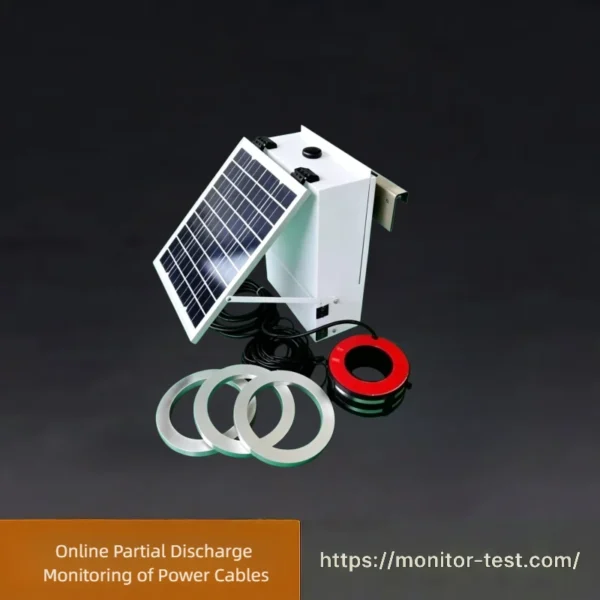
HF-C-201 Cable Partial Discharge Monitoring
This cable partial discharge monitoring system adopts HFCT, UHF and ultrasonic multi-mode detection. Solar-powered for outdoor use, it tracks sheath current and insulation conditions round the clock, delivers early fault alarms and avoids unexpected cable outages for power grids.
Send your requirements, we will quote for you within 12 hours
Overview
Cable Partial Discharge Monitoring is a continuous online monitoring solution for medium and high voltage power cables. Combining HFCT, UHF and ultrasonic triple detection technologies, the system runs round-the-clock to capture partial discharge signals, sheath circulating current and insulation variations. Supported by solar off-grid power supply, it sends real-time early warnings of internal defects, effectively lowers false alarms and guides predictive maintenance to prevent sudden cable breakdowns and ensure stable grid operation.
Detection Principle
When current flows through the cable conductor, induced potential will be generated on the metal sheath. If the sheath is left open-circuited, the induced potential can reach an extremely high level. This not only endangers personal safety but also breaks down the outer sheath insulation of the metal sheath. Especially when overvoltage or short-circuit faults occur on the cable line, extremely high induced voltage will build up on the metal sheath and puncture its outer insulation. For this reason, special connection and grounding arrangements must be adopted at designated positions along the cable metal sheath.
If both ends of the metal sheath are grounded, a closed loop to the earth is formed, giving rise to sheath circulating current. Improper grounding configuration may cause the circulating current to reach 50% of the conductor current or even higher. Excessive circulating current leads to massive power loss within the metal sheath, reduces the cable ampacity, and accelerates the aging of cable main insulation.
In addition, most cable line faults are reflected through variations in sheath circulating current, such as multi-point grounding caused by damaged sheath insulation, or broken grounding/cross-bonding wires due to theft. Therefore, it is necessary to analyze and calculate the circulating current of the cable metal sheath.
In addition, most cable line faults are reflected through variations in sheath circulating current, such as multi-point grounding caused by damaged sheath insulation, or broken grounding/cross-bonding wires due to theft. Therefore, it is necessary to analyze and calculate the circulating current of the cable metal sheath.
In the single-end grounding mode, capacitive current flows through the grounding wire. The single-core cable conductor and its outer metal sheath together constitute a cylindrical capacitor, hence capacitive current is contained in the grounding current. This capacitive current varies with the health condition of the cable main insulation.
When water trees form inside the main insulation, the rectification effect of water trees introduces DC components into the grounding current. Meanwhile, partial discharge current pulses originating from defects in the main insulation or cable joints also pass through the sheath grounding wire.
These various grounding current components can reflect not only the operating status of the cable metal sheath itself, but also degradation, defects and partial discharge faults inside the main insulation.
These various grounding current components can reflect not only the operating status of the cable metal sheath itself, but also degradation, defects and partial discharge faults inside the main insulation.
Current pulses generated by internal cable partial discharge will excite electromagnetic waves covering low, medium and UHF frequency bands (0.3–1.5 GHz). By receiving and analyzing these electromagnetic signals, engineers can evaluate the severity and pinpoint the location of partial discharge faults. This technology is ideal for cable termination inspection: cable terminals are the most frequent sites of partial discharge, and UHF signals can easily radiate outward for detection. Custom frequency bands are configured to resist electromagnetic interference and enable accurate fault localization.
Partial discharge also generates ultrasonic acoustic signals. Detecting ultrasonic waves on the cable surface serves as another effective way to capture partial discharge activity.
HFCT (High Frequency Current Transformer) is the conventional pulse current method for cable partial discharge testing. Our system supports simultaneous multi-mode detection: pulse current method, UHF detection and ultrasonic inspection. Cross-verification of results from multiple detection technologies effectively eliminates false alarms triggered by environmental interference in single-mode testing.
System Composition
A standard complete system consists of the following components:
- Master Station Computer System (Background Software Platform)
- Front-end Data Acquisition Unit
- Sensor Assembly (Partial Discharge Sensors)
- Cable Inductive Power Harvesting Module
- Integrated Detection Cabinet
Partial Discharge Signal Sensors
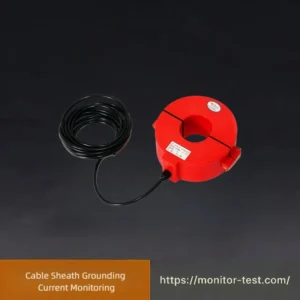
The HFCT partial discharge sensor is composed of a magnetic core, Rogowski coil, filter & sampling circuit unit, and electromagnetic shielding enclosure.
The coil is wound around a high-permeability magnetic core optimized for high-frequency response. The filter and sampling unit is designed to balance measurement sensitivity and signal bandwidth.
The coil is wound around a high-permeability magnetic core optimized for high-frequency response. The filter and sampling unit is designed to balance measurement sensitivity and signal bandwidth.
To suppress external interference and improve signal-to-noise ratio, while meeting outdoor rainproof and dustproof requirements, the Rogowski coil and sampling circuit are fully enclosed inside a metal shielding box equipped with snap locks for easy opening. This design greatly simplifies on-site installation and ensures long-term operational safety.
Online Partial Discharge Monitoring Unit
This unit is the core component of the whole system, responsible for data collection, storage and processing. It transmits data via optical fiber LAN, Wi-Fi or 4G wireless communication, and monitors partial discharge signals and sheath grounding current across all three phases (Phase A, B, C) of cable joints simultaneously.
The device can be mounted inside terminal cabinets near measuring points or standalone outdoor terminal boxes. Given harsh outdoor ambient conditions, the unit is installed inside an external waterproof housing:
- Housing Material: Stainless steel (excellent shielding against power frequency and high-frequency electromagnetic interference)
- Ingress Protection Rating: IP68
- Operating Temperature Range: -45℃ ~ +75℃
Power supply modes are flexible:
The unit can work via local mains power supply on site. For high-voltage cables laid in cable trenches, an inductive coil is adopted to harvest energy from the live cable to power the monitoring terminal continuously.
The unit can work via local mains power supply on site. For high-voltage cables laid in cable trenches, an inductive coil is adopted to harvest energy from the live cable to power the monitoring terminal continuously.
FAQ – Cable Partial Discharge Monitoring
Q1. What is Cable Partial Discharge Monitoring?
A1. Cable Partial Discharge Monitoring is an online inspection solution for MV and HV power cables. It provides 24/7 continuous monitoring of partial discharge, insulation condition and sheath current to detect potential cable defects at an early stage.
Q2. What detection technologies does the system use?
A2. The system integrates HFCT high-frequency current detection, UHF ultra-high frequency detection and ultrasonic detection. Multi-mode verification effectively reduces interference and false alarms for more accurate monitoring results.
Q3. Does the device support outdoor off-grid operation?
A3. Yes. Equipped with solar power supply, the monitoring terminal works continuously without external power cables, perfectly adapting to unattended substations and cable field environments.
Q4. Where can the monitoring equipment be installed?
A4. It can be installed at cable joints, cable wells and outdoor terminal boxes. With IP68 waterproof grade and stainless steel housing, it adapts to harsh outdoor temperature and humidity conditions.
Q5. What voltage levels does it support?
A5. It is suitable for 10kV, 35kV and 110kV medium and high voltage power cables, covering cable bodies, intermediate joints and cable terminations.
Q6. What cable faults can be detected?
A6. It early detects insulation aging, water tree deterioration, joint defects, poor grounding and partial discharge faults, helping utilities avoid sudden cable failures and blackouts.
Q7. How can users view monitoring data?
A7. Real-time data, trend curves and alarm records are uploaded to the cloud platform via 4G, Wi-Fi or optical fiber, supporting remote viewing anytime and anywhere.
Q8. Is daily maintenance required?
A8. The system features stable long-term operation with maintenance-free design, greatly reducing on-site inspection workload and operational costs.
Q9. Why use multi-mode PD monitoring instead of single mode?
A9. Single detection is easily affected by field noise and electromagnetic interference. Combined HFCT, UHF and ultrasonic monitoring ensures higher accuracy and reliable fault location.
Reviews
There are no reviews yet.